News Broadcasting
16 teams for World Cup 2007, final format to be agreed


MUMBAI: The ICC Cricket World Cup 2007 will feature 16 teams but the final format for the event is still to be agreed after the ICC Board discussed the issue in Barbados on Thursday.
While the board agreed to expand the tournament to 16 teams (from the 14-team format at this year’s event) divided into four groups of four, there was no consensus on the most effective format for the tournament beyond the group stage and the meeting considered the request from its commercial partner, Global Cricket Corporation to play more games than the originally proposed 42 matches.
An increase in the number of games would probably benefit Sony Entertainment Television India, which has the cable and satellite broadcast rights for the subcontinent.

ICC chief executive Malcolm Speed said, “The Board decided that expanding the tournament to 16 teams was an appropriate step but wanted to further investigate the best structure for the tournament beyond the group stage before making a final decision on format.”
ICC chief executive Malcolm Speed said, “The Board decided that expanding the tournament to 16 teams was an appropriate step but wanted to further investigate the best structure for the tournament beyond the group stage before making a final decision on format.”
“Given the complex logistical associated with holding this event in the West Indies, there needs to be a further analysis of the impact of these formats,” Speed said.
ICC refuses to relent on money withheld to BCCI
No money currently withheld by the ICC to deal with the claim for compensation by Global Cricket Corporation will be returned to countries until a series of strict conditions are met the ICC has announced.
These conditions will include:
The ICC’s independent auditors and lawyers agreeing that the release of any money is a prudent and appropriate action;
The independent advisors agreeing to the appropriate amount of money, if any, that should be released;
That any member country wishing to access any money that is freed following this professional advice must give an unconditional and irrevocable legal undertaking to pay back the money if required. This may take the form of a bank guarantee.
ICC President, Ehsan Mani, said that these conditions were put in place with the unanimous support of the board in order to provide those countries that wished to access their money for their own reasons with a mechanism that would allow this to occur while also protecting the overall interests of international cricket.
“Before the ICC can contemplate allowing any country to access the money currently being withheld, it is important that we have the necessary external professional advice to establish if this action is appropriate. This will be obtained in the coming weeks,” said Mani.






News Broadcasting
UDF poised to return to power in Kerala, says Manorama-CVoter survey
Massive opinion poll projects shift in Kerala politics ahead of 2026 Assembly elections.
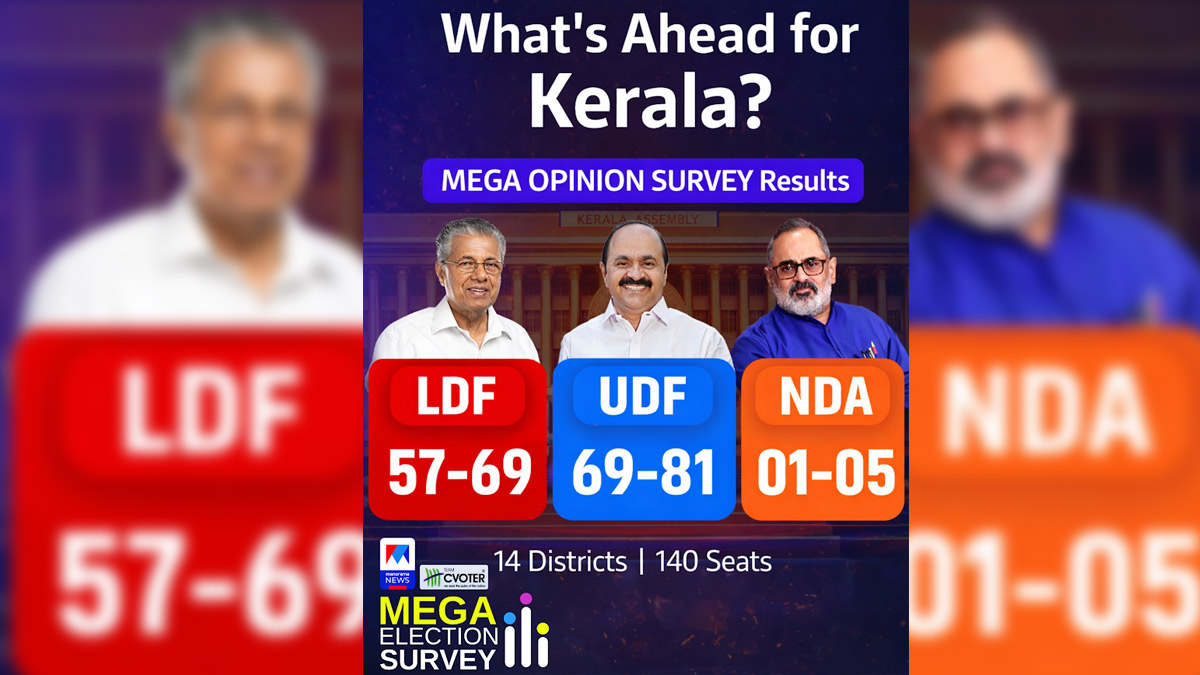
MUMBAI: The winds of change appear to be blowing through Kerala’s political landscape and this time, they seem to favour the United Democratic Front. A comprehensive mega opinion survey conducted by Manorama News in partnership with CVoter projects a potential comeback for the UDF in the upcoming Kerala Legislative Assembly Elections 2026. The survey, covering all 140 constituencies with a massive sample size of nearly 90,000 respondents, predicts the UDF could win between 69 and 81 seats.
The ruling Left Democratic Front (LDF) is expected to secure 57 to 69 seats, a significant drop from the 99 seats it won in the 2021 elections. This would mean the LDF losing 30 to 42 of its sitting seats. Meanwhile, the National Democratic Alliance (NDA), which drew a blank in 2021, is projected to open its account with 1 to 5 seats.
Region-wise, the UDF is expected to make strong gains in Malabar, winning 25 to 34 out of 48 seats, and in Central Kerala, where it could bag 29 to 33 out of 53 seats. In South Kerala, the LDF is likely to retain an edge with 21 to 25 seats, while the UDF may improve to 12 to 16 seats. The NDA could pick up 1 to 3 seats in the southern region.
The survey was conducted between 14 and 26 March 2026, with additional tracker and snap polls carried out from December 2025 to March 2026. A total of 89,693 respondents participated, ensuring representation across all demographics and social segments.
Manorama News has a strong track record of accuracy, with its previous projections closely matching the actual results of the 2019 and 2024 Lok Sabha elections as well as the 2021 Kerala Assembly polls.
In Kerala’s famously fierce political battles, this survey suggests the pendulum may be swinging back. Whether the final verdict matches these numbers or throws up another surprise, one thing is clear, the 2026 Assembly elections are shaping up to be one of the most keenly watched contests in the state’s history.






