International
WTO‘s no to China‘s appeal against opening up its film market

MUMBAI: China‘s appeal against a ruling that it must stop forcing US content owners to use state-owned companies to distribute movies and books has been rejected by the World Trade Organization (WTO).
The ruling effectively breaks the monopoly that China Film Group Corporation and Huaxia Film Distribution currently have on the distribution of foreign films in China. Under the current rules, the US studios usually take around 17 per cent of the box-office of revenue-sharing films.
However the WTO ruling does not address China‘s import quota of 20 revenue-sharing foreign films a year.
“With the rejection of China‘s appeal, the WTO has taken a major step forward in leveling the playing field for America‘s creative industries seeking to do business in China,” said Motion Picture Association chairman Dan Glickman, in a statement.
“In spite of all the restrictions we face, there is no shortage of US filmed entertainment in China. Unfortunately, far too much of it is pirated,” Glickman added.
In its argument, China had argued that it needed to impose controls on the market that are in line with the country‘s stage of economic development and also to protect public morals.
The WTO judges agreed that China has the right to ban foreign films and books that government censors deem objectionable.
The ruling comes at a time when China‘s theatrical market is expanding rapidly – box office is expected to grow by 40 per cent to $882m this year. US movies such as Transformers 2 and 2012 have seen big numbers in China this year, grossing around $60 million apiece.
Meanwhile Avatar is due to open in China in the beginning of January – a time that is usually reserved for local productions.

International
Moskino and Bollywood: Moscow Film Cluster and Film City Mumbai signed a cooperation agreement
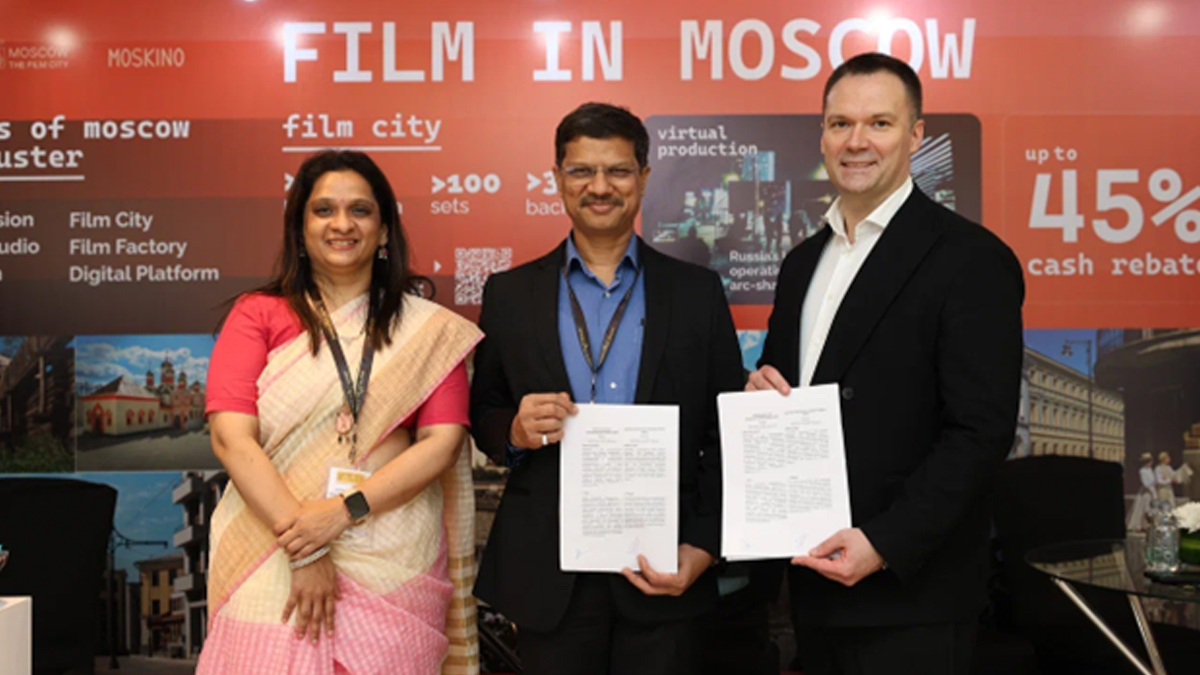
Moscow Film Cluster has signed a cooperation agreement with Film City Mumbai. The parties agreed to cooperate in developing the film industry, promoting shooting locations and supporting filmmakers.
The memorandum was signed on the sidelines of the India International Film Tourism (IIFTC) Conclave in Mumbai. At this forum, the Moscow Film Cluster presented Moscow’s opportunities for film shooting, including infrastructure projects such as Film City Moskino and Film Factory. Special attention was paid to the Moscow rebate system – up to 45% – and the co-production development.
Memorandum of Understanding between the Film City and Moscow Film Cluster provides for the establishment and development of mutually beneficial cooperation in the film industry development, including joint promotion of shooting locations, support for filmmakers, implementation of marketing and industry events, development of incentive support measures and strengthening of economic and cultural interaction between India and Moscow.

The parties also intend to promote the development of the audiovisual sector through the exchange of experience, joint initiatives and the search for opportunities to create new industry partnerships and clusters.
Moscow Film Cluster is a major city initiative led by Moscow Mayor Sergei Sobyanin to develop the capital into a global cinema hub. It brings together key production infrastructure – such as the Moskino Film Сity, Film Factory and Gorky Film Studio – along with the Film Commission, digital platform and cinema chain to streamline shooting, support productions and attract international filmmaking to Moscow.
Also, Moscow offers a rebate of up to 45%: 30% as direct production cost compensation, up to 15% for visa and accommodation support. The Moscow Image Grant provides up to $255,000 for films showcasing iconic city views.
The Moscow Film Cluster booth attracted considerable attention from Indian producers and studios. Over 80 business meetings were held, including those with major Indian companies.
One of the booth guests was the famous Indian actress Khushboo Sundar, known to Soviet and Russian audiences for her role in My Soul and considered the leading star of Tamil cinema, in whose honor one of the local temples was even built. Prithul Kumar, representative of the Indian Ministry of Information and Broadcasting and one of the officials responsible for regulating the film industry in the country, also expressed interest in the development of the Moscow Film Cluster.
One of the highlights of the India International Film Tourism Conclave was the awarding of The Greatest of All Time in the For Cinematic Excellence category. The movie was shot in Moscow. The jury members noted the project’s contribution to the development of tourism.
The shooting of The Greatest of All Time AGS by Entertainment was organized with the assistance of the Moscow Film Cluster and the Moscow Film Commission and took place in April 2024 on the streets of Moscow. The scenes were shot in such famous locations as Patriarch Bridge, Teatralnaya Square, Manezhnaya Square, Kazarmenny Lane, Podsosensky Lane, Nikolskaya Street and one of the festival venues of Moscow Seasons.
The Greatest of All Time became a landmark event in Indian box office history. It ranked fourth in box office earnings among all movies released in India in 2024 and is one of the most successful Tamil-language movies in history.
At the same time, the shooting of another joint Russian-Indian movie started at the Moskino Film City in Moscow. A film project dedicated to badminton became one of the first participants in the Moscow rebate program.
A project by Smena & WISH Media (Russia) and Kartina Entertainment And Sports Private Limited (India) will tell the story of a badminton player who travels to India with the Russian national team to compete in a tournament. Russian viewers will see for the first time the scale of sporting competitions in Asia, where badminton is a cult sport and draws packed stands of fans.
The agreement on the joint production of the Smash movie was signed st the Moscow International Film Week in August 2025. And as Moscow Mayor Sergei Sobyanin said, a rebate application was also submitted at that time to reimburse part of the costs incurred during the shooting process in the Russian capital.








