Hindi
Who will lift the filmy ‘World Cup’ this festive season?

MUMBAI: Four films release this Friday, 26 October. No Smoking directed by Anurag Kashyap, Jab We Met by Imtiaz Ali, Mumbai Salsa by Manoj Tyagi and Bal Ganesh. And that‘s going to be a tough one for audiences. How does one make the right choice? Will it be John Vs Shahid? Or Kareena Vs Ayesha? Will it be Anurag Vs Imtiaz?
Indiantelevision.com did a swot analysis to try and come up with some answers. What three of the films have in common is that new-age directors are helming them. Though of course, Anurag leads the pack, already having proved his talent with a film like Black Friday.
No Smoking is touted as a progressive film whereas Jab We Met is a romantic comedy and Mumbai Salsa offers a funny look at dysfunctional relationships in young corporate India.
But what weighs in favour of Jab We Met is the lead pair in a romantic film. The festive season is on and people are in the mood for feel-good cinema. Also the curiosity surrounding the lead pair‘s personal relationship may get audiences to the theatres.
Yet another commonality being that though all of them have been made with modest budgets, they have been very cleverly marketed. No Smoking remains in the news for its share of contests and what with John Abraham‘s appearances at all the related events, interest level in the film is sustained.
As for Jab We Met, Shahid‘s recent train ride has been splashed across all media properties. The lead pair‘s appearances on television musical shows has also worked in the film‘s favour.
Mumbai Salsa in this respect is lagging behind but word has it that the film will get its share of the pie as the story of the film is well-etched out. But the biggest downer could be the absolutely raw talent in the form of eight newcomers who make their appearance in the film. The only exception being Indraneil Sengupta, the television hottie who plays a vital role in the film.
And as these three films vie for a lion‘s share, an animated Bal Ganesh (directed by Pankaj Sharma) too, decides to release on the same day. What with the Diwali holidays on, this film may well manage to lure young kids to theatres.
And as the battle hots up one still doesn‘t know who will lift the box office ‘World Cup‘. With two blockbusters (Saawariya and Om Shanti Om) set to steamroll their way into theatres on 9 November, the end of the year could prove to be an indicator of times to come.
Will the biggies leave everything, including turnstile records, in their wake? Or will it be a filmy equivalent of a Zimbabwe or Bangladesh that walks away with the box office spoils this festive season? There‘s at least one film lovers‘ blog that has put its money on the minnows.

Hindi
Remembering Gyan Sahay, the lens behind film, television and advertising
From a puppet rabbit selling poppadums to Hindi cinema, he framed it all.
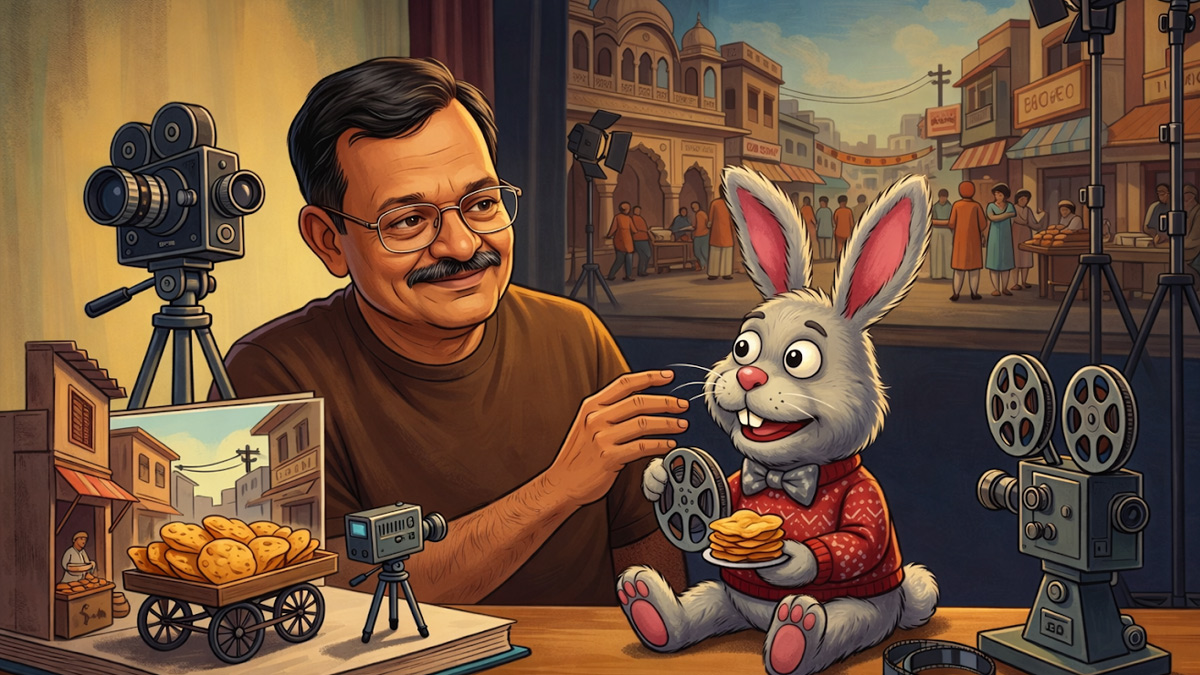
MUMBAI: There are careers, and then there are canvases. Gyan Sahay, the veteran cinematographer, director, and producer who passed away on 10 March 2026 in Mumbai, had one of the latter. Over several decades in the Indian film and television industry, he turned lenses, lights, and the occasional puppet rabbit into something approaching art.
A graduate of the Film and Television Institute of India (FTII) in Pune, Sahay built his reputation as a director of photography across a career that stretched from the early 1970s all the way to the digital age. He was the kind of craftsman who understood that a well-composed shot is not merely a technical achievement but a quiet act of storytelling.
For most Indians of a certain age, however, Sahay will forever be the man behind the rabbit. His direction of the iconic long-running television commercial for Lijjat Papad, featuring its now-legendary puppet bunny, gave the country one of its most cheerfully persistent advertising images. It was the sort of work that sneaks into the national subconscious and takes up permanent residence.

His big-screen credits as cinematographer include Anokhi Pehchan (1972), Pagli (1974), Pas de Deux (1981), and Hum Farishte Nahin (1988). In 1999, he stepped behind a different kind of camera altogether, making his directorial debut with Sar Ankhon Par, a drama that featured Vikas Bhalla and Shruti Ulfat, with a cameo by Shah Rukh Khan for good measure.
On television, Sahay was particularly prized for his command of multi-camera production setups, a skill that made him a go-to technician for large-scale shows and reality programmes. In an industry that has never been especially patient with complexity, he was the calm hand on the rig.
In later life, Sahay turned teacher. He participated regularly in masterclasses and Digi-Talks, often hosted by organisations such as Bharatiya Chitra Sadhna, sharing hard-won wisdom on cinematography, the comedy of timing in a shot, and the sweeping changes brought by the shift from celluloid to digital. He was also said to have been involved in a project concerning a biographical film on Infosys co-founder N.R. Narayana Murthy.
Tributes from the film industry poured in following the news of his passing, with colleagues remembering him as a senior cameraman who served as a rare bridge between two entirely different eras of Indian cinema. That is, perhaps, the finest thing one can say of any craftsman: he kept up, and he brought others along with him.