Hindi
Te3n disappoints while Do Lafzon Ki Kahani seems never ending!

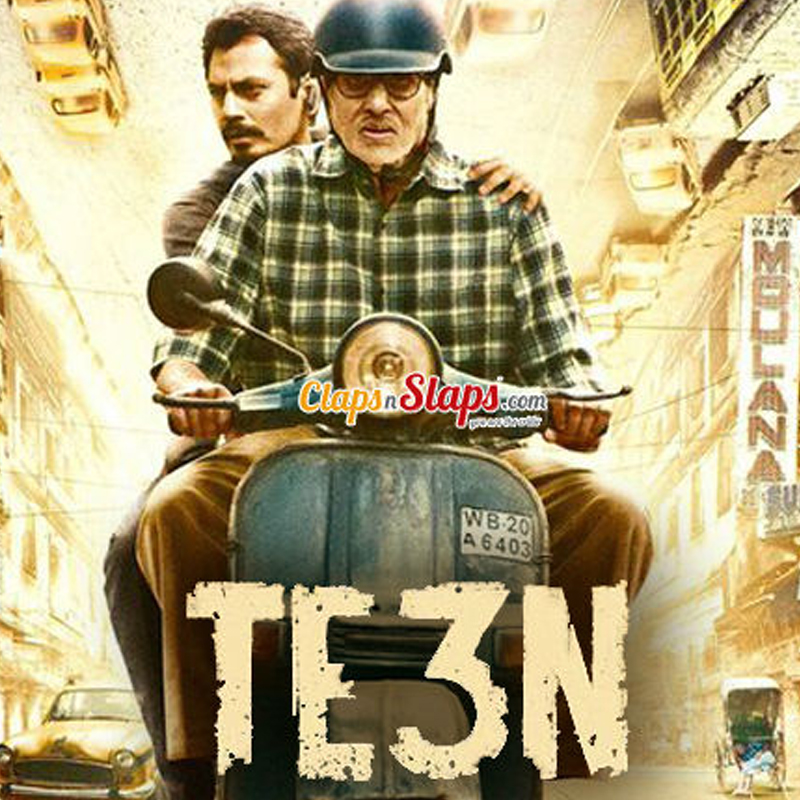
MUMBAI: Sujoy Ghosh has to his credit a score of movies by now. However, the one that is a feather in his cap and gave him recognition was Kahaani, a thriller par excellence with twists and turns lost to Hindi cinema for a long time. Wanting to be comfortable with his actors, Ghosh repeats Amitabh Bachchan, VidyaBalan and Nawazuddin Siddique, all of whom he has worked with earlier. The maker chooses the same genre, detective thriller; only the detectives fail, but the protagonist-turned-detective succeeds.
A small boy has been kidnapped in Kolkata. His mother is a heart patient and father serves on the Eastern border and is home only for brief periods.The boy is closest to his maternal grandfather. Now he has gone missing. A ransom is demanded and the police get involved.
The cop who is on the case is Vidya Balan. She finds a lot of similarities between this kidnapping and one that happened eight years ago involving the granddaughter of Bachchan. There is a joke about Kolkata that if you leave a rock on a major arterial road of the city, you will still find it in the same spot a decade later. In that case, it is no wonder that Vidya, who handled Bachchan’s case eight years ago, is still around handling the new kidnap case at the same police station. Vidya seeks the help of Nawazuddin, a policeman turned church pastor, who was a part of the investigation eight years back.

Bachchan has been restless for the last eight years since his granddaughter, left in his care, was kidnapped and found dead. He has either been dormant or ineffective and only seen pleading with the police to solve the case. But he suddenly comes to life. He connects the two kidnappings.
So Te3n seems to be about three people’s perspective of a crime, that of the policewoman, Vidya, an ex-policeman turned church pastor, Nawazuddin, and Bachchan. All three have different convictions about what happened eight years back vis-a-vis the current kidnapping.
Vidya and Nawazuddin are on different tracks and it is Bachchan who seems to have figured out the angles.
Te3n, unfortunately, is a grossly contrived script taking liberties galore. Logic has no place here when it comes to convenience of scripting. The maker likes to show the drab, depressing and dilapidated nooks and corners of Kolkata to accentuate his theme which shows the influence of 1940s films. A victim’s pursuit of justice is an interesting idea for a film.That is what made Kahaaani and Badlapur successful.But in the case of Te3n, the thrill is just not there. The first half does not seem to be going anywhere and it is only towards latter parts that the narrative manages to generate some pace only to lead to a tame ending.
With the script and direction both based on compromises, the film has mainly the performances to count on. Since only Nawazuddin has a role with some sensibility, he does well though his priest costume seems alien. Vidya has nothing to do. Bachchan spends too much energy on looking old and overdoing the old man’s mannerisms. Music has no place here but forced in. Editing needed some crisp cutting.
Te3n has poor prospects at the box office.
Producers: Gulab Singh Tanwar, AnirudhTanwar, Abhijit Ghatak, Deepak Dhar, Ram Mirchandani.
Director: Ribhu Dasgupta
Cast: Amitabh Bachchan, Nawazuddin Siddiqui, Vidya Balan, Nassar, Sabyasachi Chakrabarty, Padmavati Rao
Do Lafzon Ki Kahani…….That seems neverending!
The flavour of the season with Indian filmmakers to find ‘inspiration’ is Korea; copying or remaking Hollywood films would be a giveaway now since its films get an extensive and simultaneous release in India and the rest of the world. Do Lafzon Ki Kahani is based on the 2011 Korean film – Always. Looking at the film, one wonders why did the producers need to go as far as Korea for inspiration, they could have easily been inspired by any 1960s Hollywood B-grader or an Indian film of the same genre a few years thence.
There have been scores of movies where romance blooms between total opposites in stature, nature, character as well as able and disabled.
RandeepHooda is a rogue, a rough man, because he has been brought up in an orphanage (that seems to be an unwritten law in Indian film stories to breed such characters). He does three jobs a day because, as he says, he has some obligations to fulfill. But, to who, why, etc., is a mystery which is never revealed. One night, he signs into his third job of the day at a toll plaza or some such thing when a blind girl, Kajal Agarwal, walks in. She is a friend of Hussain chacha, the attendant at the plaza from whom Randeep is talking over.
Kajal, though blind, walks miles to the plaza to take in a TV serial with Hussain chacha. She so takes the soap opera to heart that she starts to identify with the lead character of the serial. It happens for a few days that she walks into the cabin to catch the TV serial and Randeep already starts missing her if she is late. By day six, it is romance and promises of togetherness.
It is time for her to learn about Randeep’s past. It is all chequered. The orphanage he grew up in was swept away in a river surge. He turned into a street fighter for bounty, but, when deceived once by an opponent pleading to lose a bout on the grounds of humanity, he decided to become a villain and go bashing all and sundry. He also decides never to raise his hands on anybody after an accident caused by him leaves a bitter taste in his mouth.
That is when he meets Kajal and his world starts revolving around her. It is love all the way. There is more footage unreeling without the film moving an inch till, in a typical 1960s style, the doctors tell Randeep that Kajal’s eyesight can be restored if a procedurecosting 3 lakhs is done within 15 days.
Whatever happens thereafter leads to nothing. Some new villains spring up from vacuum and Randeep’s love is put on trial.
Do Lafzon KI Kahani spells juvenile, which is to say just everything about it is amateur. The film gets everything wrong from the choice of source material to adapt to the casting. Randeep as a tough man turning a devoted lover, is a misfit?Kajal is mediocre. The chemistry between the lovers just does not happen.The direction is poor to say the least and songs are forced in to no avail. As for editing, this 127 minute film feels like 254 minutes and no editor could have changed that. The rest of the aspects don’t help either.
Do Lafzon Ki Kahani is poor fare.
Producers: Dhiraj Shetty, Avinaash V Rai, Deepak Tijori, Dhaval Jayantilal Gada.
Director: Deepak Tijori
Cast: Randeep Hooda, Kajal Agarwal, Mamik, Yuri Suri



Hindi
India’s telecom subscribers cross 1.32 billion in February 2026
Broadband base swells past 1.06 billion as Jio and Airtel tighten grip on the market.
MUMBAI: India’s telecom sector is ringing in steady growth once again adding millions of new connections every month while the race for broadband supremacy continues to heat up like a fiercely contested cricket match. According to the latest data released by the Telecom Regulatory Authority of India (TRAI) on 1 April 2026, the total telephone subscriber base in the country reached 1,321.31 million at the end of February 2026. This marked a net addition of 7.31 million subscribers during the month, translating into a monthly growth rate of 0.56 per cent.
Wireless subscribers (including mobile and Fixed Wireless Access) stood at 1,273.31 million, registering a net addition of 6.97 million and a growth rate of 0.55 per cent. Within this, urban wireless connections grew to 730.75 million (growth 0.70 per cent), while rural wireless subscribers reached 542.56 million (growth 0.35 per cent).
Wireline subscribers, though much smaller in scale, showed slightly faster growth. The total wireline base increased to 47.99 million, with a net addition of 0.34 million and a monthly growth rate of 0.70 per cent. Urban areas continued to dominate wireline connections with a share of 89.41 per cent.
Overall tele-density in India improved to 92.66 per cent. Urban tele-density stood at 150.68 per cent, while rural tele-density edged up to 60.02 per cent.
The broadband subscriber base crossed a significant milestone, reaching 1,059.05 million at the end of February 2026. This reflected a healthy net addition of 6.33 million subscribers and a monthly growth rate of 0.60 per cent from January’s figure of 1,052.72 million.
Segment-wise, mobile wireless access continued to drive the majority of growth with 996.52 million subscribers. Fixed Wireless Access (including 5G FWA) added 16.51 million, while wired broadband stood at 46.02 million.
Reliance Jio Infocomm Ltd. maintained its commanding lead with 519.64 million broadband subscribers. Bharti Airtel Ltd. followed with 364.14 million, Vodafone Idea Ltd. with 129.36 million, Bharat Sanchar Nigam Ltd. with 28.70 million, and Atria Convergence Technologies Ltd. with 2.38 million.
Together, these top five players command a massive 98.60 per cent share of the total broadband market.
In the wireless (mobile) segment, private operators continued to dominate with 92.59 per cent market share, leaving public sector undertakings (BSNL and MTNL) with just 7.41 per cent.
Out of the total 1,257.29 million wireless (mobile) subscribers, 1,177.60 million were active on the peak Visitor Location Register (VLR) date, representing an impressive 93.66 per cent activity rate. Bharti Airtel led in this metric with 99.42 per cent of its subscribers active.
Meanwhile, 14.47 million subscribers submitted requests for Mobile Number Portability (MNP) in February, indicating healthy competition and customer churn across zones.
While urban areas still lead in absolute numbers, rural connectivity is slowly catching up. Rural wireless tele-density stood at 59.46 per cent, compared with the much higher urban figure of 142.32 per cent.
Fixed Wireless Access using 5G technology also showed promising traction, growing to 11.93 million subscribers. Reliance Jio and Bharti Airtel are the primary players driving this segment.
The data paints a picture of a maturing yet still rapidly expanding telecom ecosystem. With total telephone subscribers now well past the 1.32 billion mark and broadband users comfortably above 1.06 billion, India continues to solidify its position as one of the world’s largest and most dynamic digital markets.
From bustling city streets to remote villages, more Indians are staying connected than ever before proving that when it comes to telecom, the country’s appetite for growth shows no signs of hanging up anytime soon.






