Hindi
Taare Zameem Par and A Wednesday in Indian panorama for IFFI 2008

NEW DELHI: Three highly lauded Hindi films on relevant social issues – ‘Taare Zameen Par’, ‘A Wednesday’ and ‘Summer of 2007’ – and the award-winning Kannada film ‘Gulabi Talkies’ form part of the 26 feature and 21 non-feature films of the Indian Panorama selected for the International Film Festival of India in Goa next month.
The juries submitted their reports to Minister of State for Information and Broadcasting Anand Sharma this afternoon.
In addition, the Malayalam feature film ‘Pulijanmam’ by Priyanandan and the non-feature Bengali ‘Bishar Blues’ by Amitabh Chakraborty get automatic entry for having won the best film awards in their categories in the 54th National Film Awards.
The jury for the feature films recommended that ‘Kanachivaram’ (Tamil) by S Priyadarshan and ‘Mahasatta’ (Marathi) by Ramesh Laxman More be sent for the Competition Section of the IFFI.
The feature jury recommended that ‘Yarwing’, a film in Kokborok language of Tripura by Joseph Pulinthanath, be the inaugural film of the Panorama Section.
The features include six in Malayalam, four each in Hindi and Tamil, three each in Marathi and Kannada, one each in Bengali, Assamese and Telugu, and one which is in English/Gujarati and Hindi.
The seven-member Jury for Feature Films headed by critic and filmmaker K N T Sastry saw 104 films while the five-member Non-Feature Film Jury headed by filmmaker Anjan Bose saw 82.
The award-winning Jayaraj is the only filmmaker to have films in both the feature and non-feature sections.
Apart from ‘Pulijanmam’, the Malayalam films are ‘Vilapangalkkappuram’ by T V Chandran, ‘Gulmohar’ by Jayaraj, ‘Atayalangal’ by M G Sasi, ‘Oru Pennum Randaanum’ by Adoor Gopalakrishnan, ‘Aakashagopuram’ by Manu S Kumaran, and ‘Katha Parayumpol’ by Mohanan.
The Hindi films are ‘Summer 2007’ by Suhail Tatari, ‘A Wednesday’ by Neeraj Pandey, ‘Taare Zameen Par’ by Aamir khan, and ‘Jodha Akbar’ by Ashutosh Gowariker.
The Tamil films in addition to ‘Kanachivaram,’ are ‘Kalloori’ by Balaji Sakthivel, ‘Mudhal Mudhal Mudhal Varai’ by Krishna Seshadri Gomatam, and ‘Billa’ by Vishnu Vardhan.
The Kannada films include ‘Gulabi Talkies’ by Girish Kassarvalli which won the best Indian film award at the Tenth Osian’s-Cinefan Festival of Asian and Arab Cinema, ‘Banada Neralu’ by Umashankara Swamy, and ‘Gubbachigalu’ bu Abhaya Simha.
Apart from ‘Mahasatta’, the Marathi films are ‘Dohaa’ by Pushkaraj Paranjape, and ‘Valu’ by Umesh Vinayak Kulkarni.
Apart from ‘Yarwing’, the other films are ‘Chaturanga’ (Bengali) by Suman Mukhopadhyay, ‘Mon Jai’ (Assamese) by M Maniram, ‘Mee Sreyobhilashi’ (Telugu) by V Eshwar Reddy, and ‘Little Zizou’ by Sooni Taraporevala which is in English, Gujarati and Hindi.
The non-features include seven in English, four in Hindi, two each in Bengali and Malayalam, and one each in Kannada, Manipuri, Urdu, apart from one with only music and another which is in Hindi, Bengali and English.
The English films include ‘Distant Rumblings’ by Bani Prakash Das on the remains of the Second World War in Manipur and Nagaland, ‘A Friend turned Foe’ by Gautam Saikia, ‘Divided Colours of a Nation’ by Umesh Aggarwal, ‘Four Women and a Room’ by Ambarien Al Qadar, ‘The Journalist and the Jehadi’ by Ramesh Sharma, ‘The Land of Rupshupas’ by A K Sidhpuri, and ‘Rehana: A Quest for Freedom’ by Gargi Sen and Priyanka Mukherjee.
‘Dhin Tak Dha’ by ‘ShraddhaPasi’, ‘Apna Aloo Bazaar Becha’ by Pankaj H Gupta, ‘Children of the Pyre’ by Rajesh S Jala, and ‘Antardhwani’ by Jabbar Patel form the Hindi component.
The two Bengali films are ‘The Shop that sold Everything’ by Abhyuday Khaitan and ‘Yearn to Learn’ by S K Aboul Rajjak, while the Malayalam films are ‘Vellappokkathil’ by Jayaraj and ‘Memories, Movement and a Machine’ by K R Manoj.
The others are the Kannada ‘Putti’ by Jacob Varghese, the Urdu ‘Parwaaz’ by Biju Vishwanath, and the Manipuri ‘Ratan Thiyam – the man of Theatre’ by Nirmala Chanu and Oken Amakcham, apart from ‘Three of Us’ by Umesh Kulkarni which only has music and ‘Remembering Bimal Roy’ by Joy Bimal Roy in Hindi, Bengali, and English.

Hindi
Remembering Gyan Sahay, the lens behind film, television and advertising
From a puppet rabbit selling poppadums to Hindi cinema, he framed it all.
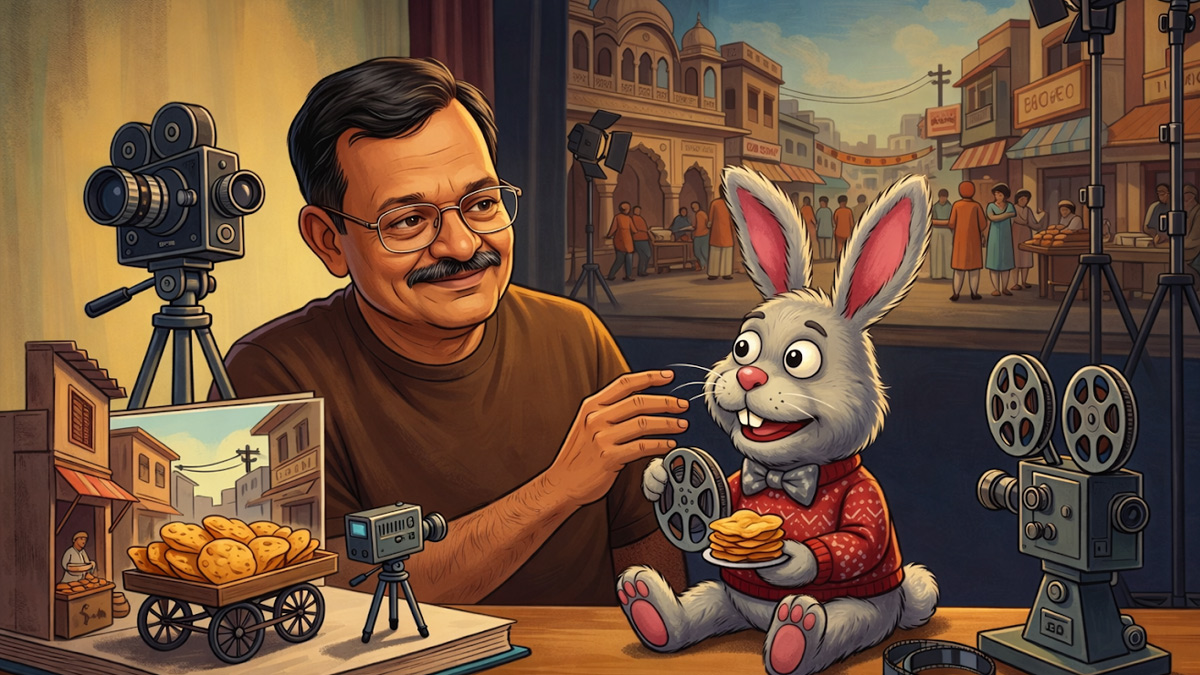
MUMBAI: There are careers, and then there are canvases. Gyan Sahay, the veteran cinematographer, director, and producer who passed away on 10 March 2026 in Mumbai, had one of the latter. Over several decades in the Indian film and television industry, he turned lenses, lights, and the occasional puppet rabbit into something approaching art.
A graduate of the Film and Television Institute of India (FTII) in Pune, Sahay built his reputation as a director of photography across a career that stretched from the early 1970s all the way to the digital age. He was the kind of craftsman who understood that a well-composed shot is not merely a technical achievement but a quiet act of storytelling.
For most Indians of a certain age, however, Sahay will forever be the man behind the rabbit. His direction of the iconic long-running television commercial for Lijjat Papad, featuring its now-legendary puppet bunny, gave the country one of its most cheerfully persistent advertising images. It was the sort of work that sneaks into the national subconscious and takes up permanent residence.

His big-screen credits as cinematographer include Anokhi Pehchan (1972), Pagli (1974), Pas de Deux (1981), and Hum Farishte Nahin (1988). In 1999, he stepped behind a different kind of camera altogether, making his directorial debut with Sar Ankhon Par, a drama that featured Vikas Bhalla and Shruti Ulfat, with a cameo by Shah Rukh Khan for good measure.
On television, Sahay was particularly prized for his command of multi-camera production setups, a skill that made him a go-to technician for large-scale shows and reality programmes. In an industry that has never been especially patient with complexity, he was the calm hand on the rig.
In later life, Sahay turned teacher. He participated regularly in masterclasses and Digi-Talks, often hosted by organisations such as Bharatiya Chitra Sadhna, sharing hard-won wisdom on cinematography, the comedy of timing in a shot, and the sweeping changes brought by the shift from celluloid to digital. He was also said to have been involved in a project concerning a biographical film on Infosys co-founder N.R. Narayana Murthy.
Tributes from the film industry poured in following the news of his passing, with colleagues remembering him as a senior cameraman who served as a rare bridge between two entirely different eras of Indian cinema. That is, perhaps, the finest thing one can say of any craftsman: he kept up, and he brought others along with him.







