Hindi
Studios losing control in internet era: Davis

ANTALYA: Hollywood has been thrown into total confusion because of the advent of movies on the Internet and the studios are losing control, renowned American filmmaker Andrew Davis said here.
One advantage was that filmmakers who were unable to put up the money to sell their films – since advertising a film could cost as much as $20 million – could find a way of getting finance by putting up their films on the Internet, Davis added.
Referring to a question about films on television, he quipped: “The channels would be happier just showing the commercials and not any programmes.”
Davis told a Masters Meet at the ongoing Third Eurasian Film Festival here that with increasing globalisation and the ‘homogenisation‘ of world cultures through cinema, people are ‘hungry‘ for movies based on their own cultures.
Films had the ability to ‘commonalise‘ the trials and tribulations of people all over the world, he added.
Davis said audiences in the United States were so ‘depressed‘ that they wanted to run away from reality and that was why there was a spurt of films based on fantasy using modern technology to create special effects.
But it was more important for a filmmaker to say something than to just rely on technology. This was unfortunately a major problem in the US, he added. Another problem was that uniquely American films were not being made anymore since the aim was to hit a global market.
He said that adult dramas were not succeeding at the present time and there was need to make more movies for families.
Andrew Davis, 60, is not only a film director and producer but also a cinematographer, noted for the action films The Fugitive and Under Siege. Born on the South Side of Chicago, Davis has directed several films using Chicago as a backdrop.
Though he had trained as a journalist initially, he says he gave up the profession when he realised that the media was not telling the truth about the Vietnam war. He thought he would be able to tell the truth in his own way through the medium of cinema. His parents involvement in the stage and in politics and interest in civil rights and anti-war issues converged with his growing interest in film-making. He said this had helped him and exhorted young filmmakers to gain expertise in some subjects.
Working with acclaimed cinematographer Haskell Wexler on Medium Cool, Davis began his film career as a cameraman on films like The Hit Man, Cool Breeze and The Slams in the 1970s. His first feature film as a director was the semi-biographical story, Stony Island. Davis then went on to direct such films as The Fugitive, Under Siege, Above the Law, Holes, The Package, and The Guardian starring Ashton Kutcher and Kevin Costner.
Referring to his plan to make a film from a fusion of two novels – Miguel de Cervantes‘s Don Quixote and Henry Fielding‘s Tom Jones – he said that the intention was to see Quixote in a modern context in today‘s world.
He revealed that he had not been able to recoup much money from his first film Stony Island and had now decided to re-release it after re-mixing it in Dolby sound.

Hindi
Marico founder Harsh Mariwala’s book Harsh Realities set for film adaptation
Almighty Motion Picture taps Karan Vyas to script Marico story
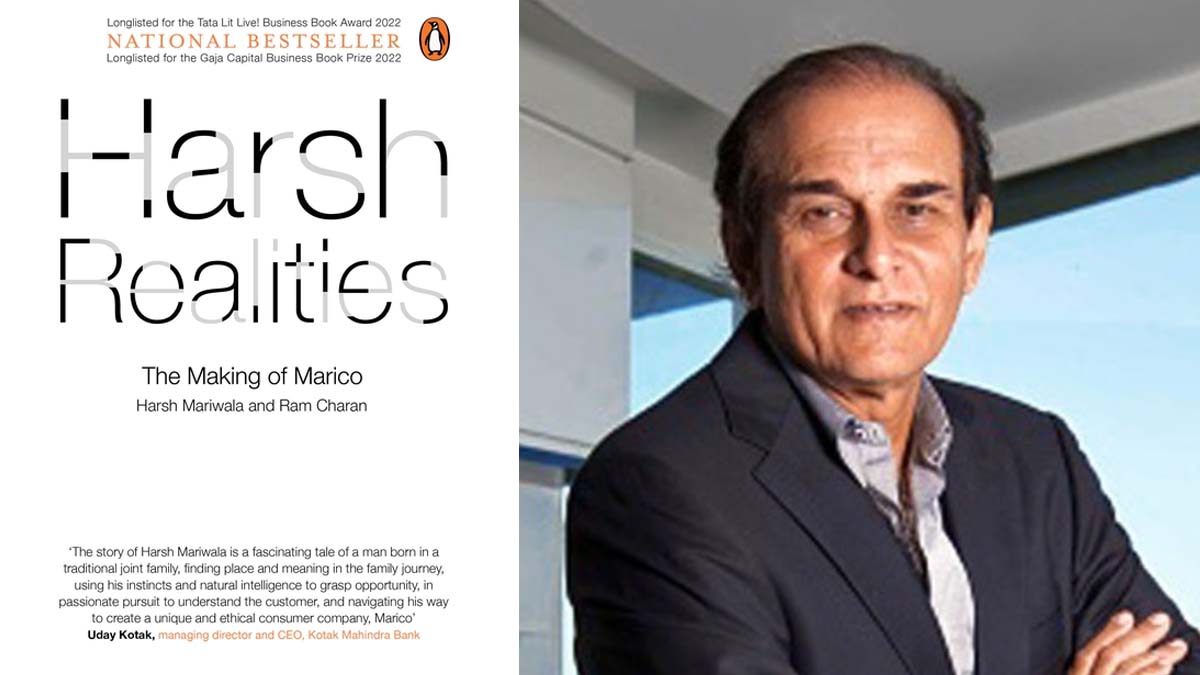
MUMBAI: Almighty Motion Picture is turning its lens on India Inc., with plans to adapt Harsh Realities: The Making of Marico into a screen project. The story charts the rise of Harsh Mariwala, the chairman and founder of Marico, and is currently in early development, according to a report by Variety.
Writer Karan Vyas, known for his work on Scam 1992, Scoop and Made in India – A Titan Story, is attached to pen the screenplay. The project continues the studio’s growing interest in real-life Indian narratives that blend business with human drama.
At the heart of the story lies a defining moment in 1987, when Mariwala chose to step away from the family-run Bombay Oil Industries and strike out on his own. What followed was not just the creation of a company, but the reinvention of a legacy. Marico would go on to become a global FMCG player, with brands like Parachute, Saffola, Set Wet and Livon becoming household names, reaching nearly one in three Indians.

The source material, co-authored by Mariwala and renowned business strategist Ram Charan, offers more than a boardroom chronicle. It captures the grit behind the growth, the risks behind the rewards and the leadership lessons forged along the way.
The adaptation aims to move beyond balance sheets and brand milestones, focusing instead on the person behind the enterprise. Expect a narrative that leans into the emotional stakes of entrepreneurship, where decisions are as personal as they are professional.
Today, Marico draws about a quarter of its revenue from international markets across Asia and Africa, reflecting its steady transformation from a domestic player into a multinational force. Yet, if the makers have their way, the screen version will remind audiences that every global success story begins with a leap of faith.
With development set to begin soon, this is one business story that may just trade spreadsheets for storytelling, and profit margins for moments that linger