Hindi
Shekhar Kapur honoured at Antalya Eurasia film fest

ANTALYA (Turkey): Eminent filmmaker Shekhar Kapur, whose Elizabeth: The Golden Age was the opening film of the Third International Eurasia Film Festival, received a special honour for his contribution to cinema.
Kapur‘s Oscar-winning Elizabeth I had also been screened in Antalya some years earlier. The festival held from 19-28 October featured the premieres of more that 80 international films.
Both the opening and the closing films of the Third International Eurasia Film Festival, the international section of 44th Antalya Golden Orange Film Festival, had an Indian presence though neither is an Indian film. Apart from Elizabeth: The Golden Age, the opening film Ang Lee‘s Lust, Caution stars Indian actor Anupam Kher in a short role.
Though there was only one entry from India in the Festival, Frozen by Shivajee Chandrabhushan, the Indian presence could also be seen in some other films – the Franco-British Far North directed by India-born Asif Kapadia; and the American-British co-production A Mighty Heart by Michael Winterbottom stars Archie Panjabi of Indian origin and Bollywood actor Irrfan Khan.
The other Indian presence was in terms of Neel Chaudhuri, who has earlier been the deputy editor of the Cinemaya Asian film quarterly published from Delhi. He was a member of the critics‘ jury.
Meanwhile, Youth without Youth by Francis Ford Coppola screened as a gala screening, has been partly shot in India.
The Turkish film Egg by Semih Kaplanoglu which was competing in both the International Eurasia Film Festival as well as the 44th Antalya Golden Orange Filmfest, bagged the maximum number of awards – eight – including the Netpac jury award, which it shared with Under the Bombs (Sous Les Bombes) by Phillipe Aractingi.
This is the first time that the Network for Promotion of Asian Cinema has instituted this award in the Eurasia Festival. A French-British-Lebanese co-production, Under the Bombs‘ also won the Critics‘ Award.
The Best Film award in the international section went to The Band‘s Visit by Eran Kolirin which is an Israel-French co-production.
The best director award went to Abdellatatif Kechiche for the French film The Secret of the Grain (La Graine et le Mulet). You – The Living by Roy Andersson of Sweden won a special jury award.

Hindi
Remembering Gyan Sahay, the lens behind film, television and advertising
From a puppet rabbit selling poppadums to Hindi cinema, he framed it all.
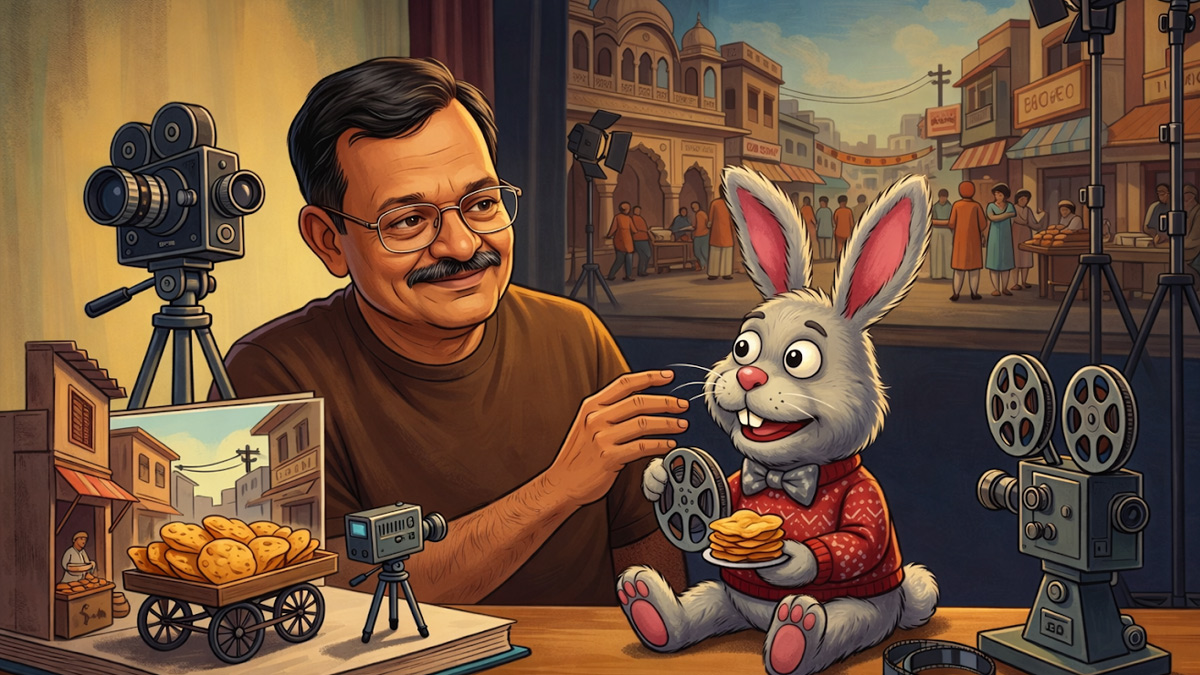
MUMBAI: There are careers, and then there are canvases. Gyan Sahay, the veteran cinematographer, director, and producer who passed away on 10 March 2026 in Mumbai, had one of the latter. Over several decades in the Indian film and television industry, he turned lenses, lights, and the occasional puppet rabbit into something approaching art.
A graduate of the Film and Television Institute of India (FTII) in Pune, Sahay built his reputation as a director of photography across a career that stretched from the early 1970s all the way to the digital age. He was the kind of craftsman who understood that a well-composed shot is not merely a technical achievement but a quiet act of storytelling.
For most Indians of a certain age, however, Sahay will forever be the man behind the rabbit. His direction of the iconic long-running television commercial for Lijjat Papad, featuring its now-legendary puppet bunny, gave the country one of its most cheerfully persistent advertising images. It was the sort of work that sneaks into the national subconscious and takes up permanent residence.

His big-screen credits as cinematographer include Anokhi Pehchan (1972), Pagli (1974), Pas de Deux (1981), and Hum Farishte Nahin (1988). In 1999, he stepped behind a different kind of camera altogether, making his directorial debut with Sar Ankhon Par, a drama that featured Vikas Bhalla and Shruti Ulfat, with a cameo by Shah Rukh Khan for good measure.
On television, Sahay was particularly prized for his command of multi-camera production setups, a skill that made him a go-to technician for large-scale shows and reality programmes. In an industry that has never been especially patient with complexity, he was the calm hand on the rig.
In later life, Sahay turned teacher. He participated regularly in masterclasses and Digi-Talks, often hosted by organisations such as Bharatiya Chitra Sadhna, sharing hard-won wisdom on cinematography, the comedy of timing in a shot, and the sweeping changes brought by the shift from celluloid to digital. He was also said to have been involved in a project concerning a biographical film on Infosys co-founder N.R. Narayana Murthy.
Tributes from the film industry poured in following the news of his passing, with colleagues remembering him as a senior cameraman who served as a rare bridge between two entirely different eras of Indian cinema. That is, perhaps, the finest thing one can say of any craftsman: he kept up, and he brought others along with him.