Hindi
RaagDesh……..Purposeless

RaagDesh has been backed by RajyaSabha Television which, in itself, is quite curious! What is the Upper House of the Parliament, which is not even elected by direct public voting and the TV channel devoted to the august house, getting into any sort of a commercial activity, obviously, financed by the tax payers’ money? Unless, of course, the credit given to the RajyaSabha TV is for some other reasons.
In the last many decades, a much selected history of India and her freedom struggle has not been available into public domain. Even when it comes to the educational institutions, the exposure has been kept limited to a select few.
The files and suspense over the sudden vanishing of the great freedom fighter, Subhash Chandra Bose, a Congress leader, who parted ways with the Congress and who, during the World War II, raised and led the Indian National Army (INA), joined forces with the Japanese army to fight the British occupying Hindustan to free her from their clutches.

One thought the Government owned TV channel got involved itself in this film project to bring to the people the glory of Bose and his endeavours towards freeing India from the slavery of British. Sadly, in the process, Indians belonging to the British army and the INA ended up killing each other; an Indian killing another Indian! However, there is little or nothing about Bose except passing references and a few visuals.
The film is about the British Indian army men of the Indian origin who, when they were losing ground to the Japanese at Burma (Myanmar), were compromised by the British and, when they surrendered, they were handed over to the soldiers of the Japanese Imperial army.
What follows is the story of three British army Indian officers from those handed over to the Japanese who, when freed, joined the INA. The three being Kunal Kapoor, Amit Sadh and MohitMarwah, portraying a Sikh, a Muslim and a Punjabi Hindu thus, according to the makers, representing all of India. The South is represented by MrudulaMurali, who plays the army doctor in INA as LaxmiSehgal.
The three officers are charged with the murder of some British army men and tried by an army court. The film also reminds one of the prominent Mumbai based Congressman and an eminent lawyer, Bhulabhai Desai (after who the upscale South Mumbai road, earlier known as Warden Road, has been named.) who decides to fight the case of these three soldiers.
As the trial begins of the three officers, it goes into the flashback of war encounters the three faced. The circumstances of their capture and accusations.
RaagDesh is a shoddy, pretentious film which even fails to establish the background and the credentials of its three protagonist. Symbolism (soldiers from three communities), unconvincing romance between Marwah and Mrudula, confusing war scenes where you don’t know who is on which side and who is killing who. The court scenes are stagey and grab most footage. And, the British court martial officers or whatever are caricatures. The language in the film is Punjabi and English just because the main protagonist is Punjabi!
The three men, Kunal Kapoor, MohitMarwah, Amit Sadh as well as MrudulaMurali look sincere to no avail.
RaagDesh fails to invoke any sort of emotions, let alone patriotism.
Producers: Gurdeep Singh Sappal.
Director: Tigmanshu Dhulia.
Cast: Kunal Kapoor, Amit Sadh, MohitMarwah, MrudulaMurali, Kenny Desai, Zakir Husain, Kanwaljit Singh, Kenny DeoriBasumatary.



Hindi
Remembering Gyan Sahay, the lens behind film, television and advertising
From a puppet rabbit selling poppadums to Hindi cinema, he framed it all.
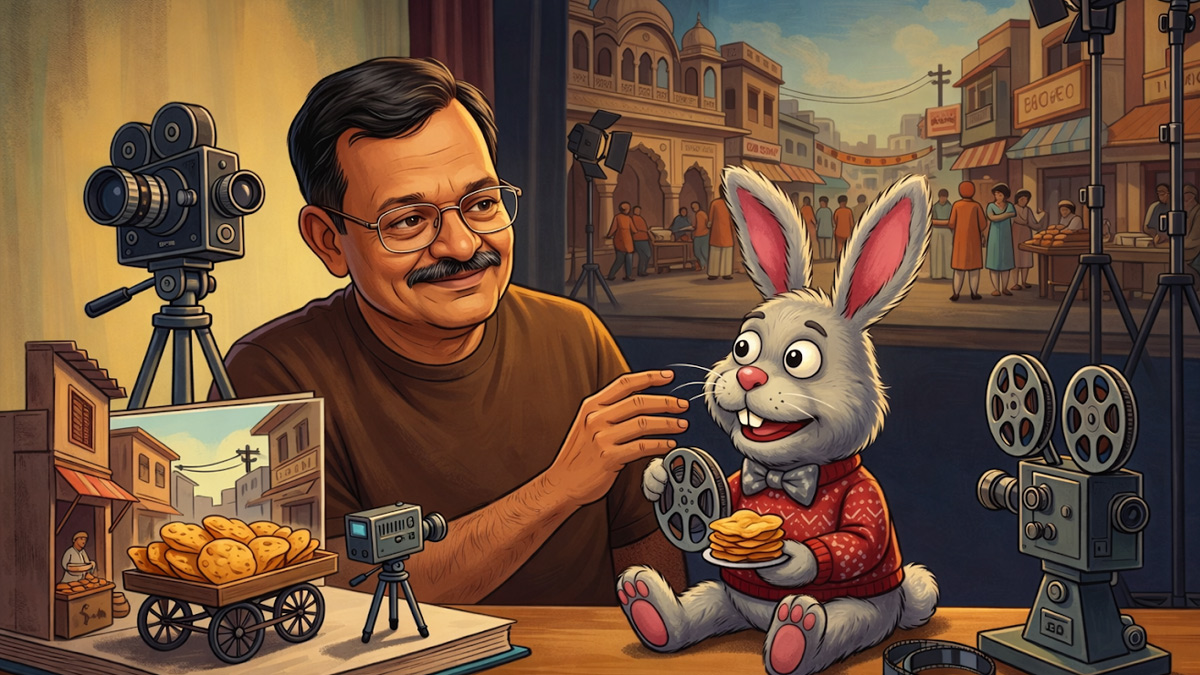
MUMBAI: There are careers, and then there are canvases. Gyan Sahay, the veteran cinematographer, director, and producer who passed away on 10 March 2026 in Mumbai, had one of the latter. Over several decades in the Indian film and television industry, he turned lenses, lights, and the occasional puppet rabbit into something approaching art.
A graduate of the Film and Television Institute of India (FTII) in Pune, Sahay built his reputation as a director of photography across a career that stretched from the early 1970s all the way to the digital age. He was the kind of craftsman who understood that a well-composed shot is not merely a technical achievement but a quiet act of storytelling.
For most Indians of a certain age, however, Sahay will forever be the man behind the rabbit. His direction of the iconic long-running television commercial for Lijjat Papad, featuring its now-legendary puppet bunny, gave the country one of its most cheerfully persistent advertising images. It was the sort of work that sneaks into the national subconscious and takes up permanent residence.
His big-screen credits as cinematographer include Anokhi Pehchan (1972), Pagli (1974), Pas de Deux (1981), and Hum Farishte Nahin (1988). In 1999, he stepped behind a different kind of camera altogether, making his directorial debut with Sar Ankhon Par, a drama that featured Vikas Bhalla and Shruti Ulfat, with a cameo by Shah Rukh Khan for good measure.
On television, Sahay was particularly prized for his command of multi-camera production setups, a skill that made him a go-to technician for large-scale shows and reality programmes. In an industry that has never been especially patient with complexity, he was the calm hand on the rig.
In later life, Sahay turned teacher. He participated regularly in masterclasses and Digi-Talks, often hosted by organisations such as Bharatiya Chitra Sadhna, sharing hard-won wisdom on cinematography, the comedy of timing in a shot, and the sweeping changes brought by the shift from celluloid to digital. He was also said to have been involved in a project concerning a biographical film on Infosys co-founder N.R. Narayana Murthy.
Tributes from the film industry poured in following the news of his passing, with colleagues remembering him as a senior cameraman who served as a rare bridge between two entirely different eras of Indian cinema. That is, perhaps, the finest thing one can say of any craftsman: he kept up, and he brought others along with him.