Hindi
Original content to drive growth of Indian animation industry

MUMBAI: Unlike the Indian cinema industry, which has brands like the Khans and the Bachchans participating in marketing stints to promote the end product that would consequently pull in audiences into theatres and create box office hits, the nascent yet growing Indian animation industry is still to witness anything of such kind, at least in the near future. This is because the industry is still under the spell of outsourced content.
Hence, industry experts and marketers, present at the Animated Feature Forum in Mumbai on 23 August to discuss the future prospects of the Indian animation industry, believe that the only way to drive brand India into animation is by producing “good original content”.
The Animated Feature Forum was organised by Animation Xpress with an aim to provide professionals from both the cinema and the animation industry with a platform to share and discuss their expertise domain.
According to Walt Disney India managing director Mahesh Sampat, the Indian animation industry is not only apprehensive about creating original content but also doubtful about the potential that the domestic market holds for the industry. “Since we as Indians, have grown up watching animated films, mostly comprising non-Indian content, we continuously seem to be under the influence of these outsourced materials. Well, now we have to start realising the potential that Indian art holds for us. The Indian film market witnesses more that three billion theatre admissions every year and 75 per cent of its revenue comes in from theatrical releases. Hence, there is a huge potential in the domestic market itself, which the industry needs to tap.”
Live action feature film directors, who now desire to walk into this new art form, believe that the biggest challenge in making animation films lay in scripting, story telling technique and visual design. They also state that if these challenges can be met confidently, then the return on investments are huge.
Govind Nihalani, whose first animation film is set to release by 2008 year-end, believes, “The animated genre can be targeted at all age groups. Hence, Indian content needs expertise in scriptwriting to maintain universality. We need to engage people, and only a good script, clubbed with a fantastic visual identity, has the potential to do so. Once we can master the craft of scripting and visualisation, we can create an emotional connect with the audience, and once that is created, our ROI will definitely be huge. This is because the audience would want to experience the film again and again.”
Meanwhile, marketers like Turner theatrical head and L&M Jiggy George believe that though, currently, the merchandising prospects of the animation industry is negligible, with the growth of the retail segment, along with the mobile and gaming market, the growth prospects of the “animation merchandising” market also looks optimistic.
“Currently, the retail market, home video segment, and the digital, mobile and gaming market are growing at an incomprehensible speed. Along with this, the animation industry is also growing at a rate of 140 per cent per annum. Furthermore, the industry is migrating from the small screen to the big screen. Its products are now fighting against live action films to capture that same Friday release slot in the same multiplexes. This means, the modules to fully exploit these properties that did not exist earlier, are now visible to us as marketers,” says George.
“Also, since animation films generally have a very long shelf life, they can be exploited for a very long time. However, this exploitation, and hence merchandising, can happen only when the product (film) has created a ‘brand stickiness‘ for itself. This is because, its only when the consumers recall the brand, will they buy the merchandise. Thus, to create that brand stickiness, the content created will require being seamlessly powerful and original,” George adds.

Hindi
Remembering Gyan Sahay, the lens behind film, television and advertising
From a puppet rabbit selling poppadums to Hindi cinema, he framed it all.
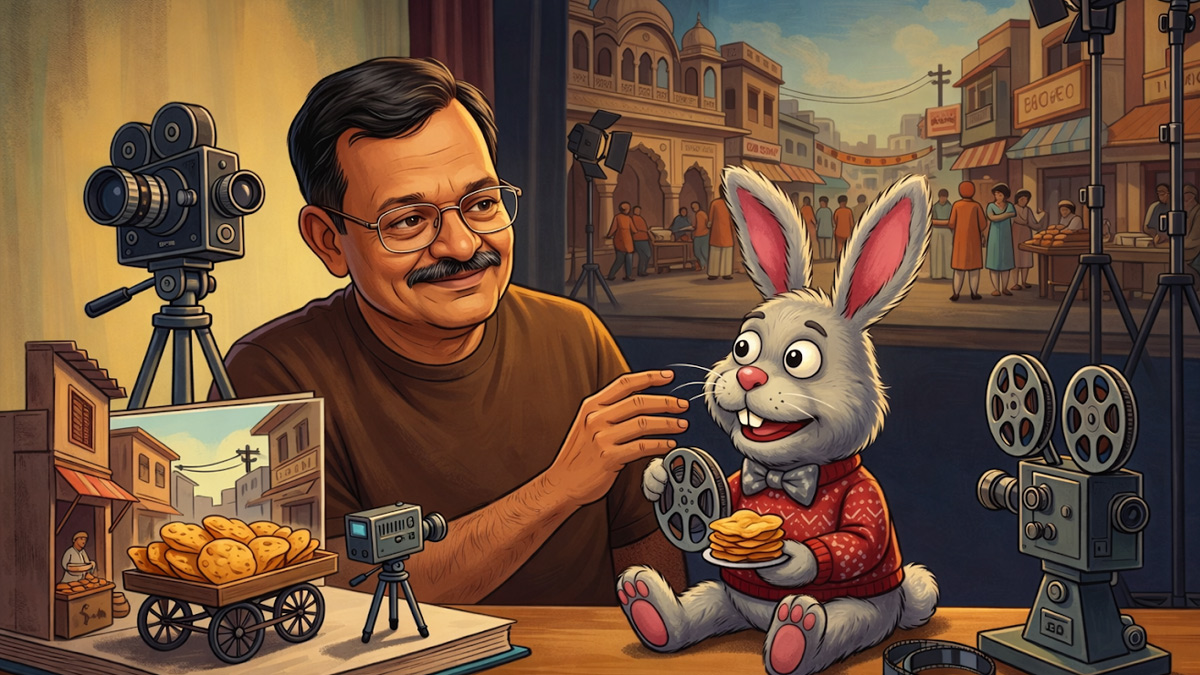
MUMBAI: There are careers, and then there are canvases. Gyan Sahay, the veteran cinematographer, director, and producer who passed away on 10 March 2026 in Mumbai, had one of the latter. Over several decades in the Indian film and television industry, he turned lenses, lights, and the occasional puppet rabbit into something approaching art.
A graduate of the Film and Television Institute of India (FTII) in Pune, Sahay built his reputation as a director of photography across a career that stretched from the early 1970s all the way to the digital age. He was the kind of craftsman who understood that a well-composed shot is not merely a technical achievement but a quiet act of storytelling.
For most Indians of a certain age, however, Sahay will forever be the man behind the rabbit. His direction of the iconic long-running television commercial for Lijjat Papad, featuring its now-legendary puppet bunny, gave the country one of its most cheerfully persistent advertising images. It was the sort of work that sneaks into the national subconscious and takes up permanent residence.

His big-screen credits as cinematographer include Anokhi Pehchan (1972), Pagli (1974), Pas de Deux (1981), and Hum Farishte Nahin (1988). In 1999, he stepped behind a different kind of camera altogether, making his directorial debut with Sar Ankhon Par, a drama that featured Vikas Bhalla and Shruti Ulfat, with a cameo by Shah Rukh Khan for good measure.
On television, Sahay was particularly prized for his command of multi-camera production setups, a skill that made him a go-to technician for large-scale shows and reality programmes. In an industry that has never been especially patient with complexity, he was the calm hand on the rig.
In later life, Sahay turned teacher. He participated regularly in masterclasses and Digi-Talks, often hosted by organisations such as Bharatiya Chitra Sadhna, sharing hard-won wisdom on cinematography, the comedy of timing in a shot, and the sweeping changes brought by the shift from celluloid to digital. He was also said to have been involved in a project concerning a biographical film on Infosys co-founder N.R. Narayana Murthy.
Tributes from the film industry poured in following the news of his passing, with colleagues remembering him as a senior cameraman who served as a rare bridge between two entirely different eras of Indian cinema. That is, perhaps, the finest thing one can say of any craftsman: he kept up, and he brought others along with him.