Hindi
‘Mastizaade:’ Sex tragedy!


Comedy films in Hindi are bad enough most of the time, but what comes in the name of sex comedy is pathetic. It is all about lewd gestures, vulgar innuendos and a voyeur for the camera. There have been films with partly lewd and suggestive scenes and dialogues but the Mastizaade script aims to be a thesis for doctorate in this genre. Milap Zaveri has been attempting to write sex comedies but this time round, he also decides to direct the film.
The saleable face or the inspiration for Mastizaade is Sunny Leone or, rather, her background. The makers stretch it a bit as they cast her in a double role of twins. Rest of their assets being same, how do you tell one from the other? One wears skimpy clothes, while the other sports scholarly specs, a red tikka on her forehead and sari. But, she being Sunny Leone too, the blouse is as skimpy as befitting Sunny.
The sisters run an institution for perverts addicted to sex. The idea is to cure them of this affliction on the face of it but actually the sisters Sunny and Sunny use such guys for their own gratification. The sisters readily find two such sex starved buffoons in Tusshar Kapoor and Vir Das. Both soon prove that if they had any expression or twitching or any movement of muscle, it is their hidden talent; hidden in their underclothes!


Both fall for one Sunny each. While otherwise they are known to be sex fiends, with Sunnyx2 oozing with sex, they seek romance as in love!
The problem is that one Sunny wants only sex sans love, the other one is in love with a paraplegic wannabe soldier.
The rest of the film is about Tusshar and Vir making bananas represent them as well as their aspirations while they see rounded fruits in Sunnyx2.
The problem is that it’s unimaginative script writing. Even what has been lifted is from PJ department. The 1960s and 1970s English film and even Dada Kondke films entertained better than this one.
Writing about direction, music, editing etc would be futile. And, to write about performances nigh impossible because no performers are involved in this film.
Producers: PNC
Director: Milap Zaveri
Cast: Tusshar Kapoor, Vir Das, Sunny Leone
‘Saala Khadoos:’ Made to prescription

A pattern has been set for sports related films in India, a pro forma is followed. The format followed by such films is an underdog from poor background, who is oozing with talent, which lies untapped. There is a down and out ex-champ of the sport in whichever sport the film deals with, who spots the talent and decides to hone it. A corrupt and debauch official heading the said sports body. The finale, of course, being the underdog under the aegis of the charged up ex-champ, takes on the best in the world.
Saala Khadoos, produced in Hindi and Tamil (as Irudhi Suttru meaning Final Round), follows the set pattern.
R Madhavan is an ex-champion boxer who aspired to win a boxing gold for India. His dream lay unrequited due to internal politics when his boxing gloves were spiked by his own coach, Zakir Hussain, due to which he had to fight blind bout and lose the fight. Madhavan has been appointed the coach of the national women’s boxing team which, Madhavan’s b?te noire, Hussain, heads now. Sparks fly between the two instantly. There is no way the power wielding Hussain would want Madhavan around him.
Madhavan is accused of molesting his women team members and, as a compromise, transferred to Chennai to coach the local team there. The state team here figures at the bottom of the national ranking and Hussain expects Madhavan to fail in his posting.
As Madhavan gets down to business and starts disciplining his wards, he is witness to partiality decision as a contender, Mumtaz Sorcar, looks the obvious winner but is declared a loser because her opponent happens to be an official’s daughter. Mumtaz’s sister, Ritika Singh, can’t take this and immediately gets violent and starts punching and felling the jury members. Ritika is the bindaas kind and street smart; she sells fish for earning. Madhavan is impressed by her aggression and the way she throws her punches.
He has spotted a prospective champ and decides to make her his pupil. She is unwilling but he offers to pay her Rs 500 per day to get her to take up boxing. Besides him, Nassar, his assistant coach, is also convinced the girl has it in her. The training of the team begins with special emphasis on Ritika. Madhavan has a point to prove to Hussain and others.
To redeem his prestige, Madhavan makes all sorts of sacrifices including financial to the extent of selling his bike. Two human emotions come to play in this situation: While Ritika is infatuated by Madhavan and professes her love to him, her sister Mumtaz starts getting jealous of Ritika. She plans to hurt her hand and Ritika is knocked out of the qualifications.
Madhavan feels let down when Ritika loses and tells her to get lost. Other predictable things happen including Hussain wanting to seduce Ritika and failing leading to her ouster from team. But, soon there is a major tournament for women on Indian soil. And, Madhavan sees the only hope for the country in Ritika. She makes it to final and slated to face the same Russian who knocked her out earlier.
The end comes on expected lines.
Indians are familiar with women’s boxing thanks to Mary Kom and have seen at least one film on woman’s boxing in her bio-pic, Mary Kom. The script is on predictable lines and, hence, does not really touch a viewer as such a film about an underdog should. But, it keeps one engaged. Direction is capable though with a heavy South touch. Music as the songs go, is purely functional. Cinematography is generally good.
The best thing is the casting, which makes the film convincing and, what’s more, all of them live up to their characters. Ritika’s casting has stories behind it already covered in the media and she tops. Madhavan is a veteran of many films in many languages (also being one of the producers of this film) and puts in his best as a determined sports failure. However, he could have done with a suave look rather than the unshaved rough one he sports. Nassar and Hussain are around for their talent and they are naturals. Others cast mostly from the South are adequate.
Saala Khadoos aims at a limited patronage and unlimited praise. The opening response is weak and the film faces opposition from India Australia T20 matches on Friday as well as on Sunday thus limiting its prospects to pick up at the box office.
Producers: Rajkumar Hirani, R Madhavan
Director: Sudha Kongara Prasad
Cast: R Madhavan, Ritika Singh, Mumtaz Sorcar, Nassar, Nazir Hussain, Bajinder Kaur, Kaali Venkat, Radha Ravi





Hindi
Remembering Gyan Sahay, the lens behind film, television and advertising
From a puppet rabbit selling poppadums to Hindi cinema, he framed it all.
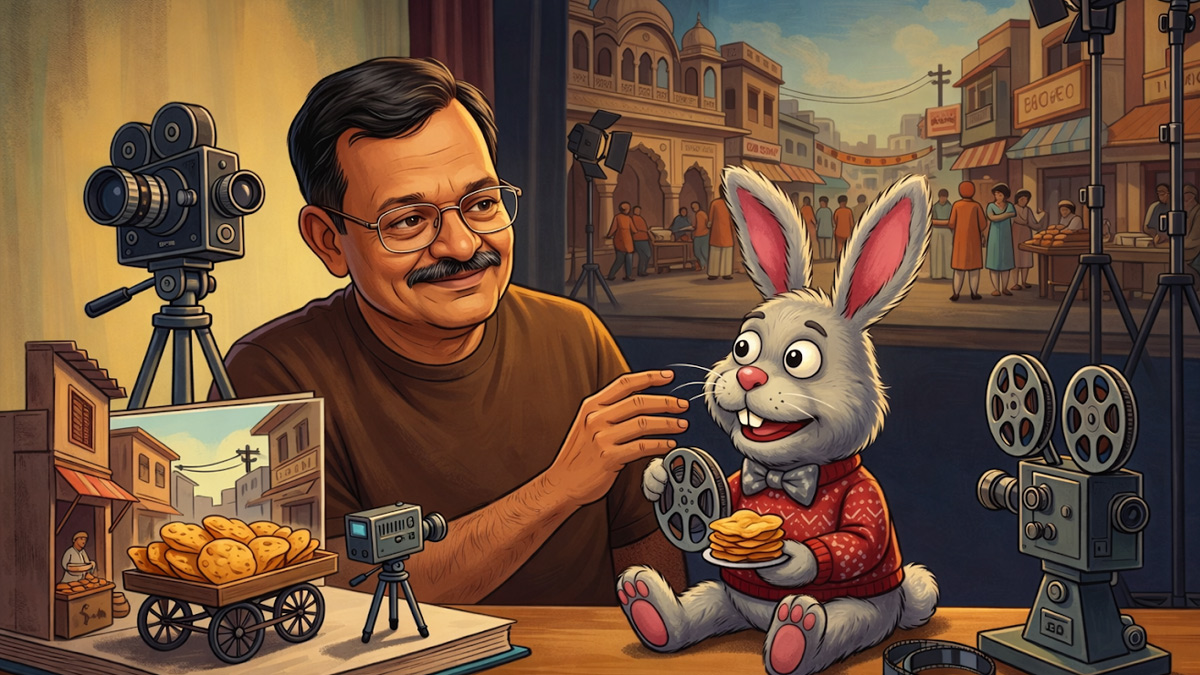
MUMBAI: There are careers, and then there are canvases. Gyan Sahay, the veteran cinematographer, director, and producer who passed away on 10 March 2026 in Mumbai, had one of the latter. Over several decades in the Indian film and television industry, he turned lenses, lights, and the occasional puppet rabbit into something approaching art.
A graduate of the Film and Television Institute of India (FTII) in Pune, Sahay built his reputation as a director of photography across a career that stretched from the early 1970s all the way to the digital age. He was the kind of craftsman who understood that a well-composed shot is not merely a technical achievement but a quiet act of storytelling.
For most Indians of a certain age, however, Sahay will forever be the man behind the rabbit. His direction of the iconic long-running television commercial for Lijjat Papad, featuring its now-legendary puppet bunny, gave the country one of its most cheerfully persistent advertising images. It was the sort of work that sneaks into the national subconscious and takes up permanent residence.
His big-screen credits as cinematographer include Anokhi Pehchan (1972), Pagli (1974), Pas de Deux (1981), and Hum Farishte Nahin (1988). In 1999, he stepped behind a different kind of camera altogether, making his directorial debut with Sar Ankhon Par, a drama that featured Vikas Bhalla and Shruti Ulfat, with a cameo by Shah Rukh Khan for good measure.
On television, Sahay was particularly prized for his command of multi-camera production setups, a skill that made him a go-to technician for large-scale shows and reality programmes. In an industry that has never been especially patient with complexity, he was the calm hand on the rig.
In later life, Sahay turned teacher. He participated regularly in masterclasses and Digi-Talks, often hosted by organisations such as Bharatiya Chitra Sadhna, sharing hard-won wisdom on cinematography, the comedy of timing in a shot, and the sweeping changes brought by the shift from celluloid to digital. He was also said to have been involved in a project concerning a biographical film on Infosys co-founder N.R. Narayana Murthy.
Tributes from the film industry poured in following the news of his passing, with colleagues remembering him as a senior cameraman who served as a rare bridge between two entirely different eras of Indian cinema. That is, perhaps, the finest thing one can say of any craftsman: he kept up, and he brought others along with him.







