Hindi
Machine…. Poor show

MUMBAI: Machine is a rather unlikely story with an unlikely title. Coming from Abbas Mustan duo, the Burmawalla brothers, who made a reputation for giving thrillers and action films with good musical score, one expected more of the same stuff. Having worked with some of the top artistes of Hindi film industry, their inspiration has almost always come from English movies besides an odd Indian language film.
Though Abbas and Mustan started their career with Gujarati films, which were usually crudely made, in Hindi films, they made a reputation for their finesse. Their brother, Hussain helped them keep their content crisp as an editor.
This time, the Burmawalla brothers were expected to give their all; they were launching a family scion, Mustafa, the son of Abbas as the hero. Mustafa earlier assisted the duo in direction department.

Mustafa’s character drops out of the blue in the life of the character played by Kiara Advani, a student at Woodstock school/college somewhere in North India as the legend on the screen informs you. Having met on a picturesque highway, he turns out to be a fresher at the same institution as her. Kiara is a car-racing enthusiast and so is he. She is in to dramatics in her institution, and so is Mustafa.
These sequences are pure copy-paste from any given 1980s campus film, though oft used later too. Kaira has fallen in love with Mustafa instantly, and that is how Mustafa wanted it to be. But, there are two more candidates on the campus vying for her attention and love in Rishabh Arora and Eshan Shankar.
Kaira keeps getting romantic messages on the balcony (no, they are not into text messages or WhatsApp) of her hostel room which looks more like a graded hotel suit! One of the three aspirants is sending her messages but, since she has fallen in love with Mustafa, she can only imagine him sending those messages. She is about to find out as the messenger has sought a rendezvous on a bridge where lovers meet and commit themselves.
Here, two of the claimants for her love lose the race. Mustafa and Kiara tie the knot.
As the couple’s honeymoon begins, it is also the end of the viewers’ hopes. The film goes haywire, hereafter. Not that it had much to promise in the first half.
The writer-director team seems to have no control over the content as well as on what they want to be the mainstay of the film. They try to cram in a few things from their own previous films which worked like the antihero from Baazigar, devious guardian from Khiladi and so on. What emerges finally is a royal mess.
Known for their positive sense for popular music, the director duo fails this time as the film falls short of the kind of songs such a love story needs. Editing is a let-down. The film does have a couple of catchy dialogues. The film is shot on scenic location overseas in the name of North India which is some relief.
Mustafa Burmawalla can be rated fair as an actor but he is no star material nor a draw. He lacks that charm or magnetism.
Kiara Advani is cute, reminds you of Hema Malini in expressions. Rishabh Arora and Eshan Shankar lack presence and their roles are poorly etched out. Ronit Roy goes overboard. Kishori Shahane, Sharat Saxena, Dalip Tahil, Supriya karnik and Johnny Lever have little to do.
Machine is poor on all counts and has no prospects at the box office.
Producers: Abbas, Mustan, Pranay Chokshi, Haresh Patel.
Directors: Abbas Mustan.
Cast: Mustafa Burmawalla, Kaira Advani, Rishabh Shukla, Shabbir Burmawalla, Eshan Shankar, Supriya Karnik, Ronit Roy, Sharat Saxena, Kishori Shahane, Johhny Lever.
Trapped…Feels like self-torture?
The urge to experiment and make a different kind of a film is strong among newer and younger filmmakers. The stars being hard to get and the budgets restraints that prevail, there is this quest is for something thought provoking.
Trapped is one such attempt. The story puts the protagonist in impossible situations, makes him go through all kinds of testing times and, eventually, lets him get out of the tight spot the same way he could have done within an hour of being trapped if he had thought carefully and planned logically. Instead, he throws tantrums and goes on destroying things around him, things that could have saved his life as well as the situation.
The character of Rajkumar Rao is some sort of a bespectacled white collar worker. You can’t say what kind because you don’t see him doing any work since he is busy trying to date a girl, played by Geetanjali Thapa. After some quirky talk on phone, the two decide to meet over a meal. No matter that the girl is due to marry in next two months.
They date, they make out and they decide to marry notwithstanding the girl’s earlier commitment. But Rao shares a small apartment with many others and can’t bring Thapa here. He goes out in search of a one-BHK accommodation and gets what he needed in an under construction building, almost ready but unoccupied.
Usually, a guy does not choose a place to live without his woman by his side; it is always her choice. But, here, Rao rents a flat, even occupies it and Thapa is not even aware or around. But this is a script that suits the makers for a very low budget film.
Having occupied the new flat, Rao learns to his dismay that he has been had. The flat has no running water or the electricity that he was promised. Next, as he decides to go to work, he discovers he has left his cell phone behind. In hurry to retrieve it, he gets locked into the flat with the keys hanging outside.
He is Trapped!
Thereafter, what he does is everything that is illogical and for the convenience of stretching the film to an intolerable 103 minutes! Seeing is believing but I would not advise it!
Shot in one flat with nothing for distraction, the film has a deficient script, patchy direction and lack of editing sense. The film counts on Rajkumar Rao to bear the burden of this non-entertainer. He does very well but not enough to salvage this misadventure. Geetanjali Thapa and others in the cast are incidental.
Trapped is a tedious watch.
Producers: Madhu Mantena, Vikas Bahl, Anurag Kashyap.
Director: Vikramaditya Motwane.
Cast: Rajkumar Rao, Geetanjali Thapa.


Hindi
Remembering Gyan Sahay, the lens behind film, television and advertising
From a puppet rabbit selling poppadums to Hindi cinema, he framed it all.
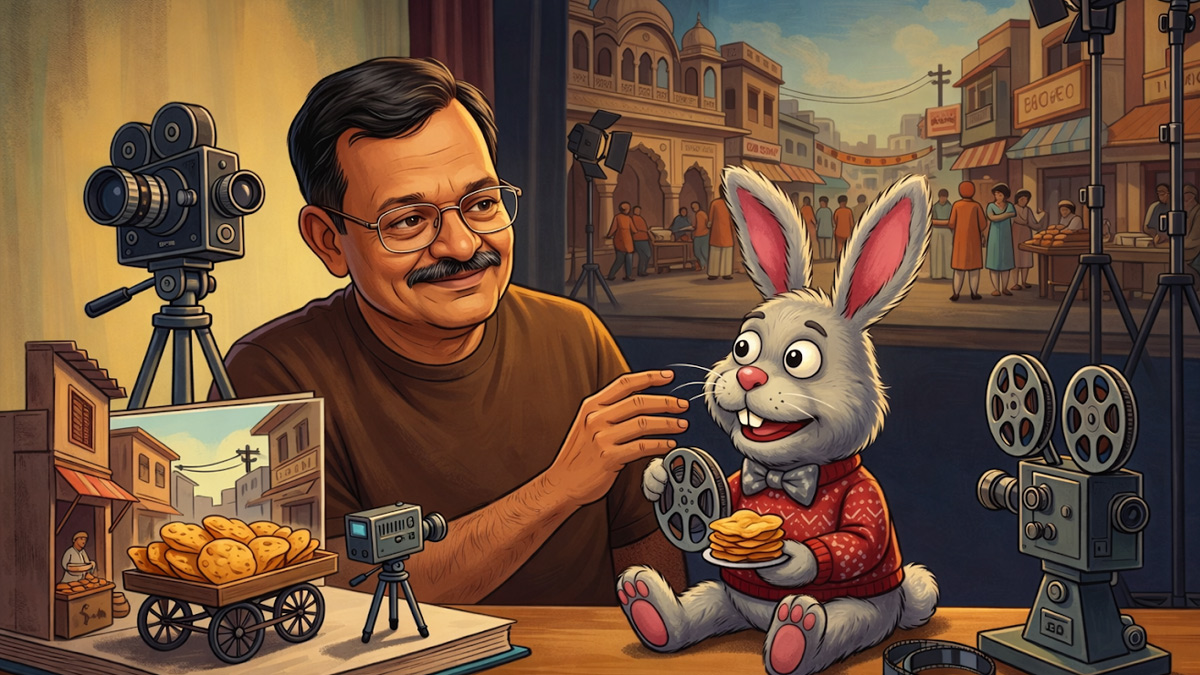
MUMBAI: There are careers, and then there are canvases. Gyan Sahay, the veteran cinematographer, director, and producer who passed away on 10 March 2026 in Mumbai, had one of the latter. Over several decades in the Indian film and television industry, he turned lenses, lights, and the occasional puppet rabbit into something approaching art.
A graduate of the Film and Television Institute of India (FTII) in Pune, Sahay built his reputation as a director of photography across a career that stretched from the early 1970s all the way to the digital age. He was the kind of craftsman who understood that a well-composed shot is not merely a technical achievement but a quiet act of storytelling.
For most Indians of a certain age, however, Sahay will forever be the man behind the rabbit. His direction of the iconic long-running television commercial for Lijjat Papad, featuring its now-legendary puppet bunny, gave the country one of its most cheerfully persistent advertising images. It was the sort of work that sneaks into the national subconscious and takes up permanent residence.
His big-screen credits as cinematographer include Anokhi Pehchan (1972), Pagli (1974), Pas de Deux (1981), and Hum Farishte Nahin (1988). In 1999, he stepped behind a different kind of camera altogether, making his directorial debut with Sar Ankhon Par, a drama that featured Vikas Bhalla and Shruti Ulfat, with a cameo by Shah Rukh Khan for good measure.
On television, Sahay was particularly prized for his command of multi-camera production setups, a skill that made him a go-to technician for large-scale shows and reality programmes. In an industry that has never been especially patient with complexity, he was the calm hand on the rig.
In later life, Sahay turned teacher. He participated regularly in masterclasses and Digi-Talks, often hosted by organisations such as Bharatiya Chitra Sadhna, sharing hard-won wisdom on cinematography, the comedy of timing in a shot, and the sweeping changes brought by the shift from celluloid to digital. He was also said to have been involved in a project concerning a biographical film on Infosys co-founder N.R. Narayana Murthy.
Tributes from the film industry poured in following the news of his passing, with colleagues remembering him as a senior cameraman who served as a rare bridge between two entirely different eras of Indian cinema. That is, perhaps, the finest thing one can say of any craftsman: he kept up, and he brought others along with him.







