Hindi
Israel, China among awardees of films on disability issues

NEW DELHI: Twelve films, including one each from China and Israel, have received awards in four categories in the Fifth We Care Film Festival on Disability Issues that was held online earlier this year.
The films also include some made by or starring people who are physically or mentally challenged.
The recipients of the three awards in the category of films of up to one minute duration are: ‘Dark’ (Visually Impairment) by Indranil Goswami of Mumbai; ‘Chal’ (Come…) on inclusion by Jayesh S Pillai and Haveesh Vemuri of Kanpur; and ‘Sonal’ on Disability Awareness and Cerebral Palsy by Arjna Gaurisaria of Mumbai.
The top three films in the up to five minute category were: ‘Girl Star: Anuradha the Medical student’ on Physical disability by Pallavi Arora of Delhi; ‘Sparsh’ on Cross disability by Vrishnika of Delhi; and ‘Shri Rakum School for the Blind’ on Visually Impaired by Miditech of Delhi.
In the 30-minute category, the films were ‘Believe Me’ on the Downs Syndrome by Rajani Ratnaparkhi of Pune; ‘Nobody‘s Perfect’ on Cerebral Palsy by Bhaskar Hazarika of Delhi; and ‘You wanted to make a film?’ on the Physically Challenged by Gali Weintraub of Israel.
‘Bullets and Butterflies’ on Physical Impairment by Sushmit Ghosh of Delhi; ‘To Whom I am Concerned’ on the mentally challenged by Somya Sharma of Delhi; and ‘Children of the Stars’ on Autism by Robin Aspey of China won the awards in the category of films up to 60 minutes.
The awards were given away by eminent Danseuse Sonal Mansingh, UNIC Director Shalini Dewan, Asian Academy for Film and Television founder Sandeep Marwah, and Poonam Natarajan, Chairperson of the National Trust for Welfare of Persons with Autism, Cerebral Palsy, Mental Retardation and Multiple Disabilities. Brotherhood founder Satish Kapoor, who has founded the annual film festival, was also present.
Announcement was also made about the sixth festival for next year, which will be held for the first time in collaboration with the United Nations Information Centre as part of its celebration year-long campaign to mark the 60th Anniversary of the Universal Declaration of Human Rights.
Two sets of three DVDs each containing the award-winning films were also released on the occasion, apart from the launch of a website www.wecarefilmfest.net where all films on disability issues are available for viewing. The 12 films were selected by the 48 films entered from countries like the Philippines, China and Israel besides India.
Marwah’s studio had given the technical support for the making of several films on the issue of disability.
Kapoor told indiantelevision.com that the next festival would be held in February 2009 and the awards will be distributed on 3 May 2009 to mark the day when the United Nations Convention on the Rights of Persons with Disabilities came into force earlier this year. The film festival will be organized first in Delhi and will then travel to Mumbai/Pune and Kolkata.
He said he had began six years earlier by using the audio-visual media to initiate discussions and dialogue for the integration of people with disability into the mainstream of society, there was immediate realization among various sections of society for the need of such an initiative. Brotherhood had, through several projects, demonstrated that film and documentaries can be a powerful medium for educating the public about disability issues, dispelling myths, stereotypes and misconceptions about persons with disabilities and promoting a new approach to disability which guarantees equal rights and opportunities and equal access.
Physically challenged achievers – Divya Arora and Shibani Gupta – and Sanjeev Sachdeva who compered the programme – were honoured on the occasion.
Brotherhood is the pioneer in organizing film festivals on disability issues in India and has since 2003 organized five international Special Film Festivals jointly organized by the World Bank, the National Trust, Tamana Welfare Society and Asian Academy of Film and Television, Icongo, Iridium Interactive etc.

Hindi
Remembering Gyan Sahay, the lens behind film, television and advertising
From a puppet rabbit selling poppadums to Hindi cinema, he framed it all.
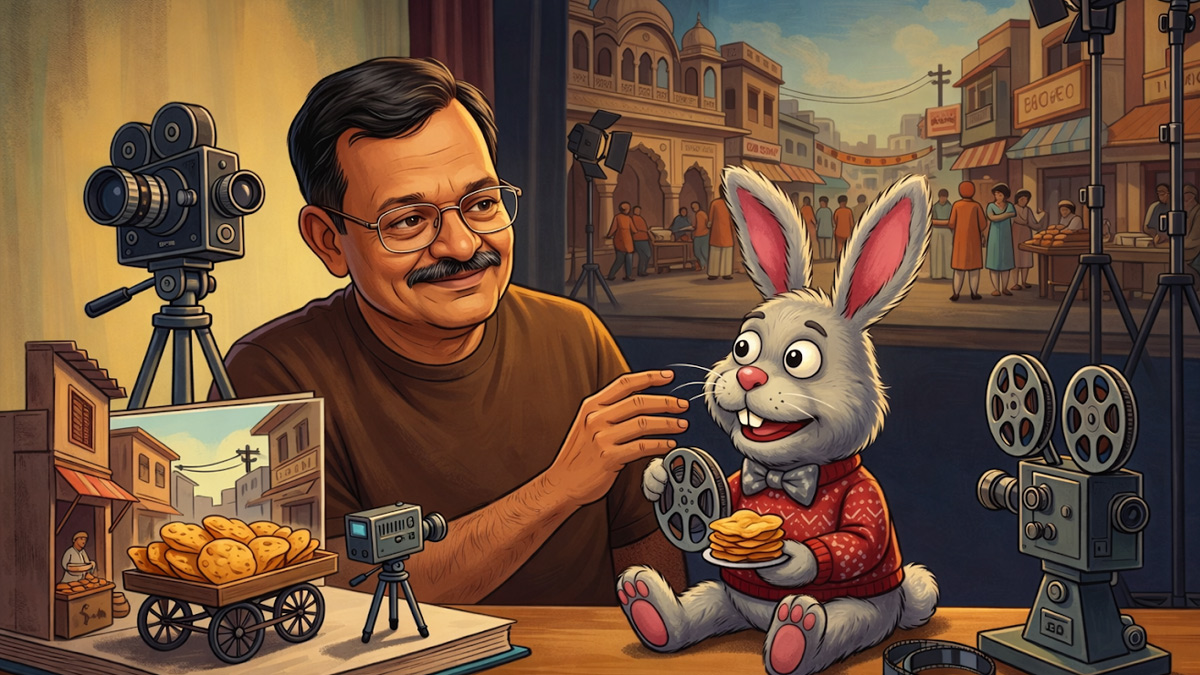
MUMBAI: There are careers, and then there are canvases. Gyan Sahay, the veteran cinematographer, director, and producer who passed away on 10 March 2026 in Mumbai, had one of the latter. Over several decades in the Indian film and television industry, he turned lenses, lights, and the occasional puppet rabbit into something approaching art.
A graduate of the Film and Television Institute of India (FTII) in Pune, Sahay built his reputation as a director of photography across a career that stretched from the early 1970s all the way to the digital age. He was the kind of craftsman who understood that a well-composed shot is not merely a technical achievement but a quiet act of storytelling.
For most Indians of a certain age, however, Sahay will forever be the man behind the rabbit. His direction of the iconic long-running television commercial for Lijjat Papad, featuring its now-legendary puppet bunny, gave the country one of its most cheerfully persistent advertising images. It was the sort of work that sneaks into the national subconscious and takes up permanent residence.

His big-screen credits as cinematographer include Anokhi Pehchan (1972), Pagli (1974), Pas de Deux (1981), and Hum Farishte Nahin (1988). In 1999, he stepped behind a different kind of camera altogether, making his directorial debut with Sar Ankhon Par, a drama that featured Vikas Bhalla and Shruti Ulfat, with a cameo by Shah Rukh Khan for good measure.
On television, Sahay was particularly prized for his command of multi-camera production setups, a skill that made him a go-to technician for large-scale shows and reality programmes. In an industry that has never been especially patient with complexity, he was the calm hand on the rig.
In later life, Sahay turned teacher. He participated regularly in masterclasses and Digi-Talks, often hosted by organisations such as Bharatiya Chitra Sadhna, sharing hard-won wisdom on cinematography, the comedy of timing in a shot, and the sweeping changes brought by the shift from celluloid to digital. He was also said to have been involved in a project concerning a biographical film on Infosys co-founder N.R. Narayana Murthy.
Tributes from the film industry poured in following the news of his passing, with colleagues remembering him as a senior cameraman who served as a rare bridge between two entirely different eras of Indian cinema. That is, perhaps, the finest thing one can say of any craftsman: he kept up, and he brought others along with him.







