Hindi
Indian Film Company shareholder wants Raghav Bahl out as director

MUMBAI: A shareholder of The Indian Film Company (IFC), which is listed on the Alternative Investment Market (AIM) of the London Stock Exchange, has asked for the removal of Raghav Bahl and Alok Verma as directors of the company.
Altima India Master Fund Ltd (AIMF), holding 14.39 per cent stake in IFC, has also called for an EGM to consider a share buy-back programme by the company or to distribute any excess cash it may have as special dividends.
The IFC board sees AIMF‘s actions as an attempt to take control of the company without outlining a detailed growth strategy and without making an offer to all shareholders to acquire their shares at a full and fair price.
“If AIMF wishes to obtain control of the company, then the board believes that it should make a formal offer at a fair price to all shareholders pursuant to the Takeover Code,” IFC said.
When IFC was admitted to trading on AIM on 18 June 2007, AIMF subscribed for one million Ordinary Shares, representing 1.82 per cent of the issued share capital. During the course of 2008, AIMF increased its holding in IFC to 14.39 per cent.
IFC board has indicated that the company currently does not have significant excess cash due to its ongoing commitments for the film projects in progress. Nor is debt financing easily available, given the current state of the financial markets. The board believes any immediate distribution of cash for buy back or special dividends “is not financially prudent, may negatively impact its business, and would not benefit the shareholders in the medium or long term.”
The board also feels that the removal of Bahl and Verma would be detrimental to the interests of the company as they have successfully guided the company‘s strategy in carrying out projects like Singh Is Kinng and Ghajini. Network18 founder-promoter Bahl holds 21.64 per cent stake in IFC.
IFC had on 22 December 2008 received a requisition from Vidacos Nominees Limited (in its capacity as nominee for, and on the instruction of, Altima India Master Fund Limited) for the directors to convene an EGM. The board of IFC tried to engage with AIMF to discuss its concerns. But AIMF indicated that it is unwilling to respond unless Bahl and Verma, an experienced corporate financier, are removed and Aashish Vyas and Atul Setia are appointed as directors.
As at 30 September 2008, the carrying value of the Company’s investments in films and films under production were in excess of ?25 million. These are to be funded through cash in hand, internal accruals from the release of films which are yet to be released, and from further exploitation of rights of films which have already been released.
IFC is also in the process of organising debt financing for further investment in film projects. As such, the company does not have any excess cash to carry out a share buy-back or any other distribution to shareholders at this stage, the board clarified.
The company will hold an EGM on 5 February to decide on AIMF‘s proposals.
IFC operates as an India-focused motion picture company with outsourced
production and distribution functions externally managed by the Investment Manager, with the Investment Adviser and Studio 18 playing a key role in the overall functioning of the company. Bahl is the promoter and director of the Investment Manager. The Investment Manager is owned 50 per cent by B K Media Mauritius Private Limited and 50 per cent by Viacom Inc.

Hindi
Remembering Gyan Sahay, the lens behind film, television and advertising
From a puppet rabbit selling poppadums to Hindi cinema, he framed it all.
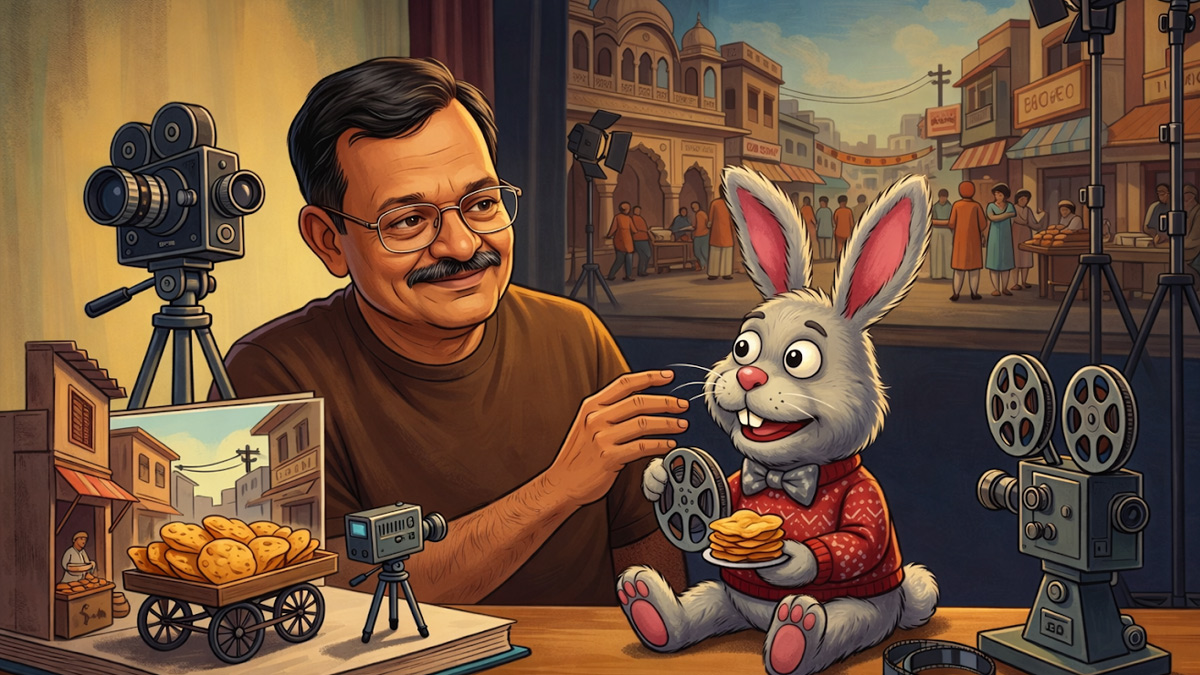
MUMBAI: There are careers, and then there are canvases. Gyan Sahay, the veteran cinematographer, director, and producer who passed away on 10 March 2026 in Mumbai, had one of the latter. Over several decades in the Indian film and television industry, he turned lenses, lights, and the occasional puppet rabbit into something approaching art.
A graduate of the Film and Television Institute of India (FTII) in Pune, Sahay built his reputation as a director of photography across a career that stretched from the early 1970s all the way to the digital age. He was the kind of craftsman who understood that a well-composed shot is not merely a technical achievement but a quiet act of storytelling.
For most Indians of a certain age, however, Sahay will forever be the man behind the rabbit. His direction of the iconic long-running television commercial for Lijjat Papad, featuring its now-legendary puppet bunny, gave the country one of its most cheerfully persistent advertising images. It was the sort of work that sneaks into the national subconscious and takes up permanent residence.

His big-screen credits as cinematographer include Anokhi Pehchan (1972), Pagli (1974), Pas de Deux (1981), and Hum Farishte Nahin (1988). In 1999, he stepped behind a different kind of camera altogether, making his directorial debut with Sar Ankhon Par, a drama that featured Vikas Bhalla and Shruti Ulfat, with a cameo by Shah Rukh Khan for good measure.
On television, Sahay was particularly prized for his command of multi-camera production setups, a skill that made him a go-to technician for large-scale shows and reality programmes. In an industry that has never been especially patient with complexity, he was the calm hand on the rig.
In later life, Sahay turned teacher. He participated regularly in masterclasses and Digi-Talks, often hosted by organisations such as Bharatiya Chitra Sadhna, sharing hard-won wisdom on cinematography, the comedy of timing in a shot, and the sweeping changes brought by the shift from celluloid to digital. He was also said to have been involved in a project concerning a biographical film on Infosys co-founder N.R. Narayana Murthy.
Tributes from the film industry poured in following the news of his passing, with colleagues remembering him as a senior cameraman who served as a rare bridge between two entirely different eras of Indian cinema. That is, perhaps, the finest thing one can say of any craftsman: he kept up, and he brought others along with him.