Hindi
India says ‘Jai Ho!’ as Slumdog sweeps Oscars

MUMBAI: The might of the marriage between Hollywood and Bollywood may have just arrived. Slumdog Millionaire, the rags-to-riches story using Indian actors and landscape, has taken home eight Oscars including that of the best picture award and the best director for Danny Boyle.
Indian musical maestro A R Rehman has scooped two Oscar awards – best original score and best soundtrack.
Slumdog, the feel-good account of a Mumbai orphan’s break away from poverty, has further picked top honours for editor Chris Dickens, cinematographer Anthony Dod Mantle and screenplay writer Simon Beaufoy. The Best sound mixing prize was bagged by Ian Tapp and Resul Pookutty, another Indian to represent the country on the red carpet.
Says PVR Pictures CEO Uday Singh, “Slumdog‘s win at the Oscars has opened up new avenues for Indian cinema to travel abroad. The win only suggests that if the content is right and is padded with the right mix of marketing and distribution strategies, no Indian film can be kept away from reaching out to the global audience.”
The other India-based film to capture the Oscar attention is Smile Pinki. The film, made by Megan Mylan, has won the best short documentary prize after contesting against four others in the same genre.
Congratulating the Slumdog Millionaire and Smile Pinki team for winning the prestigious Oscar Awards, the Minister of State of Information & Broadcasting and External Affairs Anand Sharma said that this is the finest hour of Indian cinema in the global scenario.
The other winners at the 81st Academy Awards include:
Best actor (male): Sean Penn for Milk
Best actor (female): Kate Winslet for The Reader
Best sound editing: Richard King for The Dark Knight
Best visual effects: Eric Barba, Steve Preeg, Burt Dalton and Craig Barron for The Curious Case of Benjamin Button
Best documentary short subject: Megan Mylan for Smile Pinki
Best documentary feature: James Marsh and Simon Chinn for Man On Wire
Best actor in a supporting role: Heath Ledger for The Dark Knight
Best live action short film: Spielzeugland (Toyland)
Best makeup: Greg Cannom for The Curious Case of Benjamin Button
Best costume design: Michael O‘Connor for The Duchess
Best art direction: Donald Graham Burt (art direction) for The Curious Case of Benjamin Button
Best animated short film: La Maison en Petits Cubes
Best animated feature film: Wall.E
Original screenplay: Dustin Lance Black for Milk
Best actress in a supporting pole: Penelope Cruz for Vicky Chistina Barcelona
Best foreign language film: Departures (Japan)

Hindi
Remembering Gyan Sahay, the lens behind film, television and advertising
From a puppet rabbit selling poppadums to Hindi cinema, he framed it all.
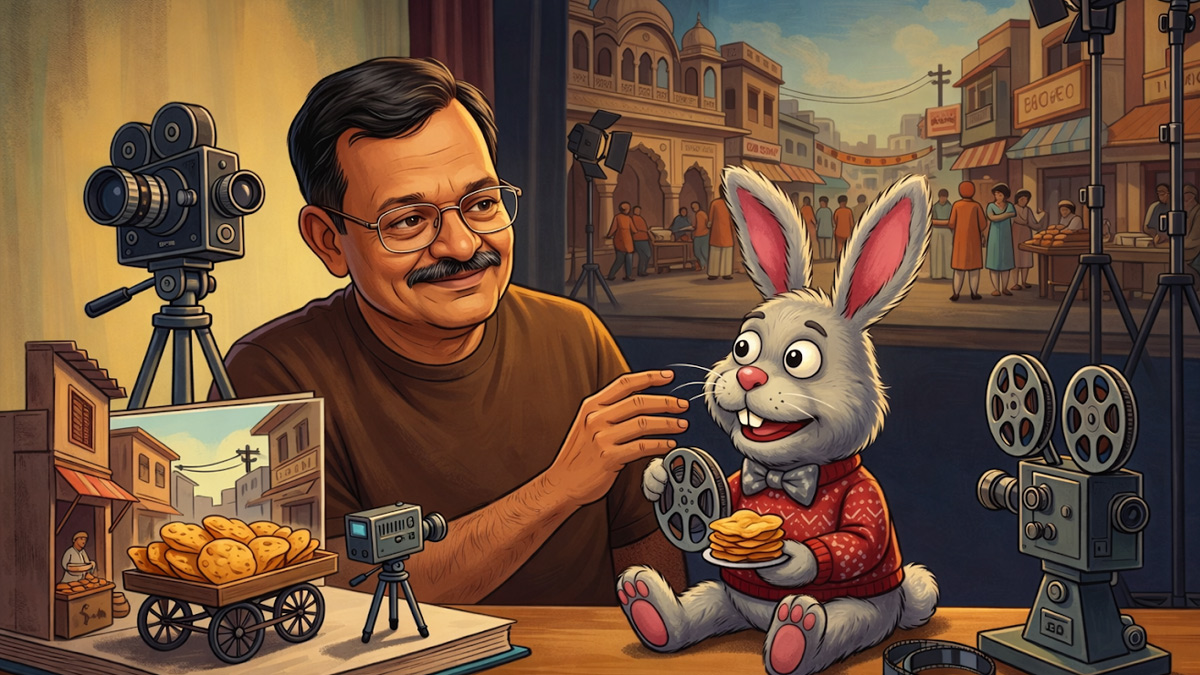
MUMBAI: There are careers, and then there are canvases. Gyan Sahay, the veteran cinematographer, director, and producer who passed away on 10 March 2026 in Mumbai, had one of the latter. Over several decades in the Indian film and television industry, he turned lenses, lights, and the occasional puppet rabbit into something approaching art.
A graduate of the Film and Television Institute of India (FTII) in Pune, Sahay built his reputation as a director of photography across a career that stretched from the early 1970s all the way to the digital age. He was the kind of craftsman who understood that a well-composed shot is not merely a technical achievement but a quiet act of storytelling.
For most Indians of a certain age, however, Sahay will forever be the man behind the rabbit. His direction of the iconic long-running television commercial for Lijjat Papad, featuring its now-legendary puppet bunny, gave the country one of its most cheerfully persistent advertising images. It was the sort of work that sneaks into the national subconscious and takes up permanent residence.

His big-screen credits as cinematographer include Anokhi Pehchan (1972), Pagli (1974), Pas de Deux (1981), and Hum Farishte Nahin (1988). In 1999, he stepped behind a different kind of camera altogether, making his directorial debut with Sar Ankhon Par, a drama that featured Vikas Bhalla and Shruti Ulfat, with a cameo by Shah Rukh Khan for good measure.
On television, Sahay was particularly prized for his command of multi-camera production setups, a skill that made him a go-to technician for large-scale shows and reality programmes. In an industry that has never been especially patient with complexity, he was the calm hand on the rig.
In later life, Sahay turned teacher. He participated regularly in masterclasses and Digi-Talks, often hosted by organisations such as Bharatiya Chitra Sadhna, sharing hard-won wisdom on cinematography, the comedy of timing in a shot, and the sweeping changes brought by the shift from celluloid to digital. He was also said to have been involved in a project concerning a biographical film on Infosys co-founder N.R. Narayana Murthy.
Tributes from the film industry poured in following the news of his passing, with colleagues remembering him as a senior cameraman who served as a rare bridge between two entirely different eras of Indian cinema. That is, perhaps, the finest thing one can say of any craftsman: he kept up, and he brought others along with him.









