Hindi
Gujarat in focus 2 documentaries released

MUMBAI: Film-maker Rakesh Sharma today released his latest films for previews in Gujarat.The two new films — Khedu Mora Re and Chet‘ta Rejo — have been researched over the last couple of years and shot during the last eight months. Speaking about his new films, Rakesh Sharma said, “Ever since I started showing Final Solution around, many people urged me to do follow-up films as well. I wanted to go beyond highlighting the events of 2002 and the State and Sangh Parivar‘s complicity, which by now has been well-documented, especially after the Tehelka expose . These films are also in the nature of my response to Mr. Modi and his propaganda as a member of civil society.”
Khedu Mora Re (62 minutes)
This film specifically deals with the myth of ‘Vibrant Gujarat‘. The film graphically documents the phenomenon of farmer suicides in Gujarat. It also deals with farmers‘ opposition to SEZs as well as widespread anger against the Modi government and its lopsided policies which many farmers in the film claim are tailored to suit corporates and industries. The much-hyped ‘ Sujalam Sufalam‘ scheme is probed at the ground level, especially during the recent floods in Saurashtra -where farmers squarely blame this scheme for their misfortune. Says a farmer in the film, “Till a couple of years ago, there was never a flood in Gokharwada (district Surendranagar) but ever since this ‘ Sujalam Sufalam‘, our village and lands get submerged every year due to these new check dams, faulty planning and construction. Modi keeps announcing packages worth hundreds of crores, but the reality is that the people are yet to receive even 5 Rupees out of the post-flood package announced for 2005! And now this flood in 2007 – it has destroyed us totally.”
A strand that runs through is a specific RTI (Right to Information ) campaign designed by the film-maker. Filed through activist Bharat Jhala, the information nails government lies and exposes its attempts to suppress the truly horrifying scale of farmer suicides in Gujarat. Says Rakesh Sharma, “Modi has been trying to reinvent himself as Vikaspurush, hoping that glitzy films and investor summits will whitewash his image as the butcher of Gujarat. I felt it was critical to examine the true story behind the hype, but also realized that the film is liable to be attacked and its credibility challenged. That‘s why I chose the RTI route to use the government‘s own figures to bring out the true story.”
“Modi claimed in a TV interview to NDTV on March 14, 2007 that no farmer commits suicide in Gujarat,” continues Rakesh Sharma. “A month later, he admitted to 148 suicides on the floor of the assembly. Official data that we finally got in Oct 10, 2007, five months after we filed queries, confirms 498 suicides formally. However, even this list is partial as it does not feature several suicide stories painstakingly documented in the film! As many suicides are passed off as accidents, we also filed RTI queries seeking details of all accidental deaths. Of the 6,695 farmers who died in “accidents”, over 4000 have not been paid any ‘Kisan Vima Yojana‘ money (we‘ve informally learnt that insurance companies have denied many such “accident” claims as many of these are suicides)! Amazingly, on Oct 10 itself, the day the Gujarat government gave us RTI data confirming 498 suicides, an official ad released on ETV categorically stated that there are no suicides in Gujarat and people should not believe in false propaganda. The ad was obviously in response to the media coverage, press conferences and film excerpts that appeared in end Sept and October!”
The film features several suicide stories done as very personal, intimate portraits. Opposition to land acquisition for SEZs in Bhavnagar district are intercut with the havoc unleashed by private companies in Kathivadar. The film itself reports 10-12 suicides in Amreli, Surendranagar, Bhavnagar, Rajkot, Bharuch and Surat. The RTI data reveals shocking district-wise figures – Rajkot (63 suicides), Junagad (85), Amreali (34), Mehsana (48), Nadiad (44), Jamnagar (55), Narmada (30) and even in Gandhinagar (13), right under the Chief Minister‘s nose!
Chet‘ta Rejo (72 minutes):
The back cover of the CD itself contextualizes the film – the saffronisation of the Dalit-OBC population and its consequent plight! The film looks specifically at the patterns of arrests and litigation since 2002. A majority of those charged with rioting, arson, murder etc are either tribals or Dalits and OBCs. An analysis of those arrested from 32 police stations in Ahmedabad suggests that of the 1577 detainees, only 30-odd were upper caste! Are these foot soldiers victims too? Cynically recruited, then discarded, left to rot in jails, what do the ‘perpetrators of the violence feel today about the VHP and the BJP?
The film has several personal portraits and conversations. Some of the issues that emerge:
1. 6-8 families of the deceased passengers of the fatal S-6 speak of how they were told people were going for a picnic tour, certainly not any karseva, that the VHP-BJP exploited their tragedy for electoral gains in 2002, how ever since then no one has come to help, how monies raised in their name never reached them…and how some of them who spoke in public about it have been threatened by the VHP!
2. VHP made tall promises to help the detained and the injured Hindutva cadre, but barring some rations and monetary help in the first month or two, not much came. The VHP/ BJP combine simply vanished. A telling account is of Kanti and Deepak from Gomtipur – both shot by the police, both appealed to the BJP for help (including the CM) but got nothing. When they went to the Togadia-owned Dhanvantri hospital for operations/ treatment, they were turned away, asked to bring a deposit of Rs 50,000 first!
3. Cops don‘t arrest the upper castes. They come and take away Dalits/OBCs – any men they can find in the area. The men are normally told to come along for haziri but then booked formally. Women in such families speak of the subsequent harassment and hardships.
4. Dalits ask why violence is engineered in their areas, and not in the posh upper caste areas? They ask a series of searching, probing questions and offer their own analyses throughout the film.
5. Dalit elders speak of how the Ram Mandir at Ayodhya doesn‘t mean much to them, as they cannot even enter the mandir in their own villages – upper castes prevent them from doing so till today!
7. An OBC Hindu boy and a Muslim boy, both friends, used to play cricket together in Behrampura. During the riots, both lost their right hands to bombs during the riots! The film ends with both of them appealing to the youth not to join such parties or get involved in such violence as no one lifts a finger to help — it is them and their families who will suffer forever.
The overall message that emerges through a range of voices – violence and politics of hate destroys the Dalit-OBC-Muslim communities; it is best to stay away from parties that preach hate.

Hindi
Remembering Gyan Sahay, the lens behind film, television and advertising
From a puppet rabbit selling poppadums to Hindi cinema, he framed it all.
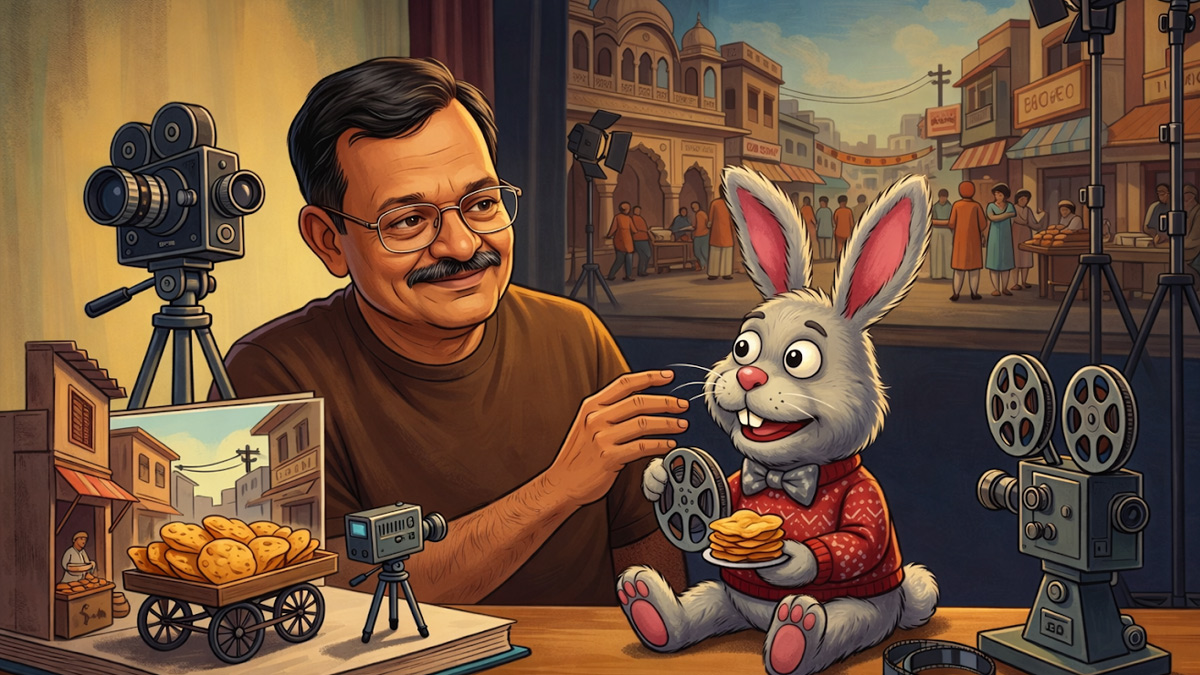
MUMBAI: There are careers, and then there are canvases. Gyan Sahay, the veteran cinematographer, director, and producer who passed away on 10 March 2026 in Mumbai, had one of the latter. Over several decades in the Indian film and television industry, he turned lenses, lights, and the occasional puppet rabbit into something approaching art.
A graduate of the Film and Television Institute of India (FTII) in Pune, Sahay built his reputation as a director of photography across a career that stretched from the early 1970s all the way to the digital age. He was the kind of craftsman who understood that a well-composed shot is not merely a technical achievement but a quiet act of storytelling.
For most Indians of a certain age, however, Sahay will forever be the man behind the rabbit. His direction of the iconic long-running television commercial for Lijjat Papad, featuring its now-legendary puppet bunny, gave the country one of its most cheerfully persistent advertising images. It was the sort of work that sneaks into the national subconscious and takes up permanent residence.

His big-screen credits as cinematographer include Anokhi Pehchan (1972), Pagli (1974), Pas de Deux (1981), and Hum Farishte Nahin (1988). In 1999, he stepped behind a different kind of camera altogether, making his directorial debut with Sar Ankhon Par, a drama that featured Vikas Bhalla and Shruti Ulfat, with a cameo by Shah Rukh Khan for good measure.
On television, Sahay was particularly prized for his command of multi-camera production setups, a skill that made him a go-to technician for large-scale shows and reality programmes. In an industry that has never been especially patient with complexity, he was the calm hand on the rig.
In later life, Sahay turned teacher. He participated regularly in masterclasses and Digi-Talks, often hosted by organisations such as Bharatiya Chitra Sadhna, sharing hard-won wisdom on cinematography, the comedy of timing in a shot, and the sweeping changes brought by the shift from celluloid to digital. He was also said to have been involved in a project concerning a biographical film on Infosys co-founder N.R. Narayana Murthy.
Tributes from the film industry poured in following the news of his passing, with colleagues remembering him as a senior cameraman who served as a rare bridge between two entirely different eras of Indian cinema. That is, perhaps, the finest thing one can say of any craftsman: he kept up, and he brought others along with him.







