Hindi
Film industry wants separate courts to deal with pirates

NEW DELHI: A law on the lines of the Goonda Act of Tamil Nadu or the Maharashtra Prevention of Dangerous Act should be enacted by the Centre to deal with the menace of piracy which is eating into the vitals of the film industry, according to a memorandum submitted to President Pratibha Devisingh Patil.
Film Federation of India Honorary General Secretary Sushama Shiromanee told indiantelevision.com that Patil gave a patient hearing to the 22-member film delegation led by FFI President Jitendra Jain which met her here and immediately forwarded the Memorandum to the Government for action.
Shiromanee said the President agreed that the entertainment sector had become a major force in earning foreign exchange and also in terms of the tax revenues it paid to the government.
Shiromanee who is also Senior Vice President in the Indian Motion Pictures Producers Association said the Maharashtra Government’s law had been forwarded to the centre and it was now up to the Union Home Ministry to act upon drafting a similar law, since the Copyright Act had failed to check the rampant piracy of entertainment software.
The industry has also demanded a separate Court to deal with issues linked to the film industry, apart from a special police cell.
Shiromanee denied that pirates continued to thrive because there was no unity in the film fraternity and many filmmakers were hands in glove with the law-breakers. In fact, she said different sections of the industry had met the Information and Broadcasting Minister and officials several times in recent years to find ways to tackle this menace.
The delegation also told the President that while the Government had constituted several consultative committees for all sectors including one recently for the media, it had failed to do so for the film industry. Furthermore, the government had either not received or not acted upon the reports of the five core groups set up by former Information and Broadcasting Minister Priyaranjan Dasmunsi.
Shiromanee said that the FFI was planning to give due place of honour to those who had been awarded the Dadasaheb Phalke Awards for Lifetime Contribution and even those who had served silently without expecting recognition, for the growth of Indian cinema.
While the industry has demanded uniformity in taxation – particularly entertainment tax – vis-?-vis the film industry, Shiromanee said the FFI had written to several state governments to ensure this since the centre had maintained that Cinema was a state subject.
The memorandum demanded abolition of service tax since there was no transfer of property as defined in the Finance Acts of 2007 or 2008.
The industry also wants that the counterveiling duty on set top boxes should be exempted for the next ten years to help the television industry to grow.
It reiterated the need for complete excise duty exemption on import of colour jumbo rolls and total abolition of excise and customs duty for import of broadcast equipment.
Taxes on raw stock should be reduced in the case of small budget films, Shiromanee said, to help the growth of good cinema.
She said the base of the fringe benefit tax charged by hotels from film crews should be reduced from 20 to five per cent or completely abolished.
Replying to a question, Shiromanee criticized the exemption of entertainment tax on ‘Slumdog Millionaire’ in Delhi after it won the Oscars awards and not on the basis of the quality of the film. She said this also exposed the attitude towards Indian films which seldom received tax exemptions even if they won awards outside or within the country.
Among others, the delegation included FFI Vice Presidents Ravi Kotarakara and Sangram Shirke, eminent filmmakers T P Aggarwal and Jahnu Barua, and short filmmaker Ramesh Tekwani, apart from FFI Secretary General Supran Sen.

Hindi
Remembering Gyan Sahay, the lens behind film, television and advertising
From a puppet rabbit selling poppadums to Hindi cinema, he framed it all.
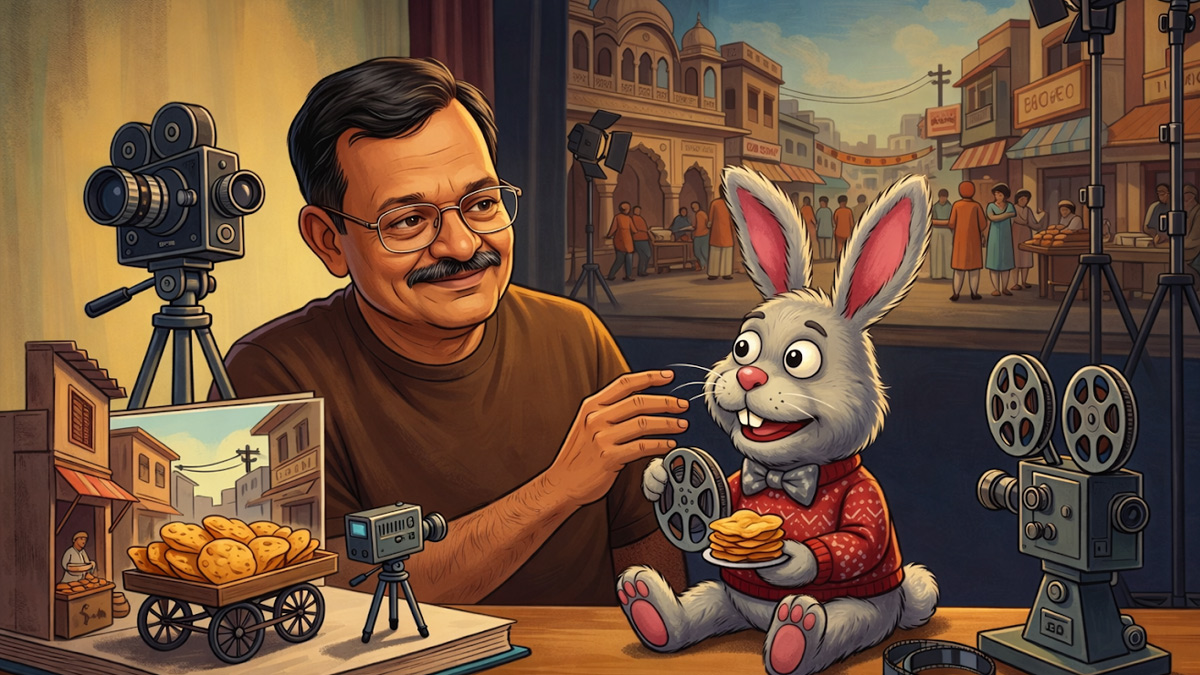
MUMBAI: There are careers, and then there are canvases. Gyan Sahay, the veteran cinematographer, director, and producer who passed away on 10 March 2026 in Mumbai, had one of the latter. Over several decades in the Indian film and television industry, he turned lenses, lights, and the occasional puppet rabbit into something approaching art.
A graduate of the Film and Television Institute of India (FTII) in Pune, Sahay built his reputation as a director of photography across a career that stretched from the early 1970s all the way to the digital age. He was the kind of craftsman who understood that a well-composed shot is not merely a technical achievement but a quiet act of storytelling.
For most Indians of a certain age, however, Sahay will forever be the man behind the rabbit. His direction of the iconic long-running television commercial for Lijjat Papad, featuring its now-legendary puppet bunny, gave the country one of its most cheerfully persistent advertising images. It was the sort of work that sneaks into the national subconscious and takes up permanent residence.

His big-screen credits as cinematographer include Anokhi Pehchan (1972), Pagli (1974), Pas de Deux (1981), and Hum Farishte Nahin (1988). In 1999, he stepped behind a different kind of camera altogether, making his directorial debut with Sar Ankhon Par, a drama that featured Vikas Bhalla and Shruti Ulfat, with a cameo by Shah Rukh Khan for good measure.
On television, Sahay was particularly prized for his command of multi-camera production setups, a skill that made him a go-to technician for large-scale shows and reality programmes. In an industry that has never been especially patient with complexity, he was the calm hand on the rig.
In later life, Sahay turned teacher. He participated regularly in masterclasses and Digi-Talks, often hosted by organisations such as Bharatiya Chitra Sadhna, sharing hard-won wisdom on cinematography, the comedy of timing in a shot, and the sweeping changes brought by the shift from celluloid to digital. He was also said to have been involved in a project concerning a biographical film on Infosys co-founder N.R. Narayana Murthy.
Tributes from the film industry poured in following the news of his passing, with colleagues remembering him as a senior cameraman who served as a rare bridge between two entirely different eras of Indian cinema. That is, perhaps, the finest thing one can say of any craftsman: he kept up, and he brought others along with him.