Hindi
Eurasia Film Market director regrets lack of participation from India

ANTALYA: Even as the three-day Film Market Eurasia Production Platform came to a close at the Fourth International Eurasian Film Festival, Market MD Julie Bergenon expressed disappointment at the lukewarm response from India despite the large number of invitations sent out to filmmakers and film distributors.
Considering that India was one of the largest film producing countries in the world, she said that it was surprising that some delegates had confirmed participation but failed to come.
However, the festival saw a marginal increase of participation from India in terms of delegates to the market, with two stalls being put up for the first time. All the invited media delegates from India expressed confidence that the interest shown by many filmmakers from different countries would result in fruitful alliances.
Meanwhile, organisers claimed that deals had been finalised on four co-production ventures between Turkey and other countries. These included one for a documentary film Sobatei Zeri by David Silber in collaboration with Israel and Greece, feature Mixed Kebab by Guy Lee Thys of Belgium, Yes to War with Michael Stephens of New Zealand and Ellin Alimani’s Somebody’s German with Armin Kaiser of Germany. He added that talks were at an advanced stage for several other projects.
Deniz Ziya Temeltas, who was in charge of the second edition of the Eurasian Production Platform, said negotiations had been on for over 20 co-production ventures.
Bergenon said her aim had been to bring in some new participants while retaining some of those who have been coming for the past festivals. She said it was necessary to establish a link between a film festival and the film market if a festival had to succeed.
Answering a question, she said her target had been to get participants from Asia and Europe, but it was impossible to ignore Hollywood.
She said that a total of 54 countries had been represented at the Market, including four from India of which two had taken stalls. Of the total, there were 18 new companies this year.
She admitted that the ongoing Mipcom in Cannes also had its effect on the participation in the festival.
The Market had three delegates from India: Kamal Jain of Superfine Films, and Sashi B Kumar and Sudha Kumar of Mudra Arts, though the Market lists at least three others including Ultra’s S. Narayanan and Sunil Doshi of Alliance Media (which procures films for NDTV Lumiere).
While agreeing that the Market may result in new deals, Mumbai-based Sun Stone Entertainment headed by Sanjay Juman Jumani was critical of the authorities in India who failed to take advantage of such Markets. He also said the International Film Festival of India (being held in Goa next month) would not be able to put up a good market as the National Film Development Corporation (NFDC) had failed to learn anything from other markets.

Hindi
Remembering Gyan Sahay, the lens behind film, television and advertising
From a puppet rabbit selling poppadums to Hindi cinema, he framed it all.
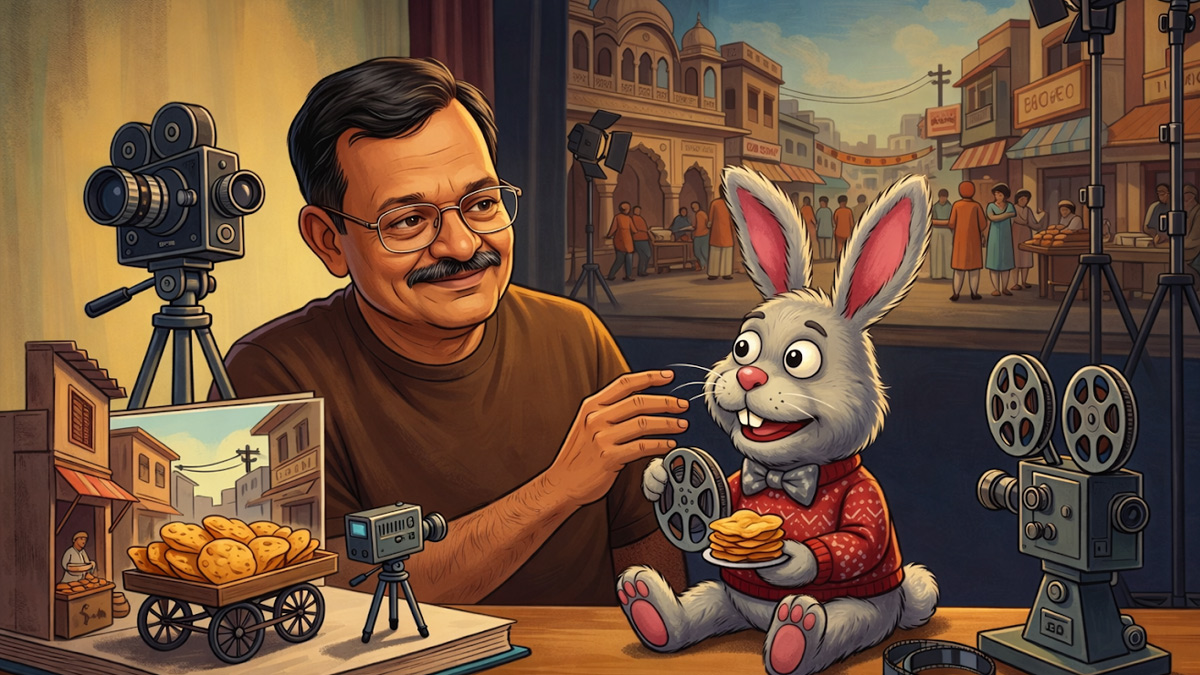
MUMBAI: There are careers, and then there are canvases. Gyan Sahay, the veteran cinematographer, director, and producer who passed away on 10 March 2026 in Mumbai, had one of the latter. Over several decades in the Indian film and television industry, he turned lenses, lights, and the occasional puppet rabbit into something approaching art.
A graduate of the Film and Television Institute of India (FTII) in Pune, Sahay built his reputation as a director of photography across a career that stretched from the early 1970s all the way to the digital age. He was the kind of craftsman who understood that a well-composed shot is not merely a technical achievement but a quiet act of storytelling.
For most Indians of a certain age, however, Sahay will forever be the man behind the rabbit. His direction of the iconic long-running television commercial for Lijjat Papad, featuring its now-legendary puppet bunny, gave the country one of its most cheerfully persistent advertising images. It was the sort of work that sneaks into the national subconscious and takes up permanent residence.

His big-screen credits as cinematographer include Anokhi Pehchan (1972), Pagli (1974), Pas de Deux (1981), and Hum Farishte Nahin (1988). In 1999, he stepped behind a different kind of camera altogether, making his directorial debut with Sar Ankhon Par, a drama that featured Vikas Bhalla and Shruti Ulfat, with a cameo by Shah Rukh Khan for good measure.
On television, Sahay was particularly prized for his command of multi-camera production setups, a skill that made him a go-to technician for large-scale shows and reality programmes. In an industry that has never been especially patient with complexity, he was the calm hand on the rig.
In later life, Sahay turned teacher. He participated regularly in masterclasses and Digi-Talks, often hosted by organisations such as Bharatiya Chitra Sadhna, sharing hard-won wisdom on cinematography, the comedy of timing in a shot, and the sweeping changes brought by the shift from celluloid to digital. He was also said to have been involved in a project concerning a biographical film on Infosys co-founder N.R. Narayana Murthy.
Tributes from the film industry poured in following the news of his passing, with colleagues remembering him as a senior cameraman who served as a rare bridge between two entirely different eras of Indian cinema. That is, perhaps, the finest thing one can say of any craftsman: he kept up, and he brought others along with him.