Hindi
Dvortsevoy bags Golden Peacock at IIFI ’08

MUMBAI: Director Sergei Dvortsevoy bagged the best film award with the Golden Peacock and a cash award of Rs 4 million for the Kazakhstan film Tulpan at the 39th International Film Festival of India that closed today with the screening of Iranian film The Song of the Sparrows, directed by Majid Majidi.
The director also got the most promising director award for the film. The award comprises the Silver Peacock and a cash award of Rs 1.5 million.
The special jury award went to Sri Lankan actress Malini Fonseka whose film Akasa Kusum featured in the competition section. The winner was presented a Silver Peacock, a cash prize of Rs 1.5 million and a certificate. Fonseka said that her film was an India-Sri Lanka co-production and the time has come for a closer relationship between the two countries. She also hoped for peace and happiness everywhere in these troubled times.
The five-member competition-jury was headed by noted Director from Hong Kong Peter Chan. Other members of the jury were Marco Mueller (Venice), Niki Karimi (Iran), Lav Diaz (Philippines) and Tabassum Hashmi (Tabu- India).
Two Indian entries — S Priyadarshan’s Tamil film Kanchivaram and Ramesh Laxman More’s Marathi film Mahasatta —were in the “competition” section among 13 other films chosen from Bangladesh, Russia, New Zealand, Malaysia, Kazakhstan, Sri Lanka, Iran, the Philippines, Argentina, China and Japan.
Chief Minister of Goa, Shri Digambar Kamat in his remarks said that IFFI 2008 was a landmark event. He said that the government of Goa is keen to develop the state as a hub for the entertainment industry. More multiplexes and other facilities are being created in Mudgaon, he added.
Joint Secretary (films) Ministry of Information & Broadcasting V.B.Pyarelal said that the festival gave us an opportunity to experience the visual interpretation of the various facets of life. He said that the occupancy remained very high throughout the festival as compared to last year.
During the 11-day festival, which began on 22 November, with the screening of Peter Chan’s Warlords, a total of 185 movies were shown from 44 countries. Films from Russia, Switzerland and Iran were screened under Country Focus section. The films of Aki Kaurusmaki (Finland), John Landis (USA) and Wong Kar Wai (Hong Kong) were screened in Foreign Retrospective. Eight restored heritage film classics were included in the Film Heritage – Thematic “Women” section. Five films were shown in Film India Worldwide.
Also, 83 Indian movies including 47 in the Indian Panorama were screened.

Hindi
Remembering Gyan Sahay, the lens behind film, television and advertising
From a puppet rabbit selling poppadums to Hindi cinema, he framed it all.
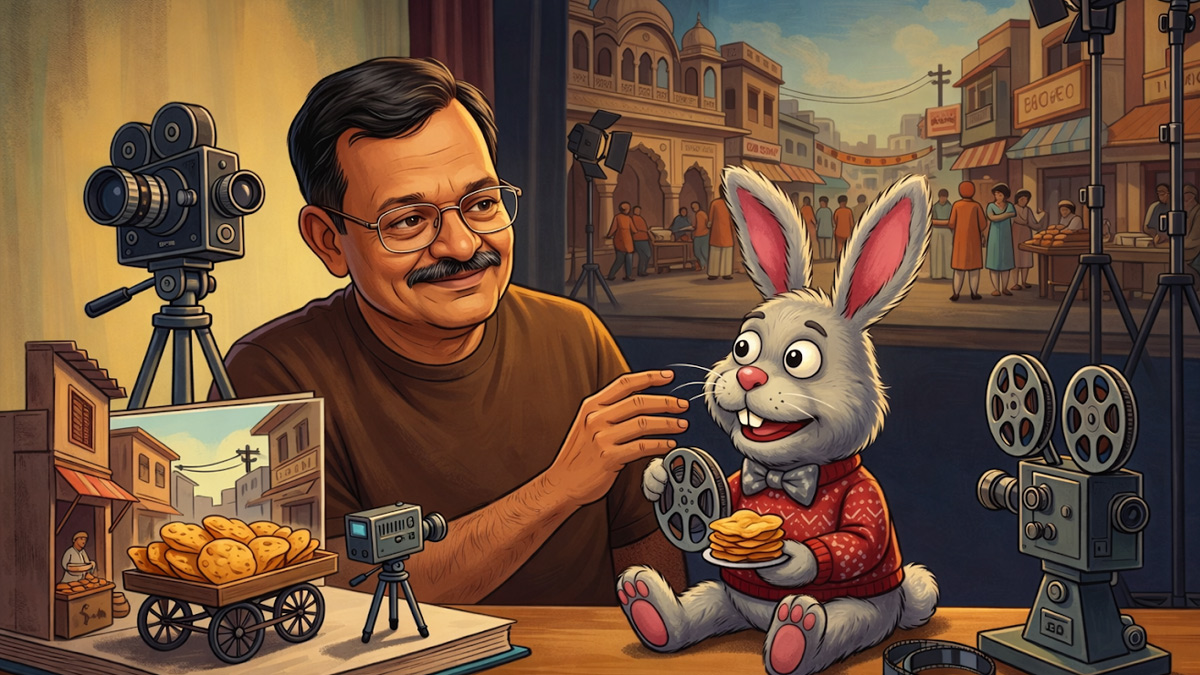
MUMBAI: There are careers, and then there are canvases. Gyan Sahay, the veteran cinematographer, director, and producer who passed away on 10 March 2026 in Mumbai, had one of the latter. Over several decades in the Indian film and television industry, he turned lenses, lights, and the occasional puppet rabbit into something approaching art.
A graduate of the Film and Television Institute of India (FTII) in Pune, Sahay built his reputation as a director of photography across a career that stretched from the early 1970s all the way to the digital age. He was the kind of craftsman who understood that a well-composed shot is not merely a technical achievement but a quiet act of storytelling.
For most Indians of a certain age, however, Sahay will forever be the man behind the rabbit. His direction of the iconic long-running television commercial for Lijjat Papad, featuring its now-legendary puppet bunny, gave the country one of its most cheerfully persistent advertising images. It was the sort of work that sneaks into the national subconscious and takes up permanent residence.

His big-screen credits as cinematographer include Anokhi Pehchan (1972), Pagli (1974), Pas de Deux (1981), and Hum Farishte Nahin (1988). In 1999, he stepped behind a different kind of camera altogether, making his directorial debut with Sar Ankhon Par, a drama that featured Vikas Bhalla and Shruti Ulfat, with a cameo by Shah Rukh Khan for good measure.
On television, Sahay was particularly prized for his command of multi-camera production setups, a skill that made him a go-to technician for large-scale shows and reality programmes. In an industry that has never been especially patient with complexity, he was the calm hand on the rig.
In later life, Sahay turned teacher. He participated regularly in masterclasses and Digi-Talks, often hosted by organisations such as Bharatiya Chitra Sadhna, sharing hard-won wisdom on cinematography, the comedy of timing in a shot, and the sweeping changes brought by the shift from celluloid to digital. He was also said to have been involved in a project concerning a biographical film on Infosys co-founder N.R. Narayana Murthy.
Tributes from the film industry poured in following the news of his passing, with colleagues remembering him as a senior cameraman who served as a rare bridge between two entirely different eras of Indian cinema. That is, perhaps, the finest thing one can say of any craftsman: he kept up, and he brought others along with him.







