Hindi
‘Dum Laga Ke Haisha’….Missing audience


MUMBAI: Dum Laga Ke Haisha is very unlike a Yash Raj Films product. It gives you nothing of that finesse most of their films boast of. What’s more, Bhumi Pednekar, who makes her debut with this film, is not the kind who can become a heartthrob of young men. She is not the traditional slim, stylish, chiffon clad actress Yash Raj women are identified with. Also, unlike most of their films, this one is about a traditional middleclass family based in a small town Haridwar of mid 1990s.
Ayushmann Khurrana, the only son of Sanjay Mishra, looks after the family tape recording shop but is a zero when it comes to studies and is deficient in English. He is a huge Kumar Sanu fan. He is shy and terrified of his dominating father. His father has decided it is time to get him married and the match is found in Bhumi, a fat chubby girl who loves to dance and never wears clothes that match. However, she is better qualified and ready to become a teacher.
The marriage is performed notwithstanding Khurrana’s reluctance. The first night draws a blank and Bhumi starts working on attracting Khurrana towards her. Her first stop is a lingerie shop. Let alone loving her, Khurrana is even ashamed of the fact that she is his wife. But Bhumi is determined and not the kind to take taunts and insults as she gives it back to Khurrana’s aunt and also ends up slapping Khurrana when she hears him insult her behind her back. Bhumi has had enough and is ready to return to her parents.

 |
|
Producer: Manish Sharma Director: Sharat Kataria Cast: Ayushmann Khurrana, Bhumi Pednekar, Sanjay Mishra |
The dual continues as both miss no opportunity to make each other conscious of their problems. There is a scene where she plays the tape with a song to provoke Khurrana and he on his part comes out of bathroom with soap all over him to play another song to give it back to her. This turns out to be a medley of old songs. And there are times when Khurrana finds it tough to balance his scooter with Bhumi on the pillion.
The story may not find identification with today’s audience initially but its simplicity may finally touch them. The director makes sure he keeps it as simple and maintains its old-fashioned native flavour. However, one thing that stands out as an eyesore is Khurrana’s dressing; there is nothing native about it as his costumes are dandy. Anu Malik stages a comeback and with him come some sensible lyrics and soulful tunes in ‘Moh moh ke dhage….’ As Kumar Sanu gives other two songs, ‘Dard karaara…’and ‘Tu’ the ‘90s feeling. The dialogue has subtle humour. The film is 111 minutes long and becomes more lively post interval.
Khurrana is good in a subdued role. Bhumi is impressive. Sanjay Mishra, as usual, stands out. The rest are good as supporting cast.
Though watchable, Dum Laga Ke Haisha has not been given due publicity and has opened poorly with very little chance of catching up.
‘Ab Tak Chhappan 2’.. Ab tak enough!
Ab Tak Chhappan 2 as the title suggests is a sequel to Ab Tak Chhappan, released 11 years back to the day (27 February, 2004). This also suggests that the sequel has come too late as the theme of specialist police shooters, called encounter specialists, has passed its expiry date and is no more relevant. Also, so many bullets have been fired since by all and sundry (good as well as bad) that a gun-toting cop is no longer exciting.
Nana Patekar is encounter specialist Sadhu Agashe, is facing court cases for unsanctioned killings of criminals. He is happy whiling away his time fishing, making meals for his teenaged son and playing marbles in his native village somewhere in Goa. The criminals have resurfaced and there is chaos in the city of Mumbai. The ex-commissioner, Mohan Agashe, is summoned by CM Dilip Prabhavalkar and HM Vikram Gokhale, during whose tenure as police chief the encounter specialist team was formed and underworld reined in.
Agashe suggests Nana be brought back even as two other senior cops, Ashutosh Rana and Govind Namdeo, disagree with the idea. For his part, Nana too is reluctant despite an offer to withdraw all litigation against him. However, his son convinces him finally to go back since he is a cop and not a fisherman.
 |
|
Producers: Raju Chadha Director: Aejaz Gulab Cast: Nana Pateka, Gul Panag, Mohan Agashe, Govind Namdev, Raj Zutshi, Vikram Gokhale, Ashutosh Rana |
So Nana is back heading the force with a very resistant Rana as an enemy within. It is business as usual as Nana goes on a shooting spree, killing a goon first and then telling the viewers about the deceased. They are just dummies. But, the joke is about the two dons who rule over Mumbai underworld; one is a suave, computer-wiz Raj Zutshi, holed up somewhere abroad because he is scared of his rival, a nondescript actor, who may just pass off as a street side gunda, least of all a big time don!
As has been reported often, these specialists also work on behest of dons and that happens in this story too as it did in the earlier version 11 years back. Nothing is new. Nana’s wife was shot dead in part one, this time his son falls to the villains’ bullets. That is the final push he needs.
However, there is an effort to salvage the already sunk plot; this is not just another cop story, there is a twist though a very predictable one from reel one. There is a greedy politician pulling strings.
Ab Tak Chhappan 2 is built on a wrong premise: just about everything about it is misconceived. The script is run of the mill and the direction is copy book; nothing original or inspirational. Camera angles are corny. Thankfully, there are no songs and the background score is okay. Despite a tolerable 105-minute duration, the film gives the feeling of being lengthy; some crisp editing could have brought it down to maybe 90 minutes.
Dialogue is very tacky. There is no scope for performances and Nana sticks to being Nana. So do Rana and Namdeo, who stick to their routine. Gul Panag, whose character is forced in, is a misfit and miscast. Prabhavalkar has little to make an impact. The only actor who makes his presence felt is Gokhale.
Ab Tak Chhappan 2 has had a miserable opening and may find it hard to last the week.








In a music industry that often rewards speed, spectacle, and instant recall, Navjot Ahuja’s journey feels refreshingly different. His story is not built on noise. It is built on patience, discipline, emotional honesty, and a quiet commitment to becoming better with every passing year. After 14 years of struggle, learning, performing, and writing, Navjot stands today as an artist whose success has not changed his centre. If anything, it has only made his purpose clearer.
For Navjot, music has never been about chasing fame alone. It has always been about expression. It is about writing more truthfully, singing more skillfully, understanding himself more deeply, and becoming a kinder human being in the process. That rare clarity is what gives his journey its beauty.
Where It All Began: A Writer Before a Singer
Indian singer and songwriter Navjot Ahuja’s musical journey began in the most familiar of places: school assemblies. But even then, what was growing inside him was not only the desire to sing. It was the need to write.
Long before he saw himself as a performer, he had already discovered the emotional release that writing offered him. For Navjot, words became the first true channel for feeling. Songwriting came before singing because writing was the only way he could let emotions flow through him fully. That inner pull shaped his artistic identity early on.
Like many young musicians, he sharpened his craft by creating renditions of popular songs.
Those experiments became his training ground. But the turning point came in 2012, when he wrote his first original song. That moment did not just mark the beginning of songwriting. It marked the beginning of self-definition.
A Calling He Did Not Chase, But Accepted
What makes the latest Indian singer-songwriter Navjot’s story especially compelling is the way he describes his relationship with music. He does not frame it as a career he aggressively pursued. In his own understanding, music was not something he chose. It was something that chose him.
There was a time when he imagined a very different future for himself. He wanted to become a successful engineer, like many young people shaped by ambition and conventional expectations. But life had a different script waiting for him. During his college years, around 2021, music entered his life professionally and began taking a firmer shape.
That shift was not driven by image-building or industry ambition. It came from acceptance. Navjot embraced the fact that music had claimed him in a way no other path could. That sense of surrender continues to define the artist he is today.
An Artist Guided by Instinct, Not Influence
Unlike many singers who speak openly about idols, icons, and musical role models, Navjot’s creative world is built differently. He does not believe his music comes from imitation or inherited influence. He listens inward.
He has never considered himself shaped by ideals in the traditional sense. In fact, he admits that he does not particularly enjoy listening to songs, especially his own. His decisions as a songwriter and singer come from instinct. He writes what feels right. He trusts what his inner voice tells him. He positions his music according to what he honestly believes in, not what trends demand.
That creative independence gives his work a distinct emotional sincerity. His songs do not feel calculated. They feel alive.
The Long Years of Invisible Struggle
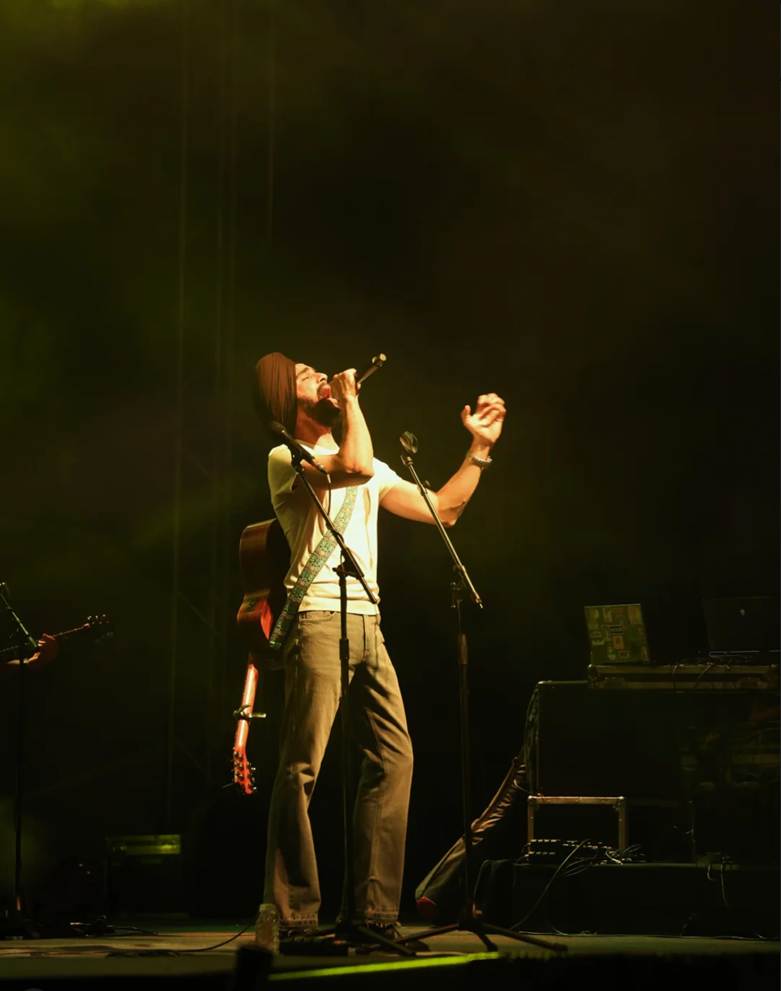
Every artist carries a chapter of struggle, and Navjot’s was long, demanding, and deeply formative. One of the biggest challenges he faced was building continuity as the best new indian singer songwriter in an era where musical collaboration is increasingly fluid.
For emerging singers, especially those trying to build with a band, consistency can be difficult. Instrumentalists today have more opportunities than ever to freelance and perform with multiple artists. While that growth is positive and well deserved, it can make things harder for singers who are still trying to establish a steady team and sound around their work.
For Navjot, one of the most difficult phases came during 2021 and 2022, when he was doing club shows almost every day. It was a period of relentless performance, but not always personal fulfillment. He was largely singing covers because clubs were not open to original songs that audiences did not yet know.
For a new Indian singer and songwriter, that can be a painful compromise. To perform constantly and still not have the freedom to share your own voice requires not just resilience, but restraint.
“Khat” and the Grace of Staying Unchanged
After 14 years of effort, Navjot’s new love song Khat became a defining milestone. Professionally, he acknowledges that the song changed how society viewed him as a musician. It strengthened his place in the public eye and altered his standing in meaningful ways.
Yet personally, he remains unchanged.
That is perhaps the most striking part of his story. Navjot says his routine is still the same. His calm is still the same. His writing process is still the same. He does not want success or failure to interfere with the purity of his art. For him, emotional detachment from public outcomes is essential because the moment an artist becomes too attached to validation, the writing begins to shift.
His joy comes not from numbers, but from the attempt. If he has tried to improve his skill today, if he has written his heart out more honestly than before, then he is at peace.
Growth, Not Glory, Remains the Real Goal
Even now, Navjot is not consumed by labels such as singles artist, performer, or digital success story. His focus remains deeply personal. He wants to sing better. He wants to play instruments better. He wants to understand himself more. And he wants to become a kinder person.
That is what makes Navjot Ahuja’s journey so moving. It is not simply the story of a musician finding recognition. It is the story of an artist who continues to grow inward, even as the world begins to look outward at him. In an age obsessed with applause, Navjot reminds us that the most meaningful success often begins in silence, honesty, and the courage to remain true to oneself.






