Hindi
‘Drishyam:’ A dull affair


MUMBAI: Drishyam belongs to a genre, which is tried very seldom. It is a thriller involving two families and, hence, can be termed a family thriller. The film can be likened to 36 Ghante (1974), inspired by Desperate Hours or Kanoon Kya Karega (1984), which in turn was a lift from Cape Fear (1964) and such.
The film was first made in Malayalam as Drishyam (2013) following the success and acclaim and awards, it was remade in Telugu as Drushyam in (2014) followed by a Tamil remake as Papanasam (2015).
The advantage of making Drishyam, despite it being a film for limited audience, is that it has a script that can be made very economically which the makers do while also cutting down on costs with its casting of non-celebrity performers. The fact that the film needs only two or three locations further curtail the making costs.

Ajay is an uneducated (4th fail) orphan who grows up doing odd jobs to finally start his own video cable network in a small town in Goa. Married with two daughters, one of whom is adopted, he is totally devoted to his family and their wellbeing. He would sacrifice his life for their sake if it came to that. As much as he may love his family, his love for movies comes first and he even stays back in his office to watch movies all night. While watching movies, his reactions are that of a typical front-bench audience. Yes, and that effect continues when he watches a Sunny Leone movie; he immediately wants to go home to his wife, Shriya Saran.
Ajay’s daughter, Ishita Dutta, has been shortlisted by her school to go on a camp for students from various schools. Here, another boy at the camp shoots her video while she is taking a bath. He starts blackmailing her and would delete the video only if she would let him have sex with her. He tells her to be prepared for him that night. All the pleading of Ishita fails to work as the boy is determined to have his way. When Shriya walks in to the outhouse to find his daughter with the boy and realises what is happening, she too pleads with the boy. His condition is that he would delete the video and spare Ishita if Shriya complies with his wishes instead.
While attempting to get the cell phone out of his hand Ishita picks up a rod to hit the boy on his hand but ends up fatally hitting him on his head. It is a rainy night but mother and daughter decide to get rid of the body instantly and bury it in a compost ditch dug by Ajay. Ajay has a habit of putting his landline off the hook so that his movie watching is not disturbed. The two have to wait till he returns.
 It is only after this stage that the film starts generating some interest as Ajay gets rid of the boy’s car and dispatches his cell phone to faraway places by dumping it on a transport carrier so that it could not be traced.
Now, not waiting for the car or cell to be discovered, he starts building alibis for himself and his family and also trains his wife and daughters to face the interrogation, which, he is sure, will be inevitable. After all, he may not be literate but the films he watches all night long have taught him a lot and it comes handy now in a kind of reverse version of Slumdog Millionaire.
Not long after, the boy’s car is found in a lake and the wheels start moving. The entire state police force is employed to find out details for, after all, a spoilt brat he may be, but he was the son of the director general of the state police, Tabu.
Ajay takes two days off with his family to create alibis involving totally unrelated people to the case: a restaurant owner, a bus conductor, a cinema projector operator etc and also makes his presence recorded at a bank ATM on the day the incident happened.
Finally, what points a finger at Ajay is a local cop who hates him and is keen to get back at him. He claims he saw Ajay drive away in the yellow car belonging to the missing boy. The family is summoned in Tabu’s presence. However, Ajay can prove his innocence as all witnesses created by him vouch for his being at their places respectively on the day of the incident. As a senior cop Tabu’s instincts tell her that what was going on was too good to be true but then, it also strikes her that the alibis were cleverly manipulated as an afterthought. But, Tabu’s belief can’t stand in court and she decides to use third degree to elicit a confession.
This is the last and interesting part, which is the final twist to the story bringing the film to a satisfactory end.
For a thriller, the film is too long drawn at 163 minutes. The first half is almost static just establishing Ajay’s two priorities: his family and his films. Though the direction good, the fact remains that the film has been made in three other languages earlier. There is nothing in the name of distractions or relief and, really, nobody of interest in the cast except Ajay; rest being unknown or little known faces. Even the so-called villain is a nondescript policeman; no strong villain, no strong hero. The songs are in the background and not of popular appeal. Editing needed to be much crisper. Dialogue is routine. Background score is good. Photography is apt.
It is a film about performances and on that count, most of the actors do well. Ajay, the vengeful cop Kamlesh Sawant, and the girl playing his younger daughter Mrinal Jadhav, excel. Ajay does not have to either show his muscles or raise a fist. Shriya and Ishita are good. Tabu playing the tough cop is okay. Rajat Kapoor is ornamental.
Drishyam has a limited appeal for a select audience with patience, which one is bound to have after paying high admission rates at high-end multiplexes, which is where Drishyam can expect to find its audience to some extent.
Producers: Kumar Mangat Pathak, Viacom 18 Motion Pictures, Abhishek Pathak.
Director: Nishikant Kamath.
Cast: Ajay Devgn, Tabu, Shriya Saran, Rajat Kapoor, Ishita Dutta, Kamlesh Sawant, Mrinal Jadhav.







Hindi
Zee5 and Applause Entertainment team up for whodunnit ‘Everybody Loves Sohrab Handa’
Rajat Kapoor directs star-studded murder mystery streaming from 10 April.
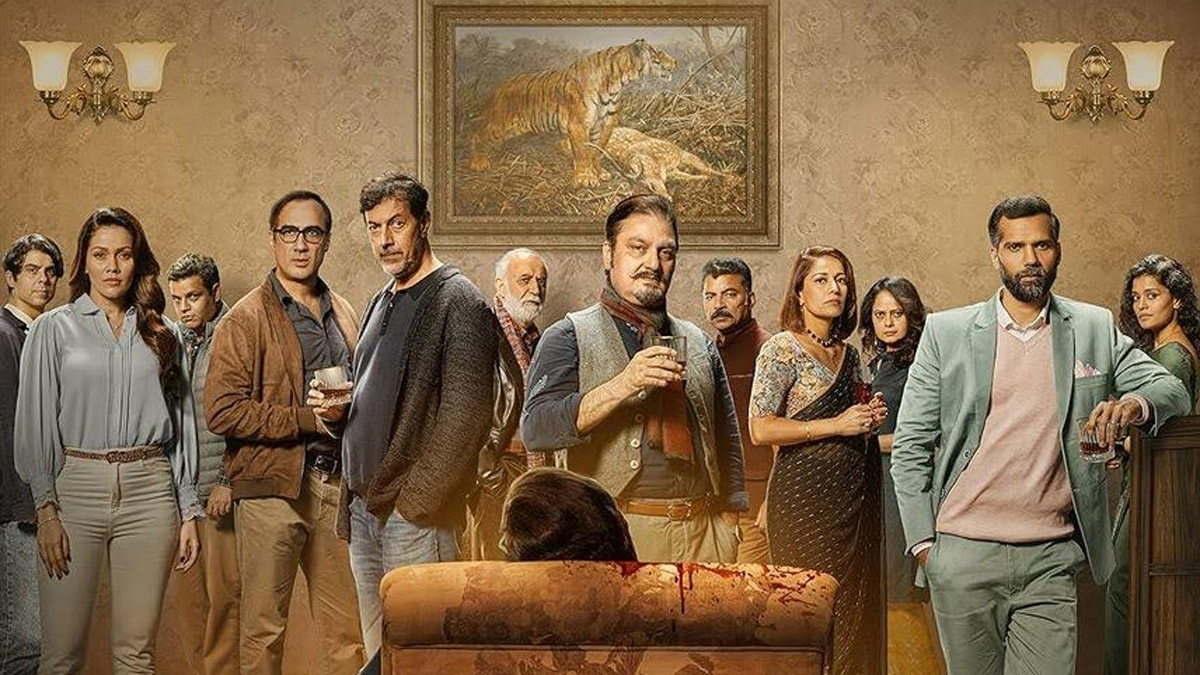
MUMBAI: Zee5 is serving up another killer collaboration and this time, the murder mystery comes with a generous side of dark humour and family dysfunction. The streaming platform has partnered with Applause Entertainment and Mithya Talkies to bring Everybody Loves Sohrab Handa, a fresh, twisted whodunnit written and directed by acclaimed filmmaker and actor Rajat Kapoor. The film will stream exclusively on Hindi Zee5 from 10 April.
The movie reimagines the classic murder mystery genre with a contemporary, darkly comic edge. It revolves around a group of friends and family who smile, drink, and celebrate together until the silence snaps and long-buried secrets spill out. The stellar ensemble cast includes Vinay Pathak, Ranvir Shorey, Waluscha De Sousa, Saurabh Shukla, Chandrachoor Rai, Neil Bhoopalam, Koel Purie, Palomi Ghosh, and Rajat Kapoor himself.
This latest offering continues the successful partnership between Zee5 and Applause Entertainment, which has previously delivered diverse hits such as Mithya, Bloody Brothers, and Jab Khuli Kitaab.
&TV Business Head of hindi Zee5 and chief channel officer Kaveri Das said, “Our collaboration with Applause Entertainment has consistently delivered distinct, high-impact storytelling. Everybody Loves Sohrab Handa is a natural progression, reinforcing our focus on genre-led content with a compelling whodunnit premise and a strong ensemble cast.”
Applause Entertainment business head for movies Sunil Chainani added, “This film adds yet another compelling layer to our slate with Rajat Kapoor’s unmistakable voice.”
Rajat Kapoor shared, “What interested me was not just the mechanics of a whodunnit, but the emotional violence that precedes physical violence. These are people who smile at each other, but there’s so much that is not said.”
The film promises razor-sharp writing, layered performances, and simmering tension, inviting viewers not just to solve the crime but to unravel the complex relationships at its heart.
If you love a good murder mystery served with wit and emotional depth, Everybody Loves Sohrab Handa looks set to be your next addictive watch. Mark your calendars, the whodunnit drops on Hindi Zee5 from 10 April.






