Hindi
DIFF results announced

MUMBAI: The Dubai International Film Festival which closed yesterday announced the results of the Dubai Film Connection (DFC). DFC selected 15 filmmakers to consult and strategise three days with sales agents, producers and major broadcasters.
Three winning projects were awarded USD 15 000 each. These projects as well as one special mention will be invited to attend the prestigious 2008 Cannes Producers Network: Amreeka, by Canadian-Palestinian filmmaker Cherien Dabis, Man Without a Cell Phone, a satire about Palestinian Israelis by Sameh Zaobi, and One Man Village, a film about healing and reconciliation in Lebanon by Simon el Habre.
Special Mention went to Ziad Doueiri’s Man in the Middle, a thrilling story about Israeli-Palestinian peace talks. A 5000 Euro prize from French broadcaster Arte went to Fix Me, a meditation on mental health and conflict by director Raed Andoni.
The Muhr Awards competition was expanded this year, and included films from all over the Middle East. Masoud Amralla al Ali, DIFF’s Artistic Director and Coordinator General of Competition, said: “This year our jury had difficulty choosing winners because of the superlative quality of most of the submissions, both from a story and production value standpoint. We intend for the Muhr Awards to instigate the production of more Arabic films in the region. The Middle East is full of creativity, and our roster of winners proves that unequivocally.”
The prizes for Short Films were as follows: Bronze went to El Ezz (Garbage), by Tunisian director Lotfi Achour, which depicts a lonely night watchman in love with his neighbour. UAE film Haresat al Ma’a (The Water Guard), from director Waleed al Shehhi, won Silver, and Sarah, by Belgian director Khdija Leclere, won Gold.
The Bronze Muhr for Documentary went to journalist, writer and filmmaker Nassri Hajjaj’s Dhil al Gheyab (Shadow of Absence), about Palestinian anxiety about what Hajjaj calls ‘the site of burial.’ Silver went to Palestinian director Buthina Canaan Khoury for Magharat Maria (Maria’s Grotto), which explores honour killing in Palestine. The Gold Muhr went to Karim Goury’s stylistically unusual Soneaa fi Masr (Made in Egypt), which follows a Frenchman as he searches for his Egyptian roots.
The winning feature films covered a broad swathe of the Middle East: Bronze feature La Graine et le Mulet (The Secret of the Grain) was directed by Abdellatif Kechiche, a Tunisian actor and set in France. The comedic Akher Film (Making Of), in which Tunisian director (who has directed Abdellatif Kechiche in previous films) Nouri Bouzid plays himself in a film depicting a film shoot in danger of being interrupted by the American invasion of Iraq, won Silver. The film also took away the Best Composer award for Nejib Charradi.
The Gold Muhr was won by Taht el Qasef (Under the Bombs), which explores interfaith love in Southern Lebanon between a Shia woman and a Christian man. Filmmaker Phillippe Aractingi reacted to the 2006 war by commencing filming in July, in the heat of the bombings. Under the Bombs also won a Best Actress Muhr for Nada Abou Fahat, who played Zeina, the Lebanese Shi’a woman who rushes into the war zone to save her son.
Best Actor went to UK-based Jordanian actor Nadim Sawalha for his role in Captain Abu Raed, where he plays an airport janitor who befriends a group of children in his poor neighbourhood.
Lebanese filmmaker Borhane Alaouie’s Khalass took away two awards: the Best Screenplay award for Alaouie himself and Best Editor Award for France Duez. Best Cinematographer went to Pierre Boffety for his photography of Burnt Hearts.
In the section of the Muhr Awards that recognizes Emirati talent, three awards were presented. The prize for Best Emirati Talent went to Mohammed Saeed Harib, creator of the Freej series. Best Emirati Female Filmmaker was presented to Nayla Al Khaja, and Best Emirati Filmmaker went to Ali Mostafa.

Hindi
Remembering Gyan Sahay, the lens behind film, television and advertising
From a puppet rabbit selling poppadums to Hindi cinema, he framed it all.
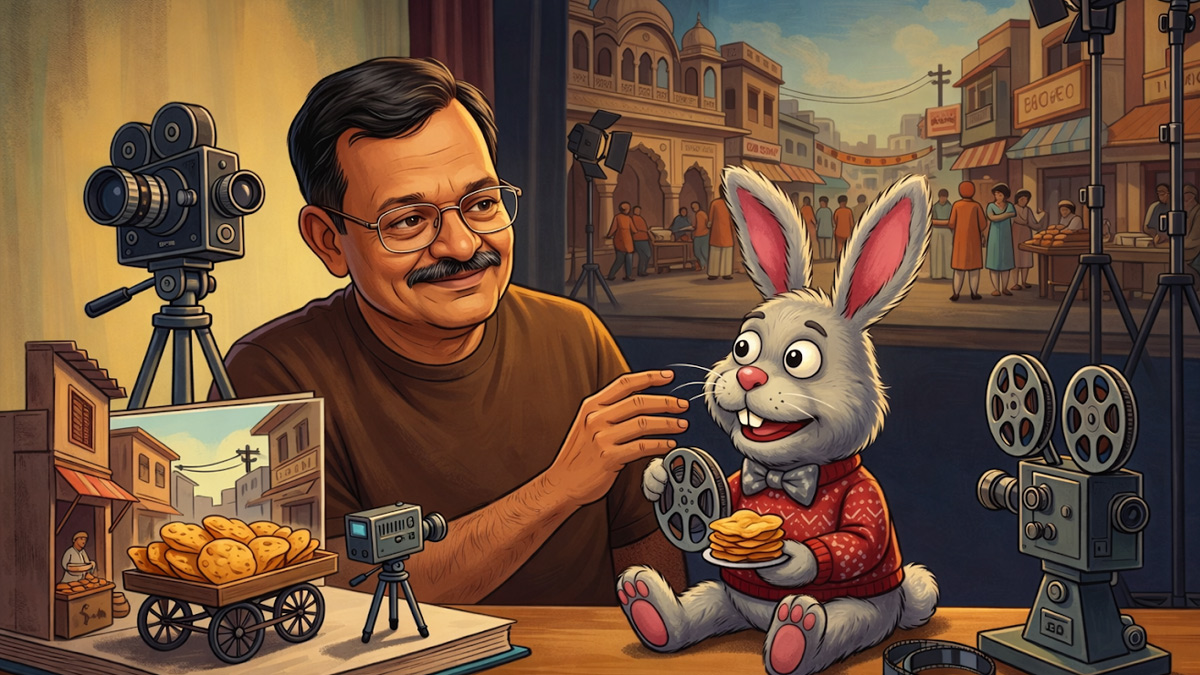
MUMBAI: There are careers, and then there are canvases. Gyan Sahay, the veteran cinematographer, director, and producer who passed away on 10 March 2026 in Mumbai, had one of the latter. Over several decades in the Indian film and television industry, he turned lenses, lights, and the occasional puppet rabbit into something approaching art.
A graduate of the Film and Television Institute of India (FTII) in Pune, Sahay built his reputation as a director of photography across a career that stretched from the early 1970s all the way to the digital age. He was the kind of craftsman who understood that a well-composed shot is not merely a technical achievement but a quiet act of storytelling.
For most Indians of a certain age, however, Sahay will forever be the man behind the rabbit. His direction of the iconic long-running television commercial for Lijjat Papad, featuring its now-legendary puppet bunny, gave the country one of its most cheerfully persistent advertising images. It was the sort of work that sneaks into the national subconscious and takes up permanent residence.

His big-screen credits as cinematographer include Anokhi Pehchan (1972), Pagli (1974), Pas de Deux (1981), and Hum Farishte Nahin (1988). In 1999, he stepped behind a different kind of camera altogether, making his directorial debut with Sar Ankhon Par, a drama that featured Vikas Bhalla and Shruti Ulfat, with a cameo by Shah Rukh Khan for good measure.
On television, Sahay was particularly prized for his command of multi-camera production setups, a skill that made him a go-to technician for large-scale shows and reality programmes. In an industry that has never been especially patient with complexity, he was the calm hand on the rig.
In later life, Sahay turned teacher. He participated regularly in masterclasses and Digi-Talks, often hosted by organisations such as Bharatiya Chitra Sadhna, sharing hard-won wisdom on cinematography, the comedy of timing in a shot, and the sweeping changes brought by the shift from celluloid to digital. He was also said to have been involved in a project concerning a biographical film on Infosys co-founder N.R. Narayana Murthy.
Tributes from the film industry poured in following the news of his passing, with colleagues remembering him as a senior cameraman who served as a rare bridge between two entirely different eras of Indian cinema. That is, perhaps, the finest thing one can say of any craftsman: he kept up, and he brought others along with him.