Hindi
‘Detective Byomkesh Bakshy!’: Lacks twists & turns; is slow

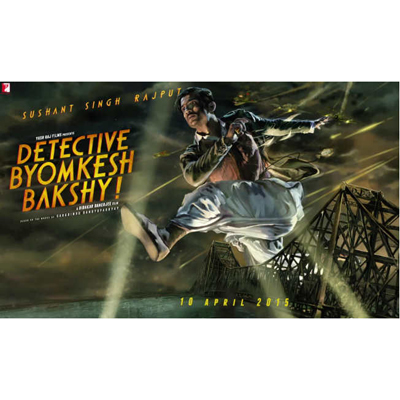
MUMBAI: As is apparent from the name, Detective Byomkesh Bakshy! falls in the detective genre, the kind that has not been tried in some time. Set in WW II Calcutta of 1942, it can be termed as a period detective saga. It is based on the famous detective character, Byomkesh Bakshy, created by writer Sharadindu Bandopadhyay, which has been made into many TV and movie versions.
Sushant Singh Rajput, who plays Byomkesh, is just finishing his college and is uncertain about his future plans. Anand Tiwari, a batch mate, learns that his father has gone missing and he asks Sushant to help find him.

Sushant has this knack for observing and making logical deductions. Sushant refuses to help saying his father may have committed some crime and vanished. This earns him a slap from Anand.
However, Sushant gets back to Anand and agrees to help him. He starts with checking in into the same guest house, Anukul Lodge. This where Anand’s father also stayed and from where he had gone missing. Sushant is an accidental detective and he beats around the bush, looking for clues everywhere. His suspicion hovers around a suddenly shut down chemical factory owned by a politician from where, finally, Anand’s father’s dead body is recovered.
The politician is booked but even while the DCP is interrogating him, it strikes Sushant that the politician is being framed. On his word, the DCP lets him go. The trial and error method of detecting continues while the truth is right around Sushant as he searches far and wide.
The plot thickens as the theme expands its scope from a murder of a chemistry scholar to heroin to the local politics to free the country to a plot to pave the way for the entry of Japanese troop through the river Ganga!
There is also a conflict between a Chinese drug dealer and a presumed dead rival who has hijacked tons of heroin of the Chinese.
After all this detective work done by Sushant, the film is taken to its conclusion in a traditional way by collecting people concerned under one roof. The culprit being one of them is a given. As happens in all detective stories, Sushant takes to retelling the plot, laying bare the intentions of culprit and who it is. How you wish you were told this an hour earlier.
The problem with Detective Byomkesh Bakshy! is that it is too slow and lacks the twists and turns and red herrings that such a story needs. It therefore has no grip. The script needed to be tight. Visually too it is drab with indoor scenes being dimly lit while outdoor ones are dulled even more with smoke added for effect.
While the background score is effective, songs are chosen keeping the period in mind and, hence, lack appeal to today’s listener.
What lands some relief to the viewer is Sushant’s pleasant outlook (which other regional actors don’t quite have). Of the women, Swastika Mukherjee brings some oomph though as a performer she has limits. Anand is good and so is Divya Menon despite getting a limited exposure. Meiyang Chang is a good addition to character artistes. The one who impresses is Neeraj Kabi (who also threatens a sequel at the end).
Detective Byomkesh Bakshy! is slow and offers nothing to recommend it.
Producers: Aditya Chopra, Dibakar Banerjee
Director: Dibakar Banerjee
Cast: Sushant Singh Rajput, Anand Tiwari, Neeraj Kabi, Divya Menon, Swastika Mukherjee, Meiyang Chang, Mark Bennington, Takanori Kikuchi, Shivam, Dr Kaushik Ghosh, Anindya Banerjee, Arindol Bagchi, Peter Wong, Pradipto Kumar Chakraborty, Manoshi Nath, Moumita Chakraborty, Tirtha Mallick, Prasun Gain, Aryann Bhaumik, Prashant Kumar & Nishant Kumar, Shaktipada Dey, Sandip Bhattacharya, Piyali Ray.







Hindi
Dhurandhar 2 hit by YouTube leak amid record box office run
Cam-rip surfaces online but blockbuster streak continues at record pace

MUMBAI: It has been a dramatic week for Dhurandhar: The Revenge. Even as the espionage thriller smashes box office records, a piracy scare briefly threatened to steal its thunder after a full-length version surfaced on YouTube.
The leak emerged on March 30 via a channel titled “A2z movie”, which uploaded what appeared to be a cam-recorded print of the film. Clocking in at nearly three hours and 49 minutes, the footage was reportedly blurry but complete enough to spark spoilers and fan outrage online.
Soon after, users on X began flagging the issue, explicitly naming the “A2z movie” channel in their posts while tagging the film’s makers and urging swift legal action. Fans of director Aditya Dhar and lead star Ranveer Singh were particularly vocal, helping the issue gain rapid traction.
Within hours, the video was taken down, likely through a mix of platform detection systems and intervention by producers Jio Studios and B62 Studios.
Despite the leak, the film’s theatrical run remains virtually unshaken. As of March 31, the sequel has raked in an estimated Rs 872.17 crore net in India, with worldwide collections soaring to Rs 1,392.23 crore. Its Hindi opening day alone brought in Rs 102.55 crore, setting a new benchmark.
In a notable milestone, the film has matched Pushpa 2 as the fastest Indian release to cross the Rs 1,000 crore mark globally, achieving the feat in just seven days.
Interestingly, the version leaked online is believed to be an earlier cut. Midway through its theatrical run, the makers issued revised prints after eagle-eyed viewers spotted a fleeting editing error involving a cameraman’s reflection. The corrected version now plays across cinemas, adding an unusual twist to the film’s release journey.
Directed by Aditya Dhar, the high-stakes sequel stars Ranveer Singh alongside Sanjay Dutt, R. Madhavan, Arjun Rampal and Sara Arjun. The film has drawn praise for its scale and action sequences, though some critics have pointed to its intense violence and layered political themes.
For now, piracy may have made noise, but it has not slowed the juggernaut. If anything, the episode underlines the film’s cultural grip, proving that even a leak cannot derail a box office storm already in full force.