Hindi
‘Antaheen’ gets national award for best film, Hindi bags maximum awards

MUMBAI: Bengali film Antaheen, directed by Aniruddha Roy Chowdhury, got the best feature film while AFSPA 1958 by Haabam Paban Kumar was named the best non-feature film for 2008.
Bala, who directed the Tamil film Naam Kadauul, was named best director while Upendra Limaye and Priyanka Chopra got the best actor and actress awards for Jogva (Marathi) and Fashion (Hindi) respectively in the 56th National Film Awards announced in Delhi. Shams Patel won the best child artiste award for the film Thanks Maa in Hindi.
Dibakar Banerjee‘s Oye Lucky! Lucky Oye! won the most popular movie award while K M Madhusudhanam‘s Malayalam film Bioscope won a special jury award.
The awards will be given away in March by President Pratibha Devisingh Patil.
Hindi films continued to dominate the feature films with as many as 13 awards while Marathi films got six (five for one film Jogva by Rajeev Patil) and Bengali films got five (four for Antaheen which had also featured in the Indian Panorama at the last International Film Festival of India at Goa). Tamil films got three awards, followed by Assamese, Malayalam, and Kannada films with two each. English, Kokoborok, Tulu, and Oriya got one award each. The best film on family values award went to a bilingual English-Gujarati film Little Jijou, by Sooni Tarporevala.
Bollywood Melodies by Ganesh Anantharaman got the award for the best book on cinema while the book “The Director’s Mind” by Ujjal Chakraborty got a special mention. Assamese critic Altaf Mazid and Manipuri critic R K Bidur Singh shared the best film critic award.
The Indira Gandhi award for the first film of a director went to Neeraj Pandey for his gripping Hindi thriller A Wednesday while the Nargis Dutt Award for the best feature on national integration was taken by Assamese film Aai Kot Nai by Manju Borah.
Interestingly, Roadside Romeo by Jugal Hansraj,a film produced by the Indian subsidiary of a foreign production house – Walt Disney- got an award for best animation film while Land Gold Women, a film on honour killings in the United Kingdom made by a British-based Indian, Avantika Hari, got the award for best English film.
The Marathi film Jogva by Rajeevi Patil got five awards: best film on social values (age old social customs), actor Upendra Limaye, male playback singer Hariharan, and music direction by Ajay and Atul. Playback singer Shreya Ghoshal won the award for both ‘Jogva’ as well as Antaheen.
Antaheen also received awards for cinematography by Avik Mukhopadhyay, and lyrics by Anindya Bannerjee and Chandranil Bhattacharya.
Fashion also received the award for supporting actress Kangana Ranaut.
Nandita Das‘ Firaq won two awards: editing by A Sreekar Prasad who had until now won the largest number of national awards for any single film editor, and art direction by Gautam Sen. The monumental Jodha Akbar by Ashutosh Gowarikar won awards for costume design by Neena Lulla and choreography by Chinni Prakash and Rekha Prakash. Abhishek Kapoor‘s Rock On won the Best Hindi film award as well as the supporting actor award for Arjun Rampal.
The Feature Film Jury was headed by famed filmmaker Shaji N Karun. Other members were Roshan Taneja, HM Ramachandra, Nagma, Satyabrata Kalita, Neelakanta, Dilip Ghosh, Swapan Mullick, Sudesh Syal, SK Srivastava, Archana, B Shashi Kumar, Subhash Sehgal, Santosh Desai and Sreelekha Mukherjee. They adjudged 126 entries.
The non-feature jury headed by Arunaraje Patil with Krishnendu Bose, Anirban Dutta, Sandeep Marwah, RV Ramani, Sarfaraz Siddiqui and Reena Mohan as members saw 99 films.
The Jury on Best Writing on Cinema headed by Sunil Gangopadhyay, with Sudhish Pachauri and Ziya-us Salam as members considered 20 book entries and 17 critics.
Other awards were: Jianta Bhoota in Oriya by Prashanta Nanda for environment conservation, Gubbachigalu by Abhaya Sinha as the best children’s film, Moorthy V as make-up artist for the Tamil Naam Kadauul, Govardhan for special effects in the Hindi Mumbai Meri Jaan, and the Marathi film Gandha which won awards for screenplay for Sachin Kundalkar and audiography for Pramod J Thomas.
The other regional language awards went to: Assamese – Mon Jai by M Maniram; Bengali – Shob Charitro Kalponik by Rituparno Ghosh; Kannada – Vimukthi by P Seshadri; Malayalam – Thirakkada by Ranjith; Marathi – Harishchadrachi Factory by Paresh Mokashi; Tamil – Veranam Airam by Gautam Vasudeva Menon; Telugu – 1940 Lookagramam by Narasimha Nandi, Kokborok – Yarwng by Joseph Pulinthanath, and Tulu – Gaggara by Shivadhwaj Shetty.
In non-features, the Best Direction Award went to Umesh Kulkarni for his work Three of Us which also received the award for Cinematography by Sharqva Badar Khan.
Additionally, the special jury award has gone to Rajesh S Jala’s Children of the Pyre which also gets the audiography award for Mateen Ahmed.

Hindi
Dhurandhar the revenge storms past Rs 1,000 crore in a week, rewrites box office records
Aditya Dhar’s spy thriller sets fastest run to Rs 1,000 crore with record-breaking weekday hold
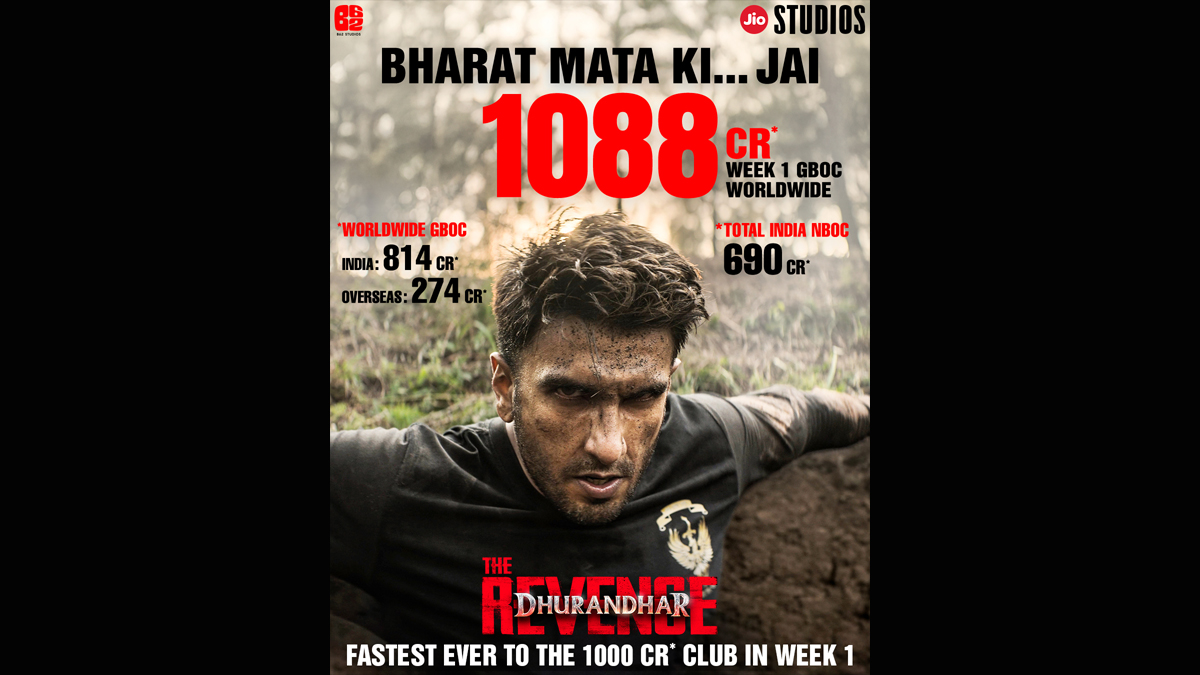
MUMBAI: The box office has a new juggernaut—and it is moving at breakneck speed. Dhurandhar the revenge has smashed past the Rs 1,000 crore mark worldwide in just a week, clocking a staggering Rs 1,088 crore and resetting the rules of the blockbuster game.
Backed by Jio Studios and B62 Studios, and directed by Aditya Dhar, the spy action sequel opened to the biggest weekend ever for an Indian film globally—and then refused to slow down. Unlike typical tentpole releases that taper off after Sunday, this one powered through the weekdays with rare muscle, posting Rs 64 crore on Monday, Rs 58 crore on Tuesday, Rs 49 crore on Wednesday and Rs 53 crore on Thursday.
The numbers stack up to a formidable first-week haul. India collections stand at Rs 690 crore nett and Rs 814 crore gross, while overseas markets have chipped in Rs 274 crore, taking the worldwide total to Rs 1,088 crore in just eight days.

The film’s opening weekend alone delivered Rs 466 crore, laying the foundation for what is now being billed as the fastest climb to the Rs 1,000 crore club in Indian cinema. Every single day of its first week has set fresh benchmarks, from the highest opening weekend to the strongest weekday hold—metrics that typically separate hits from phenomena.
A sequel to the earlier hit Dhurandhar, the film has not just built on its predecessor’s momentum but obliterated previous records, emerging as the biggest global blockbuster run by an Indian film to date.
At this pace, the film is not merely riding a wave—it is creating one.