AD Agencies
Zyler.ai unveils smart marketing analytics for the post-cookie era


MUMBAI: Zyler.ai, has officially launched its innovative marketing analytics platform, designed to help businesses navigate the impending cookie-less digital landscape. With Google set to phase out third-party cookies by early 2025, Zyler.ai provides a cutting-edge alternative, enabling marketers to gain insights without relying on increasingly restricted tracking technologies.
Marketers currently juggle multiple analytics platforms, spending over six hours per week managing complex dashboards. Zyler.ai streamlines this process, consolidating various data sources into a single, intuitive interface powered by AI-driven analysis.
Zyler.ai growth lead & co-founder, Suryansh Jaiswal stated, “With 63 per cent of marketers lacking a clear strategy for a cookie-less future, businesses need solutions that are both simple and effective, without relying on intrusive tracking. Our platform reduces analytics effort and costs by up to 98 per cent, making advanced insights accessible to all, regardless of technical expertise.”

Zyler.ai offers a suite of powerful features to simplify marketing analytics. Its one-click AI analysis enables users to generate insights instantly from multiple data sources without complex configuration. The unified dashboard integrates data from Google Analytics, Meta Ads, LinkedIn, and other platforms, consolidating key metrics into a single, user-friendly interface. First-party data optimisation helps businesses maximise their owned data sources as third-party cookies are phased out, ensuring seamless continuity in analytics. Contextual Analysis shifts the focus from user-specific tracking to performance themes and topics, aligning with evolving privacy standards. Additionally, the platform’s self-serve integration allows users to connect data sources within minutes without requiring technical expertise.
Since its soft launch, Zyler.ai has seen rapid global adoption, attracting users from dozens of countries across six continents without major marketing expenditure. The platform’s debut on Product Hunt ranked in the top 10, highlighting strong interest from the digital marketing and analytics community.
Operating on a freemium model, Zyler.ai offers full-featured access at 79 pounds per seat, significantly undercutting enterprise alternatives that start at over 800 pounds per month.
As businesses brace for Google’s 2025 cookie deprecation, the need for alternative analytics solutions has never been greater. Zyler.ai addresses this challenge by focusing on actionable insights rather than data tracking.







AD Agencies
Kevin Vaz opens FICCI-EY report with a declaration: India’s M&E industry set to breach Rs 3 trillion mark by 2027
In a keynote address at the FICCI-EY report launch, Kevin Vaz says sport, AI and the connected TV boom are driving a multi-screen revolution with no signs of slowing
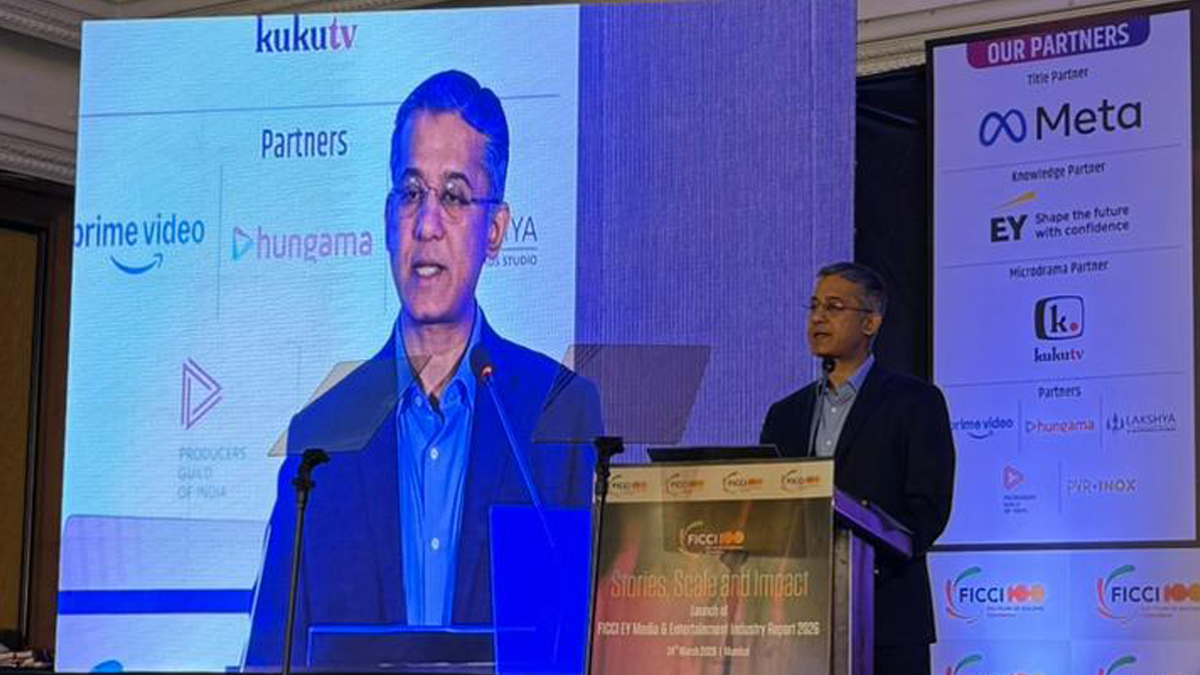
MUMBAI: India’s media and entertainment industry is growing faster than the economy, reshaping global benchmarks and is on course to blow past Rs 3 trillion by 2027. That was the headline message from Kevin Vaz, chairman of the FICCI Media and Entertainment Committee and chief executive of entertainment at JioStar, who delivered the opening keynote at the launch of the FICCI-EY Media and Entertainment Report 2026 in Mumbai on Monday. He did not waste much time on caveats.
The industry hit Rs 2.78 trillion in 2025, outpacing GDP per capita growth and surpassing even last year’s bullish forecasts. Vaz described the year in three words: scale, convergence, transformation. The numbers, he suggested, were only half the story. The other half was how that growth was happening.
Digital has become the industry’s largest segment, driven by advertising, subscriptions and commerce. But Vaz was quick to puncture the familiar narrative of digital killing everything else. India, he argued, is not an either-or market. It is an AND market. Connected TV is surging. Linear television, mobile, films and print are all still expanding. AVGC, the animation, visual effects, gaming and comics sector, is emerging as a serious growth engine, opening new storytelling formats and new global revenue streams. Nothing, he said, is replacing anything. Everything is reinforcing everything else.
Nowhere is that more vivid than in sport. In an on-demand world where audiences can watch anything, anytime, Indians still show up live. “Sports don’t fragment audiences,” Vaz said. “They unite them, just on different screens.” The ICC Men’s T20 World Cup 2026 made the point emphatically. During the final, JioHotstar delivered 72.5 million concurrent streams, a global record. Group chats exploded. Families renegotiated control of the television. Advertisers, Vaz noted with undisguised relish, stopped asking where audiences were and started asking how fast they could get in.
Cinema had its own landmark year. More than 1,900 films were released, with several crossing the Rs 1 billion mark. Dhurandhar was singled out as proof that Indian audiences will still turn up in large numbers for content that grips them. Live experiences, too, are getting bigger and more immersive, though Vaz suggested the surface has barely been scratched.
Then there is artificial intelligence, which he described as quietly, and sometimes not so quietly, reshaping everything. AI is enabling personalisation, efficiency and scale, but Vaz argued its deeper significance lies in what it is doing to creativity itself. He pointed to Mahabharat: Ek Dharmayudh, billed as the world’s first AI-produced show, as evidence that the technology can amplify creative ambition rather than hollow it out. He also used the platform to call on Indian policymakers to engage seriously with the creative industry on AI and copyright, ensuring that creators are fairly compensated as the technology spreads.
The picture that emerges from the report, and from Vaz’s keynote, is of an industry that has stopped thinking of itself as a fast-growing emerging market and started thinking of itself as a global template. Scale, diversity and innovation, he said, are no longer in tension in India. They are coexisting, and the rest of the world is taking notes.
The Rs 3 trillion milestone is two years away. As the man who chairs the committee that shapes the industry’s policy agenda and runs the country’s most powerful entertainment platform, Vaz set the tone for the day with characteristic directness: India’s media business is not just chasing growth. It is deciding what the country talks about at dinner. That is a different kind of power altogether.








