MAM
ZenithOptimedia predicts global ad spend to grow by 5.3 per cent in 2014

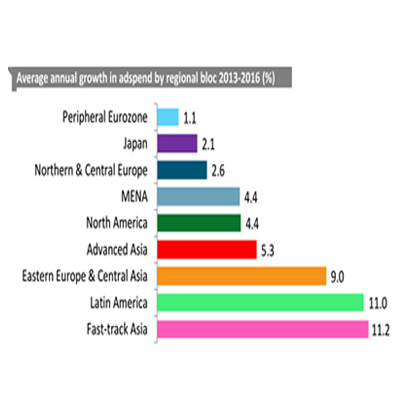
MUMBAI: Global advertising expenditure is expected to grow by 5.3 per cent to $ 532bn, according to a report from media agency ZenithOptimedia.
The agency has increased its forecast for 2014 by 0.2 percentage points since September, after recent signs of stronger growth from markets like the US, the UK, Germany, Hungary, Poland, Australia and Mexico, together with evidence that Spain’s steep downturn is finally bottoming out.
Interestingly, this is the second time that the agency upgraded its expectations for 2014 this year, the first was in June (from 5.0 per cent to 5.1 per cent). In fact, for the year 2015, it expects the global ad market to accelerate to 5.8 per cent, followed by another year of 5.8 per cent growth in 2016.

As part of its global analysis, the agency has also included Ireland in the so-called Peripheral Eurozone category. It assumes that the growth for these countries will be somewhat more muted.
The agency says that in Europe, it has separated the ‘PIIGS’ markets (Portugal, Ireland, Italy, Greece and Spain), which have faced the full brunt of the Eurozone crisis, into the Peripheral Eurozone. “Their ad markets have fallen even more sharply than their economies, as local advertisers cut back to reduce losses and preserve cash, and multinationals withdraw budgets to redeploy in more economically healthy regions. We estimate that ad expenditure in Peripheral Eurozone fell by 11.1% in 2013. 2014 looks a lot better, with ad expenditure forecast to shrink by just 0.9%, followed by a slow recovery of 1.8% growth in 2015 and 2.5% growth in 2016. This assumes that the Eurozone avoids disaster over our forecast period, and in particular assumes that no country crashes out of the euro, or falls into disorderly default on its debts,” says the report.
The report also reveals that the rest of Western Europe, as well as Central European countries like the Czech Republic, Hungary and Poland, which are currently performing more like countries such as France, Germany or the UK than the much-faster growing markets of Eastern Europe, such as Russia and Ukraine. “This is partly because many of these Central European markets are in the Eurozone, and because they have strong trading links with Zenith Optimedia Group Limited,” it says.
As far as the Asian market is concerned, the agency has divided it in to four parts – Japan, Eastern Europe and Central Asia, Advanced Asia and Fast-track Asia.
The report says that the Eastern European advertising markets, such as Russia and Ukraine, recovered quickly after the 2009 downturn and have since continued their healthy pace of growth, largely (though not entirely) unaffected by the problems in the Eurozone. “Their near neighbours in Central Asia, such as Azerbaijan and Kazakhstan, have behaved very similarly, so we have gathered them together under the Eastern Europe & Central Asia bloc. We expect this bloc to have grown 11.7% by the end of 2013, followed by 8%-10% growth for the rest of our forecast period,” it says.
The agency has kept Japan separate as the market behaves differently from the other markets in Asia. Even after the recent economic stimulus, Japan remains stuck in its rut of persistent low growth and grew 2.1 per cent in 2013. The agency estimates the growth rate of the country to remain at 2 per cent per year through to 2016.
Apart from Japan, there are five countries in Asia with developed economies and advanced ad markets and thus they are categorised as “Advanced Asia”. It includes Australia, New Zealand, Hong Kong, Singapore and South Korea. The report reveals that growth here has been a disappointing 1.3 per cent in 2013, after a period of heightened tension between North Korea and its neighbours caused advertisers in South Korea to cancel or postpone several campaigns. “We forecast a much healthier 4.5 per cent growth in 2014, followed by 6.6 per cent growth in 2015 and 4.8 per cent growth in 2016,” says the agency in the report.
Fast-track Asia includes countries like China, India, Indonesia, Malaysia, Pakistan, Philippines, Taiwan, Thailand and Vietnam as these economies are growing extremely rapidly as they adopt Western technology and practices. This group barely noticed the 2009 downturn (ad expenditure grew by 7.2 per cent that year) and since then has grown comfortably at double-digit rates. We estimate that ad expenditure in Fast-track Asia has grown 10.7 per cent in 2013, followed by 10 per cent to 12 per cent annual growth in 2014 to 2016.






Digital
GUEST COLUMN: How AI is restructuring distributor and retailer motivation models
From incentives to intelligence, AI is redefining how brands engage channel partners

MUMBAI: Artificial intelligence is rapidly transforming how brands engage with their most critical yet often overlooked stakeholders: distributors, retailers, and last-mile influencers. For Abhinav Jain, co-founder and CEO of Almonds Ai, this shift marks a fundamental departure from traditional, transaction-led incentive models toward behaviour-driven, data-intelligent ecosystems. In this piece, Jain examines how AI is enabling brands to decode partner motivations, predict engagement patterns, and deliver personalised, scalable experiences—ultimately redefining channel relationships from transactional exchanges to long-term growth partnerships.
Across many sectors, there is increasing recognition that motivating those who bring products to market (distributors, retailers, last-mile influencers) poses a growing challenge.
Brands continue to invest significant marketing and digital resources to consumers, yet in many countries and the vast majority of emerging economies, these types of consumer-focused investment areas have had little impact on ultimate product delivery. Rather, it is still the case that traditional retail continues to make up most products sold.
So why is it that the systems built around motivating these channels have yet to evolve?
For decades, distributor and retailer engagement revolved around static schemes – quarterly targets, volume-based rewards, and occasional trade promotions. These programs were designed around transactions, not behaviour. The assumption was simple: if incentives increase, performance will follow.
Now, with the advent of artificial intelligence, the definition of performance is being challenged.
With the development of artificial intelligence, businesses can move beyond simply creating loyalty based on transactional-based models and toward models built on behaviours, the behaviours of channel partners that are intrinsic to their motivations in engaging with particular brands. As a result, the means by which businesses develop relationships within their distribution network are starting to evolve; thus, ultimately changing how brands interact with those within their distribution network.
Assessing engagement: Transitioning from transactional- to behavioural intelligence
Traditional loyalty systems refer to transactional activity (sales data). Although this data is valuable and important, it only provides a partial view of engagement across the channel partner.
For example, a retailer may have a high frequency of sales of a product, but their lack of engagement with the manufacturer would not reflect that they have true loyalty toward that brand. Conversely, a retailer who actively participates in training programmes, acts as brand advocates, and is engaged in learning with the supplier would exhibit more profound levels of loyalty but would have been invisible based on historical incentive programmes.
Artificial intelligence allows for the identification of behaviours that help to address this gap. Brands are able to use a variety of engagement data points, participate in learning programs, respond to communications, redeem behaviour and track platform use behaviour in order to identify motivation through behaviour.
McKinsey has stated that companies that leverage advanced analytics for their sales and distribution functions can achieve as much as a 15-20 per cent increase in productivity due to increased awareness of their behavioural trends throughout their networks.
This visibility of behavioural patterns within channel ecosystems can be transformational to brands as they can now view how partners engage on their path to purchasing products, instead of just measuring the sales revenue generated by those purchases.
Predicting motivations, not just measuring performance
Possibly, the largest contribution of Artificial Intelligence (AI) to helping brands engage with partners via channel ecosystems is its ability to predict future engagement versus simply measuring past performance.
Traditionally, brands only realised that a partner was disengaged (not likely to purchase products) once their sales performance had already declined. By then, the brand would have to use significant amounts of incentives or aggressive promotional activities to recovery their partner’s engagement level.
AI models can help organisations to detect early signs that a partner is becoming disengaged, such as declining participation in learning modules, declining interaction via the platform, or slower reward redemption rates. These indicators can help organisations to proactively engage with their partners before their sales performance begins to decline.
The practical application of AI and predictive analytics gives brands the ability to re-engage with their partners prior to their sales performance declines. For example, instead of developing and implementing broad-reaching incentive programs that provide a “one size fits all” incentive to all partners in an ecosystem, brands are able to develop targeted, engaging re-engagement programmes. This is how personalisation can be done on a large scale, such as across global distribution and retail networks.
The vast majority of distributor and retailer channels have thousands, if not millions, of individual channel partners. Historically, providing personalisation to such a large number of businesses has not been feasible.
However, with the advent of AI, personalisation at scale is becoming a reality.
Brands can now create tailored engagement journeys for all their partners, based on their partner profiles, through some combination of machine learning models and behavioural segmentation. For example, high-performing distributors might receive higher levels of leadership-based recognition and greater incentives to continue to grow. Emerging retailers, on the other hand, might be supported with training, onboarding rewards, and measurable performance milestones.
The shift towards personalisation of partner engagement echoes the direction that consumer marketing is already moving towards.
According to Salesforce’s report, over 70 per cent of customers expect personalisation in the way that brands engage with them. As such, there is a growing expectation for B2B ecosystems to have these same types of expectations from their channel partners.
Gamification and continuous engagement
AI is also radically changing how brands will engage with their channel partners through the use of gamification.
Many traditional incentive-based contests and leaderboards would spark temporary engagement among their participants, but they struggled to sustain engagement over time. With the use of AI, gamification mechanics are evolving dynamically based on historical and evolving participation patterns by their channel partners.
Challenges, rewards, and recognition structures can be modified continuously in order to sustain engagement with all of a brand’s partner segments. This will provide a greater opportunity to move away from episodic campaigns towards ongoing, continuous engagement experiences.
When channel partners receive motivation as part of their daily business activities through recognition, learning, and tracking their performance, long-term loyalty will be achieved.
Aligning motivation to broader impact
There is a growing trend within the channel ecosystem to integrate sustainability and socially responsible behaviours into the channel partner programmes of brands.
Increasingly, brands are motivating their partners to use sustainable practices in their operations, participate in sustainable practices like sustainability-related knowledge programmes, or promote products that are in line with their sustainability objectives.
Brands can use AI to monitor and measure these types of behaviours and incorporate them into their incentive frameworks so that brands can align their commercial objectives with broader social and environmental outcomes.
A shift in the way brands view their channel partners
AI is having the most significant impact on the way that brands are now viewing their channel partners, as it relates to the underlying philosophy of those fundamental relationships.
For the past several decades, many brands have viewed their channel partners as intermediaries in the supply chain. More and more brands are now beginning to view their channel partners as key ‘partners-in-growth,’ and their actions can have a direct impact on market performance.
In fact, all the channel ecosystems are using behavioural engagement platforms to design new models that reward not just transactional behaviour, but also create continuous engagement journeys for their partners, where their partners can receive recognition for their participation, learning, and continued engagement, thereby reinforcing long-term loyalty to the brand.
The future: Intelligent channel ecosystems
As we consider what the next phase of channel engagement may look like, many believe that it will be based on intelligent ecosystems, using AI to continuously monitor and adjust the engagement strategies used to engage their channel partners, in real time and based on the behaviours of those partners.
For brands operating in complex distribution networks, the ability to perform well will be determined both by whether products are available to their customers, as well as by the enthusiasm, expertise, and loyalty shown from each channel partner that represents the brand each and every day that they are working on behalf of the brand.
While AI clearly does not eliminate the human aspect of a brand’s relationship with its channel partners, it does allow brands to better understand and nurture that relationship.
In markets where the last mile will determine whether a sale is made, how one leverages the intelligence gained by using AI will ultimately be the difference between gaining a new, sustainable competitive advantage versus losing one.






