MAM
When Will The Internet Be Divided Among Nations?

The desired goal of most countries other than the US is to end up with their own local language suffixes, own local language domain names, basically their own Internet, with its own domain registration policies — in a nutshell, a very big and a very complex global mess, indeed.
This fight over ICANN the Internet Corporation for Assigned Names and Numbers, is all about a golden key, as without it, the Internet is completely useless. That golden key is a name on the Net called a URL. It’s all about the master design of a sophisticated key management system so that billions of single domain name identities can offer access to billions of sites without any problem. After all, without this access, the Internet has no value.
It’s this portion of the magic of the Internet that is now being challenged.

It’s also ICANN, the organization that from the start has made some very stringent and often very weird policies about such issues as the golden keys. Now its global authority is being challenged, and such fights could divide the power of this controlling body, and any adverse outcome will simply split the Internet.
Upcoming Clashes
Many countries around the world have questioned how domain name management policies have been handled by ICANN. That has now set the stage for these upcoming clashes.
The UN is the self-appointed referee. It seems a fair match. In the ring, on this side is solo ICANN, representing the founding fathers’ point of view, that of the US. On the other side is a large group of nations, almost the rest of the world.
The emerging new players are questioning the evolution of the Internet, and the originating founders’ ideas are being cornered. In hindsight, the founders also made big global domain management policy blunders.
Unfortunately, the UN cannot solve the issue, although it can play a great catalyst role. The result might be a global body under the UN and the World Intellectual Property Organization (WIPO), etc.
The desired goal of the other countries is to end up with their own local language suffixes, own local language domain names, basically their own Internet, with its own domain registration policies — in a nutshell, a very big and a very complex global mess.
Choosing five original suffixes as a quick and a simple napkin solution was the biggest mistake. The Global Charter of Corporate Nomenclature and the Rules of Global Domain Name Management were never applied. It was a shortsighted academic plan based on a quick registration revenue generation scheme. The U.S. certainly missed great opportunities during the earlier inception of the Internet Magna Carta. A pity; now it’s boxing time.
Change Almost Unavoidable
The fight is also about common sense based on post-millennium realities, as now the sheer volume of e-commerce is so big, complex, fast and cruel that this overly secretive ICANN with its mysterious charter of operation now is not able to hold this unstoppable break-up movement. Like revolutions in so many sectors of so many industries, this change is almost unavoidable.
“The domain name system is the pillar of electronic commerce, and is more important than the Internet itself. For those who are monitoring the outcome of ICANN’s electronic bureaucracy, here are some possible scenarios: A complete breakdown of the domain name registration system. A type of anarchy on the Internet, allowing anyone to register anything. Trademark offices threaten to shut down, intellectual property becomes public domain. A numbering system similar to our telephones takes over, destroying all the fun of promoting and advertising interesting Web names. Battalions of lawyers will band around the world, declaring war on each other. A great windfall for the profession, as monthly billings becomes perpetual.”
Source: DomainWars, by Naseem Javed, 1999, Linkbridge Publishers.
Multilingualization?
For now, English is the big mama of the business language on the global scene, but on the spoken side, Chinese is the big papa. In a few years, as every second person in China gets a business portal, they will become dominating e-commerce players dwarfing the West. China would need its own independent control of how it will play the access game, decide on local languages, suffixes and come up with its own registration and trademark dispute policies then rather wait for annual memos from ICANN.
Many countries have long wanted their own language for the Internet and their own internal systems, while the creation of foreign language suffixes has been a sore point with ICANN. True, there have been some very technical limitations. Internet is no longer an advance science project rather it’s a global engine for the world’s e-commerce, which incidently is driven by brand name accsses and marketing rather some electronic beauracracy.
Just like the break of AT&T into five Baby Bells, which are now running wild on a open-ended telephony, it is equally possible that the Internet could experience a major break-up and a similar fast-track ride to global independence.
Just like the telephony privatization process and the introduction of various splits, there would be dozens of different types of internets, each addressing its own marketing and communication goals. The duplication and multiplication would make usage extremely complex, as if changing from a countryside drive to a maze of 20-lane highways, each with its own checkpoints, driving rules and types of vehicles. It would be like using 20 different airlines to go on a global tour; the journey would remain on target while customs, menus and languages would change each leg of the trip. Indeed, it would be a very colorful but very sluggish journey.
Web surfers would either surf on a single country’s Internet, or a specific global industry’s or a certain language’s, and then swim only in that particular ocean. The entire world could become a complex global search engine, and the use of global languages would become mainstream. This is not just a prophecy, rather it is a reality in the making. It will happen soon and it will happen very fast. It will also be the biggest shockwave that modern e-commerce has ever seen.
The Future of the Internet
There are some 247 countries with their assigned Top Level Domains (TLD), each with their own specific requirements and desired goals and an agenda. All it will take is one country to start the domino effect. China has already threantened.
First, there will be a mega shift in the access mechanism, the complete re-thinking of search engine methodologies and optimization. Second, there will be a 10-fold jump in the number of Web sites on different types of internets. Last, there will be a major overhaul of the current domain name system and suffixes, starting a series of races for new suffixes by various big countries.
The globalization of universal corporate image, name identities and cyber branding will become ultra-sophisticated, and consumers all over the world will interact far more with other languages and ethno cultural issues than just plain English. This will be an extraordinary time for the global branding on e-commerce. Website and domain name managemnent with search engine optimization will get a brand new meaning. The impact on global communication and domain name maganement would be awesome. It’s about time for all organizations big and small to better prepare themselves for these upcoming issues. Why wait ’til the ninth round.




Brands
Axis Bank named Official Banking Partner of DP World PGTI
Partnership supports all tournaments this season to grow professional golf in India.
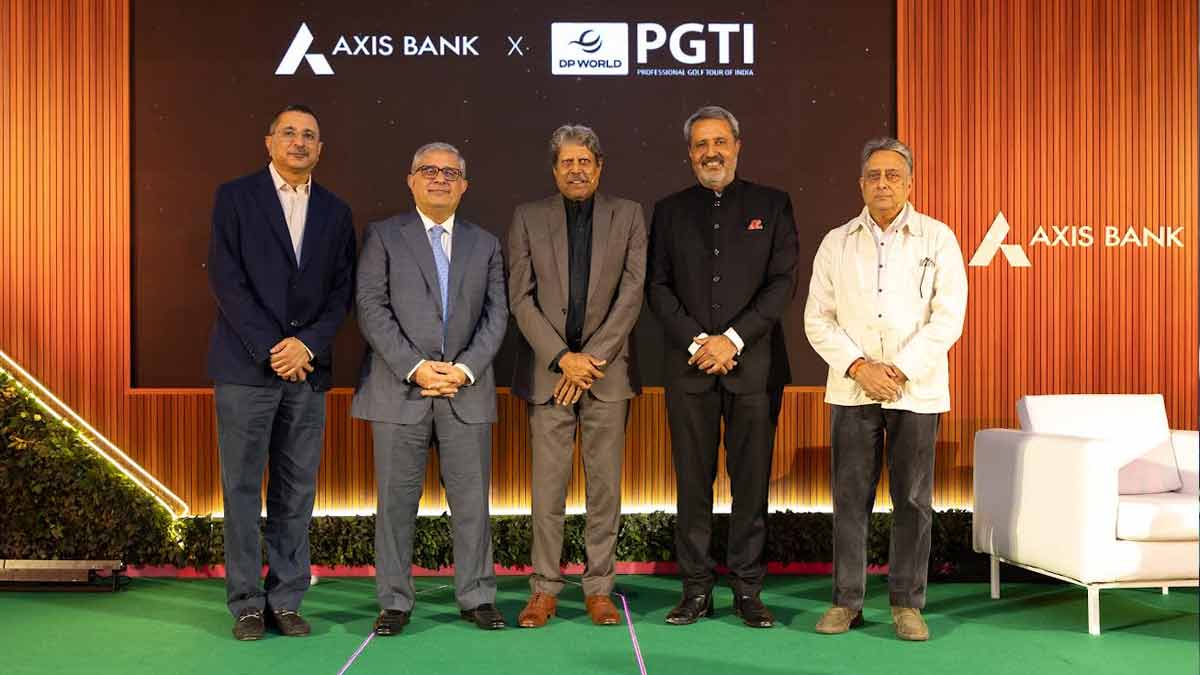
MUMBAI: Axis Bank just teed up a hole-in-one partnership because when a bank sponsors golf’s biggest swing in India, even the fairways feel more financially secure. Axis Bank has been appointed Official Banking Partner of the DP World Professional Golf Tour of India (DP World PGTI), strengthening its commitment to sporting excellence and community engagement while backing the growth of professional golf across the country.
Under the partnership, Axis Bank will support all DP World PGTI tournaments this season, contributing to talent development, enhanced tournament experiences and wider fan engagement. The collaboration aligns the bank’s values of precision, discipline and trust with the Tour’s focus on performance and opportunity.
Axis Bank executive director Munish Sharda said, “We are pleased to partner with DP World PGTI as its Official Banking Partner. Golf embodies precision, discipline, and a pursuit of excellence qualities that strongly reflect who we are at Axis Bank. This association also strengthens our engagement with India’s growing premium customer segments, where the sport has a deep and enduring connect.”
Professional Golf Tour of India president Kapil Dev said, “We are extremely pleased to welcome Axis Bank as a Tour Partner of the DP World Professional Golf Tour of India. Partnerships of this stature play a vital role in strengthening the foundation of the Tour, enhancing opportunities for our players, and expanding the sport’s reach across the country.”
Professional Golf Tour of India CEO Amandeep Johl added, “Axis Bank’s strong legacy of excellence, innovation, and nationwide reach aligns perfectly with DP World PGTI’s goal to elevate professional golf in India and provide greater opportunities for our players.”
In a sport where every stroke counts and every partnership drives distance, Axis Bank isn’t just backing golfers, it’s investing in the fairway to future, turning India’s greens into a stage where precision meets passion and every drive has the power to inspire.