MAM
When stars collide: Karan Johar and R Balki on Goafest day 2


MUMBAI: Post lunch sessions are always a challenge at any event: between people busy with their extended luncheons, grouping to go on smoke breaks, and fighting the urge for a siesta and so the house is often checkered with empty seats.
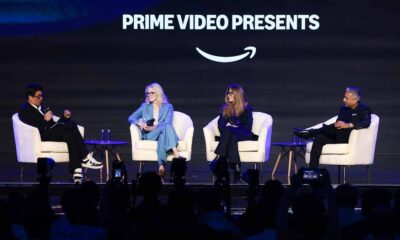
But Goafest presented a completely different picture on its second day with a packed house eagerly waiting for the afternoon knowledge summit to start. This was no surprise, as two of the biggest stars in advertising and film fraternity were the speakers and so when they took the stage, the audience welcomed the speakers with thunderous applause. It was hard to decide who got the loudest cheer — Karan Johar or R. Balki.
‘Won’t make an ad film’
The conversation kicked off with the two giving their take on what connects the two industries represented. “I just know that advertising pays a lot of money to the actors and celebrities, making it easier and cheaper for us to cast them in interesting films,” joked the sharp Johar, before going on to share his utter displeasure when his shoots are moved thanks to an actor’s endorsement schedule.

Johar was also quick to say how money was still flowing strongly in advertisements, while ‘god knows that our (film) footfalls are falling.”
If that is so, would Johar like to make an ad film himself? “Nope” came his quick and precise answer. His reason? When at one time he was asked to shoot an ad film for Shah Rukh Khan, Johar was subjected to the infamous PPM or Pre Product Meeting. That didn’t go down well, and since then he hasn’t dared to shoot another as film, chuckled Johar.
‘Digital”: a word that floats with few understanding it
Given the chance, would Balki consider making a film on the digital platform? “Certainly. Why not? It isn’t much of a question of what medium but more of a content issue. If there is a story which needs to be told, it wouldn’t matter if it’s in the digital platform. Budget is a deciding factor as well depending on the kind of story one is telling and treatment they want to give it.”
Johar said that ‘digital’ was one word floating about in his industry without a shred of comprehension of the medium meant to the industry. “I believe there is a tremendous potential in the medium, but right now, people are simply throwing the word around without actually understanding it.”
Which is a serious threat to the industry, both the speakers agreed. Johar went on to add, “Footfalls have reduced by 10 to 12 per cent this year. There are multiple alternative mediums of entertainment for the audience. If filmmakers do not push up their content ante, and don’t empower the writers well, the industry will soon see its death.”
‘How we market films is all wrong’:
A knowledge summit at Goafest is incomplete without a direct advertising and marketing question, and so Balki popped the question to Johar: Why has the film fraternity not approached the advertisers or vice versa to market their films better? Is what being done currently working for them?
“If the amount of talent in Indian advertising in this very room could sell soaps well, or another product, they could do far more for the films. Why don’t we see more collaboration between the industries?”
“As much as I love my industry, and how solid it is, we are a very big victim of the herd mentality,” confessed Johar. “Currently what you see us doing to promote a film has perhaps been done by one person and the rest followed. No one really sat and strategized what will work or not. There is no science to it and perhaps we need it. Maybe we should get some help to do some actual market research. Right now, we have these promotions and launch events where actors and actresses turn up wearing designer clothes, and only fashion sites are having fun. Is it helping consumers to come and buy a ticket and watch the film? I am not sure at all. This entire bubble is going to burst. Over Marketing of a film can sometimes kill the product. We need to change the way we market films because right now we are doing it all wrong.”
‘It’s a myth that products pay a lot to be in the films’
When quizzed about product placement in films, Balki started off with clarifying misconceptions about this. “There is a science to it. You can’t just randomly place a product in a film just because a brand has paid you money. First of all, it’s a myth that products pay a lot to be in a film. All they help is may be in promoting the film. They do not help in making the film.”
Balki continues, “product placement works when it is part of a given scene, not randomly posed there. People are getting clever, and clients are also getting smart and not wanting that kind of product placement. Brands and directors are realising that it is when s product is integrated into the storyline and has a real role to play in the story or a particular scene that the product gets the right mileage.”
On being on the Social media, the necessary evil
Celebrities, mostly in the film industry, love to hear about themselves and in this era of social media everyone has an opinion.
The speakers were asked their take on free speech on social media. Johar said. “I confess I love hearing about, reading about myself. Be it good bad or ugly I need to know what people are talking about me. I don’t believe one can be like ‘I do not care’, in today’s world. One cannot be indifferent to the reality of our times. That’s what keeps you grounded. I think the social media is a good reality check for us celebrities. You can’t beat them, so you must join them. I am on all major social media platforms and very active online. I don’t need PR to write my twitter, it’s all me.”
Balki had a dramatically opposite take on the subject. Taking a cue from Johar’s answer, Balki added, “I am deluded enough to think I am the worst. I do not people to tell me that, nor do I want people to tell me how good I am. I do not feel the need to listen to it. I find it tiring. I am not in it for the practically.”
Parting shots
While the entire session gave enough fodder to fill several online ‘powerful quotes’ sites, there were a few takeaways: Johar’s honest and straightforward acknowledgement that he is through and through ‘an unapologetic Hindi filmmaker’ and that he had no plans to make films in Hollywood.
And Balki’s explanation of how people tend to judge creativity – on films or in advertisements: “We have defined patterns of creativity. We think good must be like this. We have a picture to what good should be and when we see something violently breaking that, the first reaction is to feel uncomfortable. Because people don’t care about innovation, they are simply looking for relativity. Pain is the biggest risk in taking the risk. It is a pain everyone who breaks a mould will live with for quite some time.”






MAM
Dettol launches new emotional campaign for Antiseptic Liquid
Heartfelt film celebrates mother’s instinct with the tagline “Nothing protects like Mom & Dettol.”
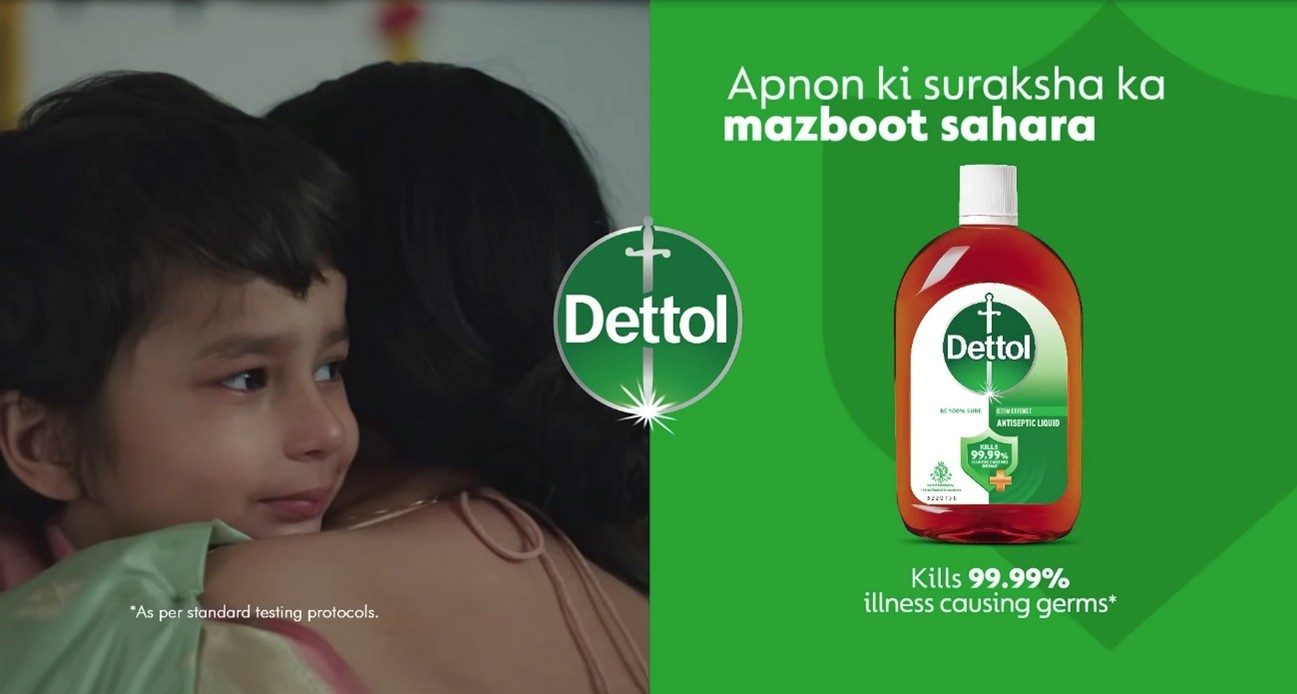
MUMBAI: Dettol has found the perfect formula for its latest campaign, a generous mix of maternal love and antiseptic care that’s sure to tug at every Indian heartstring. The iconic germ protection brand has rolled out a touching new campaign for Dettol Antiseptic Liquid built around the universal truth of a mother’s instinctive care. The film brings to life the simple yet powerful idea: “Nothing protects like Mom & Dettol.”
Set against the lively chaos of a shaadi ka ghar, the story follows a young boy who hurts himself but puts on a brave face to hide his pain. The moment he reaches his mother, she instinctively senses something is wrong. As she gently tends to his wound with Dettol Antiseptic Liquid, his guard drops, leading to a tender role reversal where the child ends up comforting his mother. The film ends with the poignant line, “Apnon ki suraksha ka mazboot sahara.”
The campaign reinforces Dettol’s timeless place in Indian homes as a reassuring companion in moments of vulnerability. It was conceptualised and written by Prasoon Joshi
, with an original track composed by Vishal Khurana K, sung by Javed Ali, and lyrics by Prasoon Joshi. Amit Sharma directed the film.
Reckitt EVP regional director for South Asia Gaurav Jain said the campaign captures the deep emotional bond between a mother’s instinct and Dettol’s protection. “This campaign encapsulates that delicate, human truth, a mother senses hurt even before it is spoken, and Dettol strengthens her ability to respond with care and confidence,” he noted.
Prasoon Joshi added, “When a child is hurt, the first instinct is to reach for their mother, their ultimate safe space. And in that moment, the mother turns to Dettol, something she trusts to protect what matters most.”
As the flagship product in the Dettol portfolio, the Antiseptic Liquid continues to offer unmatched protection for cuts and wounds, standing shoulder to shoulder with mothers through life’s small scrapes and bigger worries.
In a world full of flashy advertisements, Dettol has quietly reminded us once again that the strongest protection often comes wrapped in the simplest, most heartfelt moments, the kind only a mother and a trusted bottle of Dettol can provide.






