Ad Campaigns
When sports became front-page news

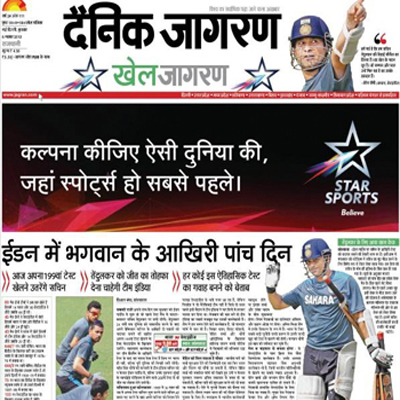
MUMBAI: When ESPN Star Sports changed its identity to Star Sports at midnight on 6 November, it was part of a mission to put sports first.
Which is exactly what came through when readers of national newspapers in some cities discovered that their morning reads did not have the usual masthead.
 |
It didn’t end there. The front page had only sports news. People were left wondering why. The answer came when two full page ads greeted them announcing the launch of the six new Star Sports channels. The motive of this disruption was simple- ‘sports first’.
It was less print campaign, more (new) brand announcement for Star India.
“It was a statement of purpose. A mission to put sports first,” as Star India executive vice president marketing & communications Gayatri Yadav puts it.

The network was aware that delivering such a powerful brand promise required a high-impact strategy. “In a bold and innovative campaign, we asked India to imagine a world where sport comes first. For the first time in history – Star Sports has enabled sports to move to the front page of a newspaper in India,” exults Yadav.
 |
The print campaign covered all editions of The Times of India, Maharashtra Times and Ei Samay, Dainik Jagran (all editions), the Madhya Pradesh and Chhattisgarh edition of Nai Duniya and the Chennai, Hyderabad and Bengaluru edition of The Hindu. It targeted six metros and the HSM markets like Uttar Pradesh, Madhya Pradesh, Bihar and the PHCHP region (Punjab, Haryana, Chhattisgarh and Himachal Pradesh). It is learnt the network spent around Rs 5-7 crore on the print ad releases.
“The time for the campaign is perfect. With Sachin playing his last series before retirement, we knew there will be a whole buzz around this match and so, for us, it was a good time to bring it up front for maximum impact,” informs Star India’s media agency’s Mindshare principal partner, client leadership Anita Kotwani.
 |
Getting the sports section to the front page was a strong innovation. “We needed to bring sports to the forefront and what better way to bring the back page to the front page. The live edit of the sports page was upfront and there was no repetition of the sports section in the latter pages. We have been able to execute this innovation with the top publications having the best sports coverage. And this in itself is an achievement,” she says.
In fact, the one-point brief to Mindshare was – ‘How can we bring sports to the forefront? “Given the fact that it’s sports, the male audience becomes our main target group and naturally, newspapers and publications became the right medium to communicate,” explains Kotwani.
Asked about the response to the disruption, Kotwani says: “We are talking about the leading newspapers in the country, so of course we couldn’t go wrong with our plan. When the consumers opened the newspaper and saw the sports page upfront, wondering where the masthead was: our job was done. In short, we have achieved the impact that we wanted to create among consumers.”
 |
Says Maxus managing director south Asia Ajit Varghese: “Rebranding and repositioning the Star Sports network as the sports destination is surely very good messaging. They have four channels and one cannot miss any action across sporting events. It is something that sports lovers will clearly connect with.”
A media observer points out that Star India still has its work cut out with viewers. Says she: “India is a one sport nation – cricket. With so many channels on offer, there could be some confusion in viewers’ minds: how is each of them different from the other? And will they have to pay additionally for each of them? How much and why? Star India will have to address these issues separately through some promos and advertising later.”
That probably should give the marketing folks at Star India some food for thought!






NATIONAL: Amazon Ads has laid out a sharply tech-led vision for the advertising industry in 2026, arguing that artificial intelligence, streaming TV and creator partnerships will combine to turn brand building into a more precise, performance-driven business.
At the heart of the shift, the company says, is the fusion of AI with Amazon’s vast trove of shopping, browsing and streaming signals, allowing advertisers to move beyond blunt reach metrics to campaigns designed around real customer behaviour.
“The future of advertising is not about reaching more people, but the right people with messages that resonate,” said Amazon Ads India head and vice president Girish Prabhu. “By combining AI with deep customer insights, we help brands move from broadcasting campaigns to having meaningful conversations wherever audiences spend their time.”
One of the biggest changes, according to Amazon Ads, will be the collapse of the wall between media planning and creative development. Retail media, powered by first-party data, is increasingly shaping everything from brand discovery to final purchase, pushing marketers to design campaigns around audience insight rather than internal instinct.
AI is also moving from a support tool to a creative engine. Agentic AI, which automates and accelerates production, is expected to make high-quality creative accessible even to small businesses, compressing weeks of work into hours and giving challengers the ability to compete with larger brands on speed and scale.
Behind the scenes, AI-driven analytics will take on a bigger role in campaign optimisation, identifying patterns, spotting opportunities and recommending actions that would previously have required teams of analysts.
Streaming TV is another big battleground. With India’s video streaming audience now above 600 million and connected TV users at 129.2 million in 2025, advertisers are set to treat streaming not just as a branding channel but as a performance engine, measured increasingly by sales, sign-ups and bookings rather than just reach.
Finally, Amazon Ads sees creators and contextual advertising reshaping how brands tell stories. Creators will act less like influencers and more like long-term partners, while scene-aware ads on streaming platforms will allow brands to insert hyper-relevant offers into the flow of what viewers are watching.
Taken together, Amazon Ads argues, these shifts mark a move towards advertising that is both more human and more measurable, where AI handles the complexity, and creativity does the persuading.