MAM
When I write, I learn, it is a big inspiration: Ambi


MUMBAI: In his three-decade-long career, chemical engineer-turned-adman MG ‘Ambi’ Parameswaran has handled a wealth of assignments across advertising, marketing and sales. The brain behind the transformation of Ulka Advertising into Draftfcb Ulka Group, this former IIT-ian not only knows his subject like the back of his hand, he has a sharp wit and a way with words to boot.
Ambi, who has a slew of articles and six books on advertising and brands to his credit, has just finished penning his seventh book titled For God’s Sake – An Adman on the Business of Religion slated to hit stands next week. He spoke to indiantelevision.com about his new book and what he does best – writing and advertising…

Why did you choose such a topic?
I did my PhD on Religiousity and Consumer Behaviour from Mumbai University and it took close to five years of research to file my thesis. In so doing, I read over 500 books and articles on the subject and thought it was an interesting topic. Besides, not much had been written on religion and consumer behaviour. So, I thought of converting my thesis into a book which people could use and appreciate.
What inspired you to write this book?
The fact that when I write, I learn, is one big inspiration for me. Secondly, one is adding in some way to the knowledge depository of the country. Unfortunately in India, we are very possessive about knowledge and information, so my books are all about sharing whatever little I know with people who are interested in knowing more.
How different is this book from your previous ones?
I have written several books on advertising, a couple of books on branding, and a book on the Indian consumer. This book cannot be slotted into advertising or branding categories because it is more of a neutral book which is more about business, religion and consumers. There is a lot of reference to advertising in the book, and there is also a lot of reference to a lot of business ideas that have emerged in the book. Also, there are a lot of consumer segmentation issues that I have raised in the book.
Whom are you targeting with this book?
It would be the 28 or 29-year-old executive who wants to understand a little more about the Indian consumer or the 31-year-old businessman who wants a new idea for a business.
This is your seventh book. What motivates you to write?
Well, I have always wondered why there aren’t enough books on Indian consumers and Indian brands. From a historical perspective, the first person to really write a book on branding in the Indian context was Subroto Sengupta of Clarion Advertising. He was also my professor at IIM Calcutta and after him, for many a year, no one really wrote on Indian brands or advertising.
My first book was published in 1999 and since then, we have had a lot of people like Santosh Desai, Rama Bijapurkar, Harish Bhatt and Anand Halve writing interesting books on such topics. It is a good and healthy thing that a lot of practising executives are putting down their knowledge and experience into books.
Just how easy or difficult is it to put all this into a book? In your case, are you usually content once you are done with the final draft?
I don’t think you can capture all the things you know in just one book because one is always reading and observing things all the time. For me, writing a book is also a learning process, so when I write a book, I read a lot more. Even before you get down to writing the first paragraph, you have read and learnt so much. This book, for instance, took six months of writing, but for almost three years, I was researching and reading. So, it is a learning process and after you finish writing a book, one always thinks that you could have added something more. Overall, I’m happy the way the book has come out. It is very racy and it’s easy to read. That was my objective; it is in fact much lighter to read as compared to my previous books. It was planned!
Which is your favourite book on advertising, and why?
There are many books, so it is difficult to name any one. There are books on branding and advertising globally, and in India too, we are seeing some very good books.
Do you feel youngsters today read books or are influenced by them?
There is still a very significant section of the youth which reads books. If you look at what Amish Tripathi has been able to achieve, it is commendable. He is a guy who has brought a million new readers to the English books’ market. His books cut across age groups and that is amazing.
Coming to advertising, do you think advertisers are stereotypical in their portrayal of characters, be it gender or religion-wise?
No, I don’t think there is any stereotyping. Advertisers and advertising agencies tend to borrow from the popular culture around them. And they are normally ahead of the curve. That is why in the book, there is a chapter on ‘The mystery of the missing bindi’ and you will see advertisers are showing lesser and lesser women wearing a bindi because not wearing one is perceived as a symbol of modernity, which wasn’t the case some 20 years ago. However that doesn’t mean women aren’t wearing bindis. You will still see a lot of women wearing them. But the modernity has been picked up and used by advertisers.
Coming back to your book, it will be available on…
It will be available with e-book merchants, both as hardcover and as an e-book. It will also be available at all bookstores.
Last but not the least, will we see another book from you?
Not yet, maybe something after two years…






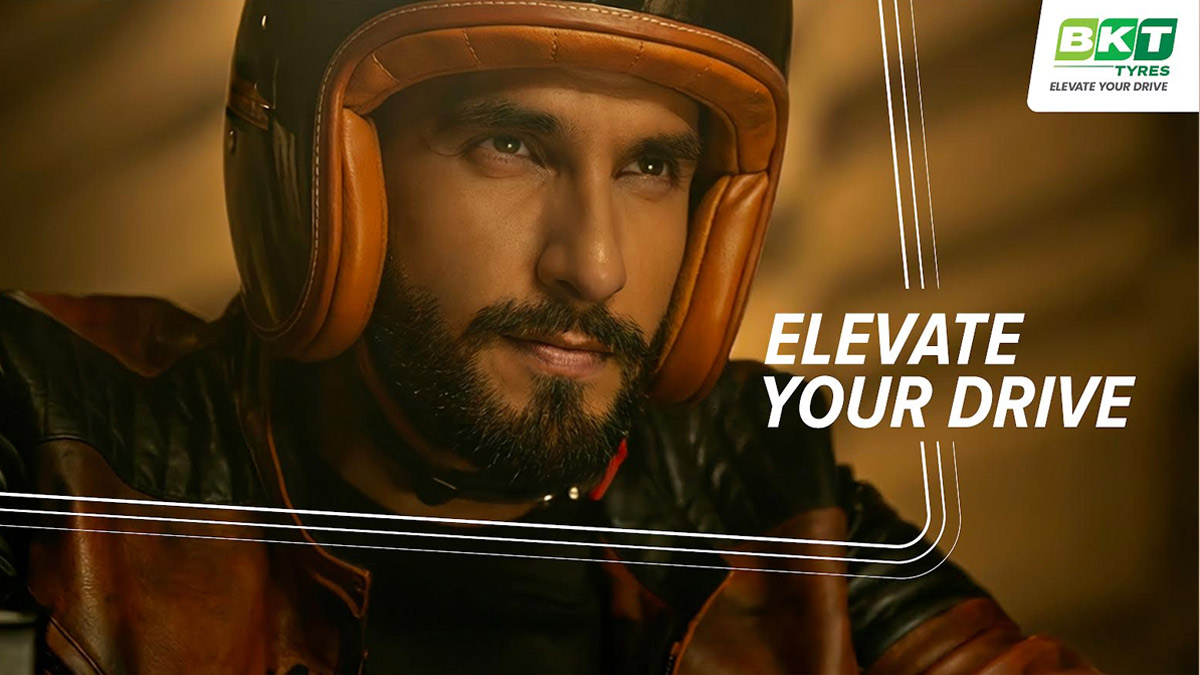
MUMBAI: BKT Tyres has decided to roll into the two-wheeler world with some serious jurrat and it’s brought Ranveer Singh along for the ride. The off-highway tyre specialist has unveiled its new campaign, ‘Jurrat’, marking a strategic push into India’s massive two-wheeler segment. The high-energy TV commercial, featuring brand ambassador Ranveer Singh, debuted on 3 April 2026 during the Indian Men’s T20 League 2026.
The campaign revolves around the core belief that true confidence on the road comes from dependable performance beneath you. ‘Jurrat’ (meaning courage) captures the mindset of riders who navigate dynamic and often unpredictable daily commutes with determination. It brings BKT Tyres’ brand philosophy ‘Elevate Your Drive’ into the two-wheeler space by spotlighting three key product benefits: long life, exceptional road grip, and unmatched comfort.
BKT Tyres chief marketing officer for India Mahesh Koppad said, “India’s two-wheeler segment reflects the way the country moves, works, and progresses every day. ‘Jurrat’ highlights how performance-led tyres, engineered for long life, comfort, and grip, enhance the overall riding experience and support uninterrupted progress in everyday life.”
The campaign is being rolled out across television and digital platforms with high-impact placements to ensure maximum reach and engagement.
This launch represents BKT Tyres’ calibrated expansion from its stronghold in off-highway tyres to becoming a more holistic mobility brand, addressing the everyday transportation needs of millions of Indian riders who rely on motorcycles and scooters as their primary mode of transport.
In a segment where confidence is everything, BKT Tyres is betting that a combination of bold celebrity appeal and strong product performance will help it gain serious traction on Indian roads. The campaign signals that the company is ready to move beyond its traditional turf and accelerate in the fast-paced two-wheeler market.






