MAM
When brands think like publishers: CMS Asia 2016


MUMBAI: As more brands are waking up to the perks of content marketing, they increasingly realise the need to think like a content platform or publisher. But, are they doing it right? — was the question raised in the panel discussion at CMS Asia 2016. The panellists were — Autocar’s Hormazd Sorabjee, Mxm’s Pradyuman Maheshwari, Scoopwhoop’s Sattvik Mishra and Reliance Broadcast Network’s Ashwin Padmanabhan. Qyunki’s Sameer Bangara was the dynamic moderator.
The panellists had a mix response to Bangara’s question – What are brands missing when they try to act as publishers? Maheshwari pointed out that brands often didn’t see the various possibilities that content can provide, being closeted in their traditional mindset. “Rarely do I see branded content that has actually explored the concept more radically. I don’t see why a Lux, backed by HUL’s money and business acumen, can’t have a content wing that does interviews with celebrities?,” he asked.
Mishra pointed out how brands need to take Ad Blockers and Youtube’s ‘skip ad’ statistics seriously and think deep into why its failing. “That’s why branded content becomes important to engage the consumer. A user doesn’t care if it’s branded or not, as long as the story is entertaining, albeit it needs to be mentioned that it is a branded content. The problem is brands want to do marketing first, and content later,” Mishra frankly stated.

Sorabjee criticised how brands often are in it for the one-time association, and are quick to seek results. “Content marketing doesn’t work that way, one needs a continuous engagement with the consumer. Long-term association is the key to content marketing, provided the communication is consistent. Brands that are in it for the short spurt may not see much of a difference in their brand uplift.”
Padmanabhan urged brands to look at different metrics when it comes to content marketing and not go for a single standard measurement. “With the amount of data available today, it is easy to get confused but the CMO needs to identify which of those figures really align with the brand objective. Do views matter, or likes? Or shares? Or, the time spent on engagement…each brand will have different metrics to look at depending on the target they have.
Seconding Padmanabhan, Mishra added, “We give brands something we call a ‘brand lift’ where, if the brand was spoken about X number of times before engaging in a campaign with us, we show them that, after the campaign, the brand was spoken of 3X times, hypothetically. We have 3rd-party agencies who work on these numbers and internal machinery as well to provide these numbers to the brands.”
When it came to the measurement of a campaign’s success, Sorabjee differed from the rest of the panellists. “Numbers don’t really matter, I don’t believe in them. In content marketing, brands should, and they do look at the quality of your reader or viewer of a certain publisher. Therefore, the key is to keep your reader as the first priority . A publisher shouldn’t decide on the content based on what the brand wants but what its readers want to consume, and trust me, brands too want to reach that reader,” he said, adding that both, brands and publishers, shouldn’t compromise on content for the sake of metrics and numbers.





MAM
Lego brings Messi, Ronaldo, Mbappé, Vinicius together
Campaign clocks 314 million views ahead of FIFA World Cup 2026 buzz.
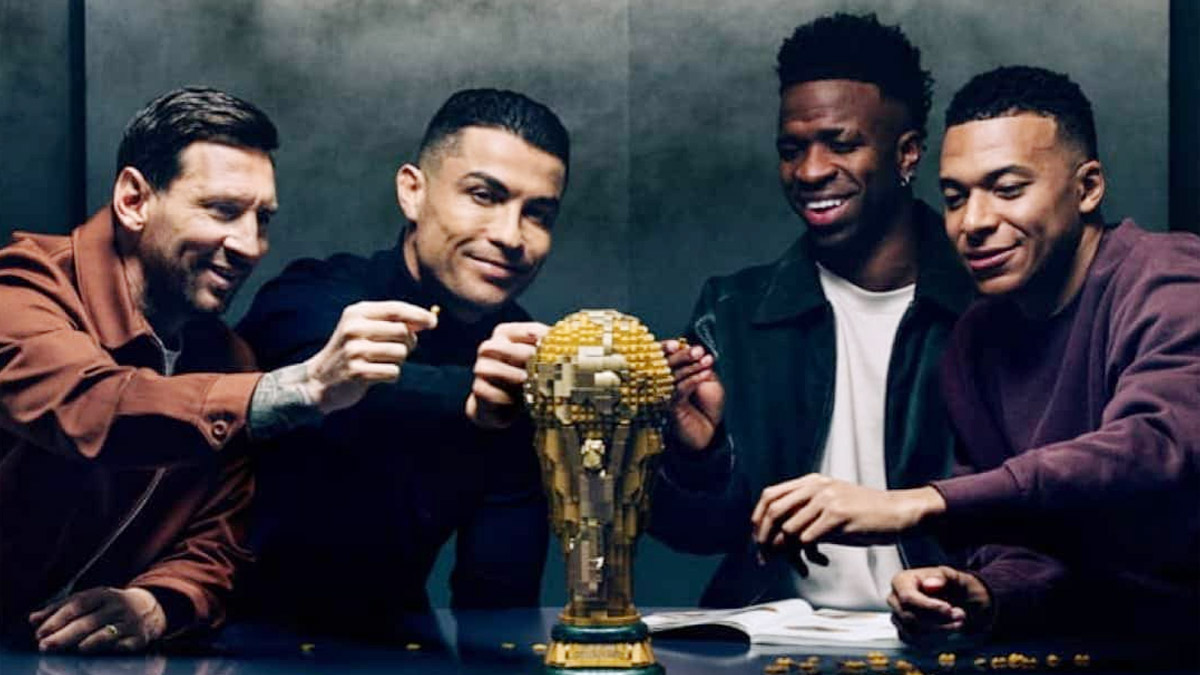
MUMBAI: Four legends, one frame and not a single tackle in sight. Lego has pulled off a crossover few thought possible, uniting Lionel Messi, Cristiano Ronaldo, Kylian Mbappé and Vinícius Júnior in a single campaign ahead of the FIFA World Cup 2026 only this time, they’re building dreams brick by brick.
Titled “Everyone wants a piece”, the campaign features the quartet assembling a Lego version of the World Cup trophy, before placing miniature versions of themselves atop it, a playful nod to football’s ultimate prize. Shared widely across social media, the ad carries a pointed disclaimer: it is not AI-generated, a subtle but telling signal in an era where even reality is often questioned.
The numbers tell their own story. The campaign has already crossed 314 million views on Instagram across the players’ accounts, with fans hailing it as a rare, almost nostalgic moment particularly for the reunion of Messi and Ronaldo, whose last shared campaign ahead of the 2022 World Cup became one of the platform’s most-liked posts.
Beyond the film, Lego is extending the play with exclusive, player-themed sets tied to each of the four stars, part of a broader football-led programme designed to ride the global momentum building towards 2026. The idea, as echoed by the players themselves, leans into the parallels between football and play experimentation, creativity, failure, and triumph.
Messi described the sets as a way to bring on-pitch moments into an imaginative, hands-on world, while Ronaldo called the transformation into a Lego figure a rare honour, blending sport with storytelling. Vinícius, meanwhile, struck a more personal note, recalling childhood moments of building with Lego and framing creativity as a universal language that transcends borders.
The timing is no accident. With the 2026 World Cup set to run from June 11 to July 19 across the United States, Canada and Mexico, and featuring an expanded 48-team format, global anticipation is already building. Argentina, led by Messi, will enter as defending champions, adding another layer of intrigue.
For Lego, the campaign does more than celebrate football, it taps into its mythology. Because when icons become figurines and rivalries turn into play, the beautiful game finds a new kind of pitch. one built, quite literally, by hand.






