MAM
Waves 2025 Brings Big Deals and Bold Dreams to India’s Media Sector

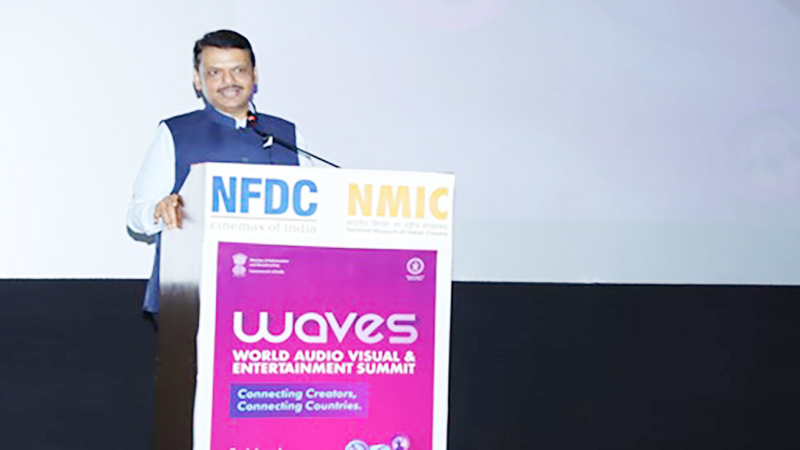
MUMBAI: If the Indian media sector were a movie, Waves 2025 would be the montage sequence fast cuts of big money, bold ideas and breakout talent all coming together for a dramatic makeover. Held in Mumbai, the Waves Summit 2025 saw the Government of Maharashtra sign MoUs worth nearly Rs 8,000 crore, giving the media and entertainment sector a starring role in the state’s growth narrative. Among the headliners:
. Rs 3,000 crore from Prime Focus to build a 200-acre Film City
. Rs 2,000 crore from Godrej for a film, TV and media campus in Panvel

. Rs 1,500 crore each from the University of York and the University of Western Australia to set up their first Indian campuses in Mumbai
And just like that, education and entertainment are sharing billing on the marquee.
Waves 2025 also introduced the Nifty Waves Index, listing 43 media and entertainment companies finally giving the sector its own Sensex-style snapshot. Meanwhile, the Indian Institute of Creative Technology (IICT) inked partnerships with industry giants including Google, Apple, Microsoft, Meta, Adobe, Nvidia, and Toon Boom, rolling out opportunities for scholarships, internships, rendering parks, game design courses and creative entrepreneurship.
Waves Bazaar cemented its role as the sector’s B2B-B2G power corridor. Launched in January 2025, the digital-first marketplace has already hosted 2,450 projects, with 6,442 buyers and 6,106 sellers participating across film, animation, XR, gaming and advertising verticals. It’s India’s global swipe-right moment for creative deals.
Elsewhere, WaveX turned into a high-stakes pitch fest where creative dreams met venture capital muscle. From 1,504 applicants, 30 high-potential M&E startups in gaming, storytelling, immersive tech and the creator economy pitched live to 29 marquee investors including Lumikai, Jio, and Warmup Ventures. With 127 startups securing connections or partnerships, and applications vetted by IAMAI and KPMG, this wasn’t just razzle, it was rigor with returns.
Enter the Create in India Challenge, a flagship talent hunt that hosted 34 creative contests across animation, AR/VR, gaming, music and films. Finalists competed in the buzzing Creatosphere, a zone dedicated to next-gen creators. Eight expert masterclasses helped sharpen their edge, while the finals turned the stage into a launchpad.
Not to be left out, Waves Culturals gave attendees a feel of India’s artistic pulse through performances blending traditional and global forms. The event’s heart, however, was the Bharat Pavilion, inaugurated by prime minister Narendra Modi on 1 May 2025. Designed as an immersive tribute to India’s storytelling roots, it showcased four thematic zones Shruti (oral traditions), Kriti (written heritage), Drishti (visual storytelling), and Creator’s Leap (future tech).
Over in the FM lane, the 8th National Community Radio Conference saw 12 CR stations receive national awards for innovation and inclusivity. With 531 CR stations and over 400 representatives attending, it was a mic-drop moment for grassroots broadcasters.
Add to that the launch of the first Indian Film Festival in New Zealand and fresh Indo-UK film collaborations and you’ve got an M&E summit that doesn’t just talk global, it screens it.
From classroom tie-ups to cultural showcases, and from startup pitches to mega MoUs, Waves 2025 didn’t just imagine India as a global creative powerhouse it laid down the blueprint, cast the crew and started shooting.
And with Maharashtra calling action on infrastructure, investment and innovation India’s media industry is no longer just watching the story unfold. It’s writing the script.





Brands
Maharashtra panel orders Lodha to refund Rs 5 crore to homebuyers
Consumer court flags unfair practices in long-running property dispute case
MUMBAI: In a sharp rebuke to one of India’s biggest real estate players, the Maharashtra State Consumer Disputes Redressal Commission has directed Macrotech Developers to refund nearly Rs 5 crore to a senior citizen couple, Uttam and Anindita Chatterjee. The ruling, delivered on March 13, 2026, calls out the developer for “deficiency in service” and “unfair trade practices”, bringing closure to a dispute that has stretched over a decade.
The case traces back to 2015, when the couple booked a 3-BHK flat at World Towers in Lower Parel for Rs 12.22 crore, with possession promised within a year. What followed was a series of changes that complicated matters. After deciding to exit the project, they were persuaded to shift to a 4-BHK in another development priced at Rs 8 crore, with delivery scheduled for 2018. However, within months, the price was allegedly increased to Rs 10 crore. After demonetisation reshaped the market, similar flats were reportedly being offered at lower prices, but the couple were not given the benefit.
Despite paying over Rs 2.83 crore, the couple neither received possession nor clarity. Instead, in 2018, the developer unilaterally cancelled the booking, retained part of the amount as earnest money, and argued that the buyers were investors rather than consumers. The commission rejected this claim, observing that casual references to “investment” do not take away consumer rights when the purchase intent is residential.
The bench also held that the developer could not penalise buyers for payment delays while failing to meet its own delivery commitments. It noted the lack of formal documentation for revised terms and termed the prolonged retention of funds without delivering a home as exploitative.
As part of its order, the commission directed the developer to refund Rs 2.83 crore paid by the couple, along with interest at 10 per cent per annum, amounting to around Rs 2.12 crore. In addition, Rs 1 lakh has been awarded for mental agony and Rs 50,000 towards litigation costs, taking the total payout to over Rs 5 crore. The developer has been asked to comply within two months.
For now, the ruling serves as a reminder that in real estate, shifting terms and delayed promises can carry a significant cost.







