MAM
VidNet 2022: Advertising On OTT – the way forward for the industry

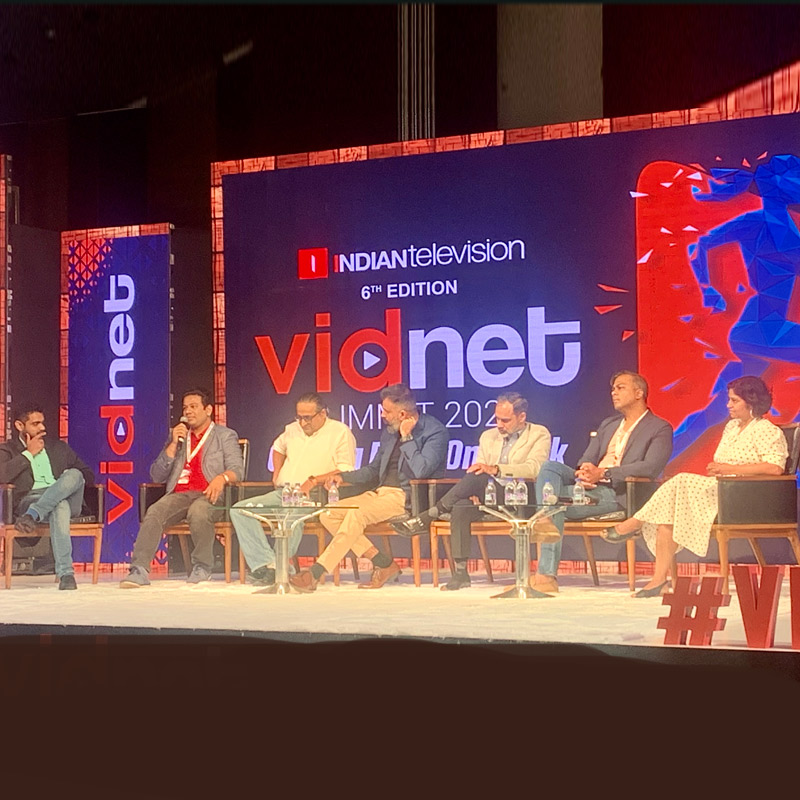
Mumbai: The OTT ecosystem in India is growing every day with new players coming into the fray and novel, edgy content being churned out. The way we look at online streaming is also changing. Today the market has 40 odd players including regional players. For these platforms to sustain, there are two ways- one: is the AVOD, that’s advertising-supported and the second is the SVOD which is subscription-supported. In a market like India, SVOD remains a challenge. Even as the OTT subscription market in India continues to grow at a gradual pace, it remains an exciting prospect for an increasing number of marketers and advertisers who are keen to promote their brands and ads on these emerging platforms.
The sixth edition of IndianTelevision.com’s annual VidNet Summit took an in-depth look at the way forward for the OTT ecosystem and all the platforms on it, and the opportunities and the challenges in the space.
The two-day summit had technology partners Dell Technologies and Synamedia, summit partners Applause Entertainment and Viewlift, industry support partners Gupshup, Lionsgate Play and Pallycon, community partners Screenwriters Association and Indian Film and Television Producers Council, and gifting partner The Ayurveda Co.

Day one of VidNet 2022 saw an interesting mix of sessions on the subject of advertising on OTT from industry experts and stakeholders on the various panels. The panel on ‘Advertising On OTT – Connecting The New Brand Order’ oversaw bristling conversations from panelists that included MediaCom chief product officer Averill Sequeira, Swiggy head of brand marketing Saurabh Nath, Zee Entertainment Enterprises chief revenue officer-Digital & SMB, South Asia Gaurav Kanwal, ITC head media & PR Jaikishin Chhaproo, Byju’s brand and creative strategy vice president Vineet Singh and Syska Group head of marketing Amit Sethiya. The session was moderated by Madison World vice president Kosal Malladi.
Today data has become a complete commodity with large OTT players like Netflix, Prime Video, Zee5, Hotstar, Sony liv etc coming in, observed Malladi. Recently Netflix declared that it has decided to support advertising. The advertising revenues on these platforms in the last four years have grown by 400 per cent, Malladi shared. So will the subscription model stay or perish in India? Also, as brands are the numbers large enough for advertising on AVOD?
According to Zee’s Gaurav Kanwal, the OTT industry in India is in its infancy. “There’s a huge AVOD play for sure, with increased reach more brands will come on board. On the SVOD side, as the economy progresses, people will pay for varied content that they can watch at their convenience. We already have about 70 million people paying for content on various OTTs across the board,” he said while adding, “As we evolve as an ecosystem, the pricing models will evolve as well and then we shall see a massive upswing in the SVOD subscriptions. It will be difficult to sustain only on the back of SVOD so an advertising-supported hybrid model will be the way forward.”
Speaking about how OTT has caught the attention of brands, Syska’s Amit Sethiya said, “We have started exploring OTT from the last three to four years and the money that we are putting in it is increasing year on year in the entire media mix. From single-digit investment in the medium about four years back the brand has now expanded to double-digit investment. We are in a position to fetch incremental audiences with this new avenue and connected TV is aiding the entire process.”
The role of agency here is more of a consultant or facilitator, rather than a gatekeeper in bringing the two worlds of brands and the rich, emerging ecosystem of OTTs together, MediaCom’s Averill Sequeira averred. “Am very bullish about the OTT sector, the pace at which they are growing, especially the phenomenal growth, regional OTTs and the void they have fulfilled in terms of quality content. They have opened people’s minds to new forms of storytelling.”
Sequira spoke of two ways to validate OTT reach and audience. “As far as programmatic is concerned it is simpler as you’re buying the audience and not inventory on the platform. But where programmatic is not available, she encouraged all stakeholders to actively seek metrics such as search volumes, brand recall, and social chatter to serve as ‘proof of the pudding’.”
On what attracted FMCG brands to OTT, ITC’s Jaikishin Chhaproo explained that their primary target audience is women. “We knew most women were missing the first telecast of their favourite shows and watching repeat telecasts. When that consumption moved to OTT they could watch it at their convenience on hand-held devices, rather than by appointment viewing as on TV. OTT provided that platform seamlessly,” he said, adding that “the other huge chunk of their TG is the youth 18-40, who watch differentiated on OTT only and who aren’t interested in appointment viewing. This age group that forms the core TG of FMCGs is also present on OTT.”
Swiggy’s Saurabh Nath pointed out that for a food tech brand, the consumer journey is key as there are specific times of the day when food is relevant to their lives. “One can only increase their ‘desire to action’ by building awareness via advertising but one cannot expect immediate action. The kind of marketing that we are talking about is changed and is different when it comes to tech and D2C from that of FMCGs as the cycle is much more condensed,” he said, adding that, “the attribution for the FMCGs was very clear, that the brand will build over a period of time.”
Nath shared three-pointers on brand equity for any brand to perform well- saliency, meaningfulness, and differentiation. Putting the ad on an OTT may give the brand salience but the outcome in terms of recall, engagement and differentiation will depend on one’s campaign relevance. The industry stakeholders agreed on the importance of “tracking the right metric” for the same.
For D2C brands like edtechs, content marketing is the way to create love for the brand, affirmed Byju’s Vineet Singh, adding, “We need to figure out what works for us and what doesn’t as marketers first- Brand recall, salience, relevance etc.” Going back to basics is important such as understanding what our requirement is, instead of unnecessarily complicating. We’ve evolved from a world where just pushing the narrative is going to work. Creative excellence from a brand is important.”
Investments in content continue to burgeon as viewers’ insatiable appetite continues to demand more and more. With all agreeing that OTT’s a high-growth industry with everyone wanting ‘a piece of the OTT pie,’ panelists agreed that the end goal/objective has to be clearly defined for the brand or a particular campaign. Cookie-cutter branding is not going to work for brands.
It was agreed that OTT platforms need to take some responsibility too, even as marketers need to own it, for ‘passive integration’ will not work. With nearly 18-20 percent of FMCG’s money for television going to OTTs today, expectation setting needs to be clear and realistic.






MAM
India’s financial sector spent less on TV ads in 2025 but flooded the internet
Banks, insurers and lenders cut tv ads as digital jumps, LIC and Muthoot lead tv and Axis Bank tops online
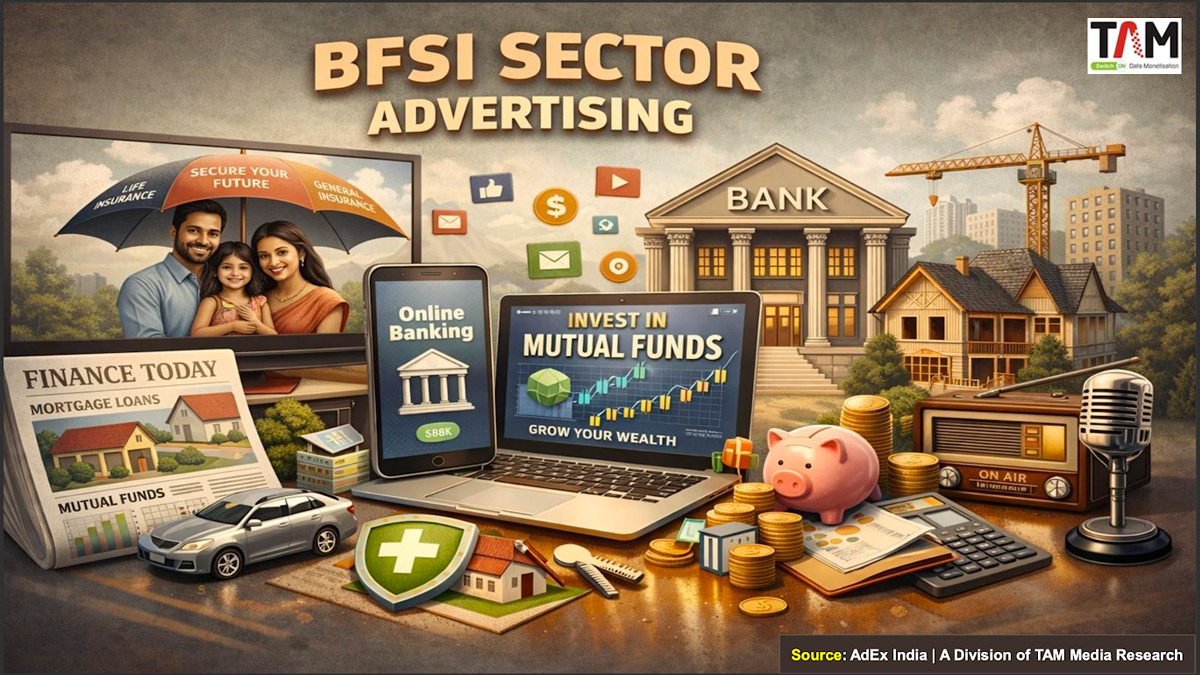
MUMBAI: India’s banking, financial services and insurance sector, one of the most prolific advertisers in the country, delivered a split verdict on media in 2025. It spent less on television, held its nerve in print, turned up the volume on radio and deluged the internet with a ferocity that left every other medium looking pedestrian. The picture that emerges from TAM AdEx’s cross-media report for the BFSI sector is of an industry in transition, still wedded to the news bulletin but increasingly seduced by the algorithm.
Television: a retreat with caveats
TV ad volumes for the BFSI sector fell 16 per cent in 2025 compared with 2024, a sharp reversal after two years of consistent growth that had pushed volumes 16 per cent above 2021 levels by 2023 and a further 7 per cent higher by 2024. Within 2025 itself, the drop was concentrated in the middle of the year: the second and third quarters saw ad volumes slide 35 per cent each against the first quarter, with a partial recovery of 13 per cent in the fourth.
The retreat did not reshuffle the deck. Life insurance retained first place among TV categories with 19 per cent of ad volumes, mortgage loans held second with 16 per cent, and the top ten categories together accounted for 82 per cent of all BFSI television advertising. The dominance of news channels was equally pronounced: news claimed 68 per cent of ad volumes, general entertainment channels a distant 14 per cent and movies 12 per cent. Together, news and GEC captured 82 per cent of the sector’s television spend. News bulletins alone took 48 per cent of programme-genre volumes, with feature films second at 12 per cent. Prime time, between 6pm and 11pm, drew 34 per cent of ad volumes, followed by afternoon at 22 per cent and morning at 20 per cent. A full 82 per cent of all ads ran between 20 and 40 seconds.
Life Insurance Corporation of India was the sector’s biggest TV spender with 11 per cent of ad volumes. Muthoot Financial Enterprises came second with 9 per cent, followed by National Payments Corporation of India at 6 per cent, Tata AIG General Insurance at 5 per cent and State Bank of India at 5 per cent. The top ten advertisers together accounted for 51 per cent of total TV volumes. Three names were new to the top ten in 2025: Tata AIG General Insurance, IIFL Finance and Tata Capital. At brand level, Muthoot Finance Loan Against Gold led with 9 per cent share, Tata AIG Health Insurance entered the top ten for the first time, and the top ten brands together contributed 35 per cent of ad volumes.
Print: the long climb continues
Print told a different story. Ad space for the BFSI sector has grown every year since 2021, rising 16 per cent in 2022, 30 per cent in 2023, 51 per cent in 2024 and 64 per cent in 2025, all measured against a 2021 baseline. Within 2025, ad space was flat in the second quarter but surged 46 per cent in the third and 33 per cent in the fourth compared with the first. Life insurance led print categories with 21 per cent of ad space, followed by mutual funds and banking services and products at 13 per cent each, and corporate financial institutes at 11 per cent. The top ten categories together took 82 per cent of print ad space. LIC led print advertisers with 6 per cent share, and the top ten together covered just 19 per cent of ad space, a reflection of how fragmented print spending remains. Three new entrants joined the top ten in 2025, with Billion Brains Garage Ventures the only exclusive presence not seen in 2024’s list. In the top ten brands, LIC dominated with a 2 per cent share, while Nippon India Mutual Fund rose to third position from fourth in 2024. English accounted for 62 per cent of print ad space, Hindi for 20 per cent. Business and finance publications took 59 per cent of the genre split. The south zone led regional spending with 33 per cent of print ad space, Bangalore topping that zone, while New Delhi and Mumbai were the leading cities nationally.
Radio: louder than ever
Radio ad volumes for the BFSI sector have climbed steadily, rising 12 per cent above 2021 levels in 2023, 36 per cent in 2024 and 45 per cent in 2025. The quarterly pattern within 2025 was volatile: a sharp drop of 43 per cent in the second quarter and 42 per cent in the third, followed by a near-full recovery in the fourth. Life insurance led radio categories with 22 per cent of volumes, banking services and products second at 14 per cent and corporate NBFCs third at 11 per cent. LIC of India held its position as the leading radio advertiser with 20 per cent of ad volumes; the top ten radio advertisers together covered 69 per cent. Muthoot Financial Enterprises led radio brands with 10 per cent share, five of the top ten brands belonged to LIC alone, and SBI Mutual Fund made a remarkable leap to fifth position from 272nd in 2024. Evening and morning time-bands together captured 84 per cent of radio ad volumes, with evenings at 44 per cent and mornings at 40 per cent. Maharashtra was the leading state for radio BFSI advertising with 18 per cent share; Maharashtra, Gujarat and Uttar Pradesh together accounted for 43 per cent.
Digital: the five-times surge
If one number defines the 2025 BFSI advertising story, it is five. Digital ad impressions for the sector multiplied fivefold between 2021 and 2025, having already doubled in 2023 and doubled again in 2024 before the 2025 leap. Within the year, impressions dipped 19 per cent in the second quarter and 12 per cent in the third before recovering 8 per cent above the first quarter by the fourth. Banking services and products led digital categories with 27 per cent of impressions, life insurance and credit cards tied at 19 per cent each, and securities and sharebroking organisations fell from first place in 2024 to fourth in 2025. Axis Bank was the runaway leader among digital advertisers with 12 per cent of impressions, followed by ICICI Bank at 9 per cent, IDFC First Bank at 7 per cent and Kotak Mahindra Bank at 6 per cent. The top ten digital advertisers covered 59 per cent of impressions, and seven of them were new entrants compared with 2024, signalling rapid churn in the digital spending hierarchy. At brand level, Axis Bank led with 9 per cent, ICICI HPCL Super Saver Credit Card vaulted to third place from 921st in 2024, and six of the top ten digital brands were new to the list. Programmatic buying accounted for 91 per cent of all digital BFSI transactions; combined with ad networks, it captured 96 per cent.
The data from TAM AdEx paints the portrait of a sector that still believes in the power of the television news bulletin to sell insurance to the masses, but increasingly knows that the next generation of borrowers, investors and cardholders is scrolling, not watching. The race is now on to reach them before the algorithm serves up someone else’s loan offer first.






