Brands
Victorinox sharpens Swiss watch ambitions in India
From Jura precision to bold Indian launches, 2026 marks a serious horology push

MUMBAI: From pocket tools to precision timepieces, Victorinox is tightening its grip on time itself.
In 2026, the Swiss brand best known for its iconic Swiss Army Knife is turning the spotlight firmly on its watches in India. This is not a seasonal refresh or a cosmetic marketing tweak. It is a clear statement of intent: Victorinox wants to be recognised not merely as a dependable accessory brand, but as a serious Swiss watchmaker.
At the centre of this transformation lies Delémont, Switzerland. Since 2016, the company’s 17,800 square metre Watch Competence Centre in the Swiss Jura has brought every discipline of watchmaking under one roof. More than 200 Swiss specialists design, prototype, manufacture, assemble and test each timepiece in house. Bezels, cases, movement integration and final assembly are handled internally, ensuring quality control at every step.

Sustainability is also part of the story. The facility’s 2,750 square metres of solar panels generate around 500,000 kWh of clean energy each year. It is a blend of traditional horology and future focused responsibility.
Every Victorinox watch can take up to two years to move from design board to wrist. Each piece undergoes rigorous multi stage testing that goes beyond legal Swiss Made requirements. For Indian consumers, the message is clear: these watches are Swiss crafted, Swiss controlled and Swiss tested.
In India, the shift is being anchored by a new campaign titled “Spend Your Time Wisely”. Under the leadership of Debraj Sengupta, Managing Director Sales and Marketing, and Avirup Mukhopadhyay, Head of Marketing, Victorinox is positioning its watches as the emotional and technical core of its future strategy. Sengupta brings three decades of watch industry experience, including 15 years at Victorinox India, while Mukhopadhyay’s FMCG background adds a fresh consumer first approach.
The 2026 portfolio reflects that renewed ambition.
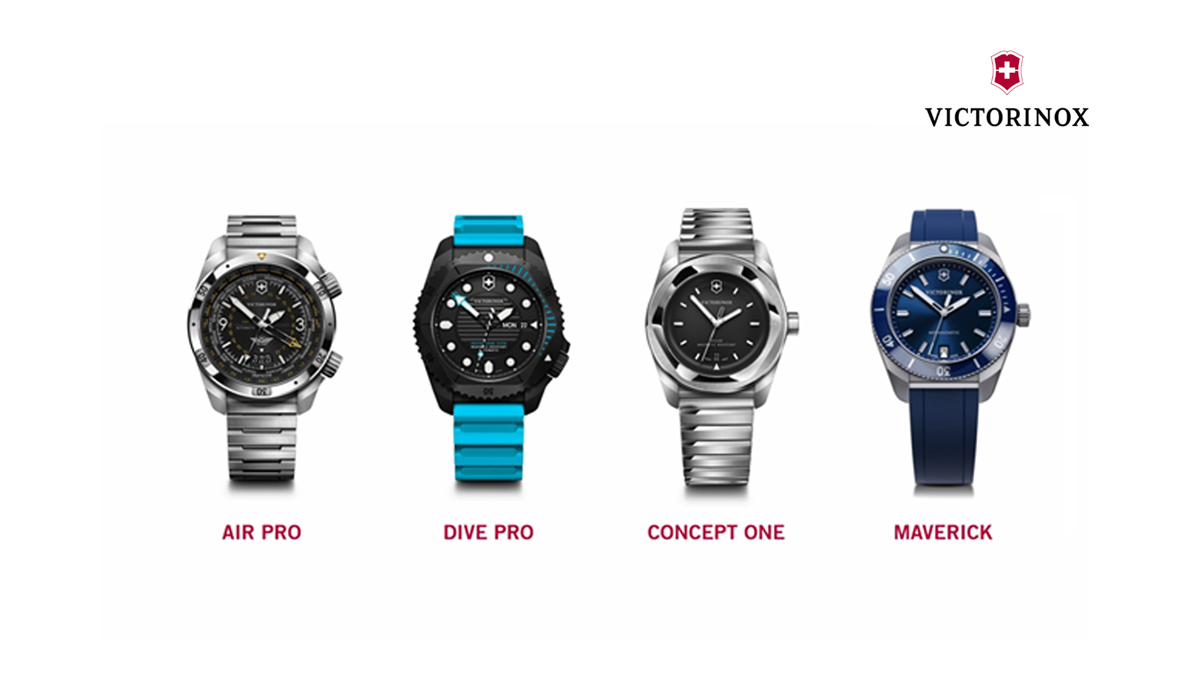
The Air Pro GMT Automatic is built for globally mobile professionals, tracking up to three time zones with ease. It pairs a refined GMT complication with everyday wearability, making it as practical in a boardroom as it is in an airport lounge.
The Concept One arrives in both automatic and solar powered versions. The solar models offer up to eight months of autonomy without light, while the automatic models deliver a 68 hour power reserve. It is a confident showcase of energy efficiency and mechanical know how.
For those drawn to the deep, the Dive Pro collection carries full ISO 6425 diver certification, with 300 metre water resistance, anti magnetic protection and serious shock resistance. These are purpose built instruments rather than lifestyle props.
Then there is the Square One, a bold square cased automatic that signals a more contemporary design language for the brand. It is confident, distinctive and refreshingly different.
Victorinox has also refreshed two of its most popular lines for the Indian market. The Maverick returns with bolder aesthetics aimed at modern wearers who prefer to lead rather than follow. Meanwhile, the I.N.O.X. Elegant combines the brand’s trademark toughness with refined detailing and interchangeable straps, offering durability with a touch of polish.
Together, the collections nod to India’s dual personality: resilient yet expressive, practical yet stylish.
After more than 140 years of Swiss craftsmanship, Victorinox is making it clear that in India its future is measured not just in heritage, but in horological credibility. From the engineering floors of Delémont to wrists across the country, the brand is no longer simply keeping time. It is staking a claim to lead it.



Brands
India’s food culture takes a bold turn in 2025
From fusion desserts to experiential dining, four trends reshape how the nation eats.
MUMBAI: India’s plates just got a serious upgrade in 2025 because when tradition meets TikTok and fusion meets fitness, even the humble samosa starts feeling trendy. The Godrej Food Trends Report 2025 predicted several shifts in Indian eating habits, and the past year proved the forecasters right. From reimagined desserts to immersive dining experiences, Indian consumers showed they want authenticity, convenience, global flavours and health in equal measure.
Here are four trends that truly came alive in 2025 and are now shaping how India eats and dines:
1. Indian Desserts Get a Modern Makeover Traditional mithai found fresh life through fusion experiments. Cheesecakes, truffles and plated desserts inspired by classics like gulab jamun and rasgulla gained popularity, while chocolate-forward, fruit-led and lower-sugar options appealed to younger diners. According to the How India Eats 2025 report, desserts and ice-cream parlours were among the fastest-growing segments in organised food services. Examples: The Bombay Canteen’s Coffee Rasgulla Sundae and Le Chocolate Cakes and More’s Gulab Jamun Cake. Chef Aarohi Sanghavi of Maki Patisserie noted the shift toward seasonality and fresh Indian produce, while Chef Heena Punwani of Maska Bakery highlighted the appeal of flexible, weekend-special menus.
2. Social Media Becomes the New Menu Food discovery went fully digital. Instagram Reels, YouTube reviews and creator-led content heavily influenced dining choices, with food remaining one of the most consumed categories on social media. Restaurants began designing visually striking dishes specifically for shareability, while many diners found new spots through viral videos rather than traditional advertising. The How India Eats 2025 report revealed that over 75% of marketing spends by leading QSR chains now go toward digital channels. Cafes like Mokai and Candies became creator favourites, and brands such as Bastian Hospitality curated highly shareable pop-ups and events. Kavita Rajwade of IVM Podcasts emphasised how long-form storytelling helps decode food’s cultural and economic layers, while Pranav Joshi of Floydian Cookery admitted his page grew far beyond expectations.
3. Snacking Culture Goes Mainstream India’s love for snacks evolved into a full grazing lifestyle, with many opting for multiple small bites throughout the day instead of three structured meals. This shift spurred innovation in formats—from gourmet chips and fusion street food to protein-packed options. Restaurants responded with small-plate menus designed for sharing. The How India Eats 2025 report noted that late-night orders grew nearly 3x faster than dinner. Brands like The Whole Truth Foods and Green Snack Co. popularised clean-label snacks such as protein bars and roasted nuts. Madhushree Basu Roy of Pikturenama Studios predicted a mix of convenience, health consciousness and global influences, while freelance food writer Sharmila Vaidyanathan observed that consumers want the best of both worlds healthy options for routine snacking and traditional treats for special occasions.
4. Dining Becomes an Experience, Not Just a Meal The most noticeable shift was the rise of experiential dining. Consumers increasingly sought restaurants that offered more than good food, they wanted immersion, storytelling and chef-driven concepts. Venues like Papa’s in Mumbai (intimate tasting menus), Bombay Daak (theatrical regional flavours) and Masala Library (modernist presentations) turned meals into memorable events. Tasting menus, themed pop-ups and chef collaborations became more common, transforming dining out into entertainment. The How India Eats 2025 report highlighted how experience-led formats and storytelling are key to attracting younger diners. Chef Karan Upmanyu of ParTTwo in Bengaluru observed that new outlets are breaking away from rigid formats, focusing instead on creating relaxed spaces where people simply enjoy spending time.
As 2026 unfolds, these trends suggest India’s food culture is no longer just about what’s on the plate, it’s about how the plate makes us feel, connect and remember. From a quick Reel-inspired snack to a full theatrical dining experience, Indian diners are voting with their forks for food that is both rooted in tradition and unafraid to experiment. The table, it seems, has never been more exciting.








