MAM
Vi and Team Vitality forge a strategic esports partnership in India Sub


Mumbai: According to the State of India Gaming Report 2022, the Indian esports industry is expected to grow to Rs 140 million by 2027. Over the last few years, esports as a category gained recognition as a mainstream sport especially after being debuted as an official medal sport at various international sports platforms. To capitalise on this growing consumer category, Vodafone Idea (Vi), one of India’s telecom operators and Paris based Team Vitality, international esports organisation, have announced a long-term union to boost the esports ecosystem in India.
With this first of its kind collaboration, the two brands jointly aim to create opportunities and exposures to esports fans and gaming enthusiasts alike. The partnership encompasses many aspects such as brand sponsorship, content partnerships, gaming events and unique experiences at a never-seen-before scale. This will enable Vi customers to participate in esports and allow exclusive access to some of the popular Team Vitality tournaments and teams. This partnership will create opportunities for budding esports talent from across the country to have access to professional players, master classes, meet & greets with esports talent and many other opportunities.
Vi is known for its presence in the mobile games segment, offering a wide range of hyper casual mobile games to users via Vi Games on Vi App. Through this association with Team Vitality, Vi now aims to deepen its focus on esports in India. Vi Games in the recent past forayed into the esports segment by hosting popular free-to-play tournaments across games like Call of Duty: Mobile, Free Fire Max, Asphalt 9, Clash Royale, etc.

Commenting on the association, Vi CMO Avneesh Khosla, said, “Gaming has always been our strategic focus area and we have continuously strived to strengthen our gaming portfolio with right partnerships and relevant offerings. Over the last few years, esports has revolutionized the mobile gaming arena especially with younger audiences, and hence, deepening our focus in this space was a natural progression for Vi Games. We are excited to partner with one of the leading esports organizations of the world – Team Vitality. Together, we aim to drive and democratize access to the esports ecosystem in India. In the coming months, we will introduce some exciting esports and other youth centric content for our consumers to experience.”
Speaking on the occasion, Team Vitality India managing director Randall Fernandez said, “We are exhilarated to announce our partnership with Vi. We are at a juncture where technology will catapult gaming to the next level and eagerly look forward to our journey together. We will unlock new horizons searching for aspiring gaming talent across the length and breadth of the country, set new precedents and create indelible marks within the esports industry.”
Locally, Team Vitality’s all Indian Call of Duty: Mobile (CODM) team were among the top 16 teams globally who qualified and competed in the CODM World Championship 2023 that was held in Atlanta, US between 15 and 17 December. The organisation previously roped in popular gaming content creators Nischay ‘Live Insaan’ Malhan, Rachit ‘Rachitroo’ Yadav, Nitin ‘Classified YT’ Chougale, Shagufta ‘Xyaa’ Iqbal and Pratik ‘Aurum’ Mehra who have a cumulative YouTube base of 20 million subscribers.
To capitalise on this upward growing industry and to build a deeper connect with consumers, Vi and Team Vitality plan to launch various gaming contests and events.






MAM
Madison World to launch AI platform M BrAIn for media planning
Agency group invests about $1 million as it shifts to AI driven growth planning.
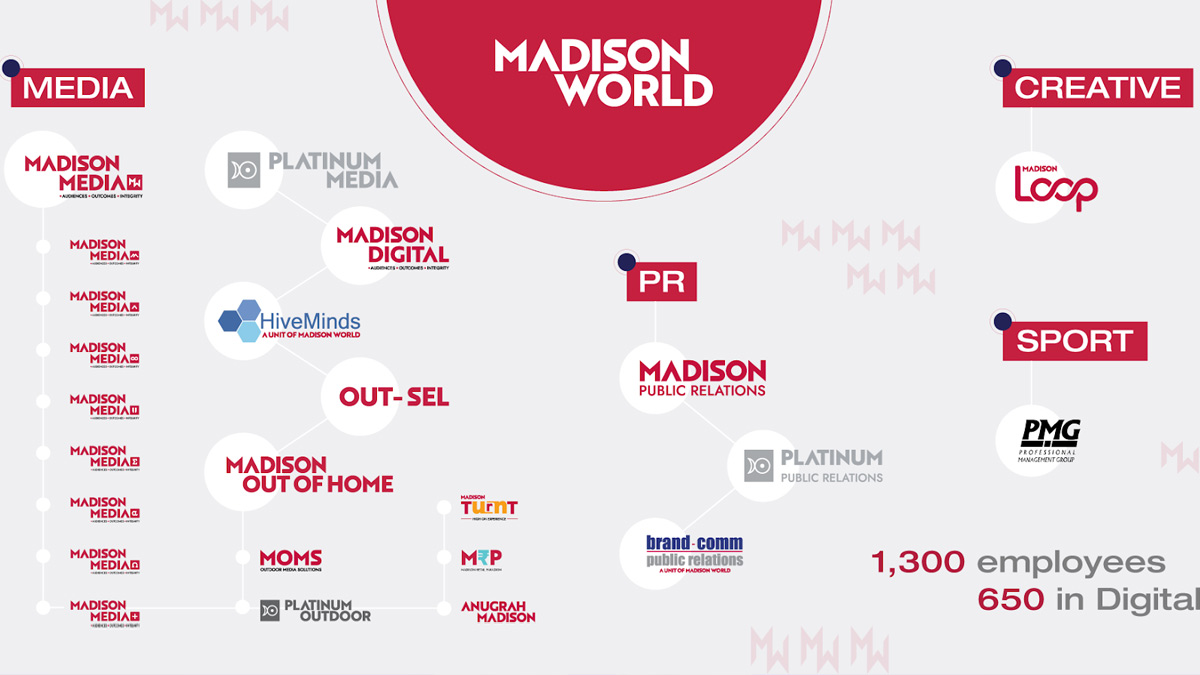
MUMBAI: If media planning once ran on spreadsheets and gut instinct, the next chapter may run on algorithms and curiosity. Madison World is preparing to roll out the first version of its proprietary artificial intelligence platform Madison M BrAIn in early April, as the independent agency group accelerates its transition toward AI driven planning and product led media services.
The platform, expected to involve an investment of around $1 million, is designed to reshape how the agency approaches strategy by combining internal knowledge, external data sources and advanced AI models into a single intelligence ecosystem.
According to Madison Media, OOH and Hiveminds partner and group CEO Ajit Varghese the initiative forms part of a larger structural rethink within the organisation. “Traditionally agencies built frameworks around media planning and allocation. We are redesigning that structure into what we call a Growth Planning System (GPS),” Varghese said.
The shift reflects a growing belief that effective media strategy must begin earlier in the decision making process. Instead of jumping directly to channel allocation, planners must first decode the market itself identifying consumer barriers, purchase triggers and the core challenges facing a brand.
Once those insights are mapped, agencies can build clearer growth agendas for clients and design media strategies that connect more closely with business outcomes.
To support that approach, Madison has built Madison M BrAIn as what it describes as a human AI cognitive ecosystem. Acting as a central intelligence hub, the platform aggregates proprietary insights alongside external data sources and large language models, enabling planners to access deeper market intelligence before building campaign strategies.
Varghese said one of the core objectives is to democratise knowledge across the organisation. “In the past, this level of understanding was largely available to senior leaders or experienced strategists. With Madison M BrAIn, even a junior planner should be able to access the same intelligence and approach clients with a far more informed perspective,” he said.
The agency has already implemented the new planning philosophy internally and completed three months of testing for the AI platform, with early trials showing encouraging results in terms of learning capability and system performance.
While the first version relied on global large language models, Madison is now developing its own proprietary Small Language Model (SLM) to serve as the core of the M BrAIn ecosystem.
“The SLM will be able to read global LLMs, but the LLMs cannot read the SLM,” Varghese explained. “That ensures all the intelligence we build remains within the Madison ecosystem and strengthens our proprietary knowledge base.”
The first version of Madison M BrAIn is expected to go live in early April, with a more refined version targeted by the end of June. Over time, the platform will integrate additional external data streams and APIs including consumer insight platforms, social listening tools and client datasets.
These integrations are expected to enhance the system’s learning capability and enable it to generate increasingly sophisticated strategic recommendations.
Although the platform is currently being deployed for internal use, Madison sees potential for it to evolve into a licensable product in the future.
“At the moment, our focus is to stabilise and strengthen M BrAIn internally. But over time there is potential for this to become a product that could be licensed externally,” Varghese said.
The AI platform is also part of a wider technology transformation underway at the agency group. Alongside M BrAIn, Madison is building a broader digital infrastructure called the Catalyst operating system, which aims to integrate operational processes, data and product platforms into a unified ecosystem.
This broader technology stack could require an additional $1 million to $1.5 million investment over time, though spending will be phased and reviewed regularly.
“We are evaluating progress every three months and prioritising the most critical capabilities first,” Varghese said.
Madison expects the full AI and operating ecosystem to be fully functional within 12 to 18 months, positioning the agency to combine human strategy with machine intelligence as the advertising industry enters its next data driven phase.







