MAM
Vernacular content consumers to be 2.5 times English by 2021: Deloitte


MUMBAI: Deloitte India has launched the eighth edition of its report on technology, media and telecommunications which predicts major advances in machine learning, voice over LTE (VoLTE) technology services and over-the-top (OTT) platforms, apart from other trends.
According to the report, VoLTE is expected to be the most prevalent voice technology in the future. It is also estimated that more than 90 per cent of all mobile subscribers will comprise of broadband subscribers by 2023. OTT platforms are witnessing an explosion in original content due to increase in consumption and viewership, the report says, adding that they will gradually become a preferred medium over television, with the consumers of vernacular content likely to be over 2.5 times that of English language content by 2021.
The publication highlights the fact that machine learning will intensify among medium and large-sized enterprises. Compared to 2017, the number of implementations and pilot projects using machine learning technology is likely to double in 2018 and then double again in 2020.

As enterprises in India embrace technology to bring transparency and efficiency in business operations, data assumes centre stage in decision-making, setting the stage for tools such as advanced analytics and machine learning to usher value-chain efficiencies, a Deloitte India spokesperson said. Organisations will take steps to realise the potential of the internet of things (IoT) for their businesses, predictive analytics and intelligent data mining technologies are set to become mainstream in India.
Deloitte India Partner PN Sudarshan, said, “India is one of the fastest growing technology markets in APAC, with the ongoing digital transformation of public sector and private sector enterprises enabled by changing market dynamics and policy interventions. Enterprises across industries are increasingly adopting technology driven solutions to improve customer experience, optimise business operations, and compete effectively in the market. Catalysed by the availability of cost effective computing infrastructure and flexible business models through cloud computing, and the adoption of exponential technologies such as AI, ML, AR, IoT etc., technology sector in India is truly at an inflection point.”
He further added, “Trends such as IoT will catalyse the emergence of analytics at the edge. Digital revolution, also known as ‘The Internet Economy’ is creating a new market for digital-first services, which has the potential to optimise value chains, bring transparency, and improve overall productivity in the economy.”
Newer technologies like LTE, LTE-A, LTE-A pro and 5G will make wireless internet commercially more viable for home internet users. The smartphone riding on new innovation will consolidate its position as the primary access to digital services and content, and live streaming and OTT video content are likely to gain popularity.
IoT-driven point solutions will be adopted to solve a specific business issue. IoT-driven enterprise solutions would help organisations redefine their business models and provide innovative services for their customers; investments will not only be assessed on KPIs, but also will involve new product launches, new supply chains and a new operating model that enables organisations to monetise their services across value chains, leveraging IoT.
Analytics will finally travel beyond the back office as enterprises will combine external perspectives, social inputs (surveys, social media comments, response to a feedback questionnaire) to the internal data sources to improve customer service. Device data will be integrated faster and on-demand to answer immediate field needs; information dissemination for decision-making will be faster and simpler using digital delivery; paying for results and provisioning on demand is the new normal (on cloud).
Deloitte also predicts that more than 60 per cent of all broadband subscribers would be utilising VoLTE technology for voice services by 2023 surpassing five billion subscribers globally. IoT appliances can be enhanced with VoLTE improving the productivity and efficiency of applications and especially effectiveness in emergency situations. One example is a smartwatch with a feature to automatically dial an emergency contact in case of abnormal heart rate. Wi-Fi would be an essential part of service provider network strategy to enhance access and extend coverage. With VoLTE supporting VoWi-Fi (Wi-Fi calling), it would be an opportunity to monetise hot-spots especially relevant in the Asia-Pacific region which would constitute 45 per cent of global hotspots.
Sports media in India is set to unlock new horizons as Indian sports business will continue to attract global investments. With broadcasters paying as much attention to rural segment, these geographies will continue to lead the way for sports sector in India, especially with tier II leagues beginning to receive widespread attention. Data analytics will increasingly play a significant role in managing all aspects of sports, especially on initiatives such as fan engagement and viewership on digital platforms. Governance-related matters will continue to be in focus in Indian sports ecosystem, and topics such as legalising betting will be discussed more than before.
Wireless home internet is bigger than imagined but due to challenges in deployment of fixed broadband networks, current rural internet penetration stands at a negative 17 per cent. In future, demand for fixed broadband would be limited to consumers with higher bandwidth/QoS requirements, with majority of home internet requirements catered through wireless network.
Augmented reality (AR) is on the cusp of reality as the Indian market is witnessing the emergence of AR service providers helping enterprises embrace it as part of their digital experience strategy. India’s $150 billion technology services industry has the potential to play a key role in increasing the adoption of AR for global businesses by building a robust supply of talent, business models, and frameworks to accelerate deployments. The public sector also has the opportunity to leverage the product and talent ecosystem in the country and adopt AR for improving the quality of experience in areas such as education and healthcare.
Also Read :
Media and marketing professionals most vacation deprived: Expedia Report 2017
55% marketers make better decisions with machine learning: iProspect report
India ad spend to grow by 12.5% in 2018: DAN report
M&E industry to hit Rs8 trillion revenue by 2022: report







Brands
IICT partners with Gativedhi to bring studio production tools to students
New MoU lets students explore AI-driven production pipelines for AVGC-XR
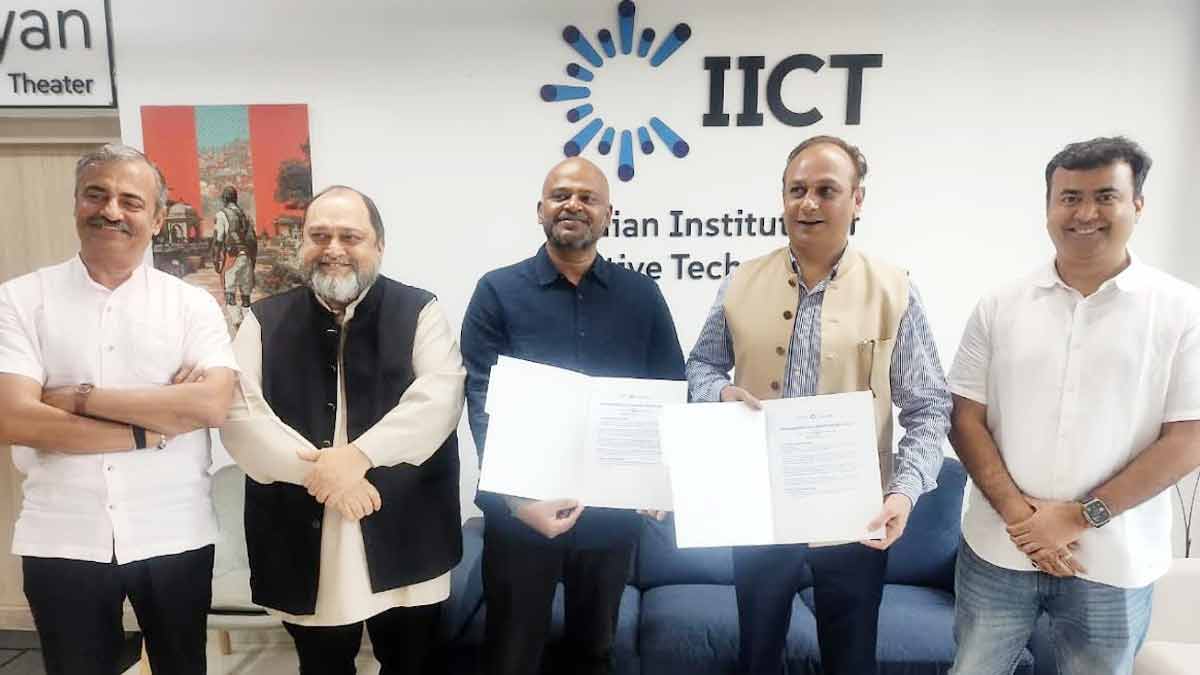
MUMBAI: The Indian Institute of Creative Technologies (IICT) has teamed up with Gativedhi Technologies to give students a front-row seat to modern studio production. The collaboration will integrate Gativedhi’s AI-powered production intelligence platform, Shotrack, into academic programmes, letting students experience the workflow systems used by animation, VFX and gaming studios.
Under the MoU, faculty, students and researchers will get hands-on access to Shotrack through beta programmes, pilot deployments and academic evaluations. This will allow them to explore simulated production pipelines, understand asset management, track tasks and monitor schedules, essentially seeing how complex projects come together behind the scenes.
Shotrack is designed to tackle a key industry challenge: when multiple studios work on the same project, differing internal systems often create bottlenecks, slow approvals and complicate version control. The platform provides a unified production environment, enabling smoother collaboration across distributed teams while generating operational insights and predictive analytics to optimise crew allocation, forecast schedule risks and manage costs.
The collaboration also opens doors to Gativedhi’s wider ecosystem. Upcoming tools include StudioTrack, for studio operations management covering budgeting, recruitment and IT infrastructure, and WorkTrack, which measures workflow efficiency and team productivity across industries.
IICT plans to embed these tools into programmes covering animation pipelines, VFX workflows, gaming production and media project management. Students will also benefit from guest lectures, masterclasses, workshops, internships and research projects that connect academic learning with real-world studio practices.
IICT CEO Vishwas Deoskar, said the partnership provides “An environment where production pipeline tools can be explored, tested and refined while students gain insight into how large-scale productions are organised.”
Gativedhi Technologies founder & CEO Senthil Kumar added, “This collaboration introduces students to real-world studio management tools and helps us improve our platform with academic feedback.”
With Shotrack in classrooms, India’s future animators, VFX artists and gaming producers will get a taste of studio life long before they step into one.