MAM
Until human crisis is sorted, nothing will make sense: DDB Mudra Group’s Aditya Kanthy


NEW DELHI: We are living in unprecedented times. The world order stands changed and the economy is reeling through a massive disruption. Everyone is gearing up for a ‘new normal’ but if DDB Mudra Group CEO and MD Aditya Kanthy is to be believed, the tomorrow will as much be our old habits as our new behaviours.
In an exclusive conversation with Indiantelevision.com, he talked about how he is dealing with work-from-home, how the agency and the industry is coping up with the disruption, and what the future has in store for us. Kanthy quoted Bill Bernbach, one of the founding members of the agency he heads today, “It is fashionable to talk about changing man. A communicator must be concerned with unchanging man, with his obsessive drive to survive, to be admired, to succeed, to love, to take care of his own,” to put forth his vision for the future.
Edited excerpts from the conversation:

How has the COVID-19 pandemic affected the team? How are they handling the situation?
It’s a tough situation, no doubt, at every level, at home and at work. This is not a regular work-from-home experience, of course. It is not something that people have dealt with in the past. So there’s no rule book here. It is a massive crisis and there are all sorts of implications that we’re dealing with – economic, social and psychological. It’s all new and the only way to tackle it is to accept the scale and seriousness of it. And do what’s needed to get better at dealing with it one day at a time – together. It’s also a moment in history that ought to remind us of our sense of privilege and assess our priorities as people and communities.
This is what we’re trying to do. And I’m so proud of the way our teams have responded to the challenge. It is a tribute to the culture they’ve fostered. I have seen the 850+ people on the team coming together, checking on one another, helping each other through this, coming through for our clients and doing their best for the community.
How are you maintaining a healthy work-life balance?
I’m not – is the honest answer. It’s all work right now. It is quite difficult as the lines between work and life blur. I’m still figuring it out but I think I am getting better at it each day like everybody else. Getting a routine going has helped. Taking the time to step away a few times every day and gather one’s thoughts and spirit.
It is my tremendous fortune that I am surrounded by incredibly good and talented people at work; they're a huge source of strength for me as well. So that helps. And at home, my family has been incredibly supportive.
The advertising industry is being touted as the backbone for many businesses with media consumption rising. There might be a little more than expected on your plate these days, but with certain restrictions. How has the experience been for you when it comes to the volume of work?
Advertising reflects (and shapes) the economy and the culture. I don’t think it is right to say that advertising will continue to thrive unimpeded through this time.
Besides, while there may be more media consumption, is selling a priority right now? Surely not. This is what I meant earlier when I talked about a sense of perspective and privilege for us in these times. Resources and efforts are and must be directed in areas that need the most attention to deal with this humanitarian crisis. Everything else follows.
As far as businesses go, the situation is far from rosy. The demand side problems are obvious. Even in categories where there is demand, there are huge supply-side/ supply chain and distribution issues. Liquidity and credit is a challenge. Advertising is dependent on all of these factors.
The industry depends on marketers who have the appetite and the means to invest. That is compromised in the current market scenario. It cannot operate in isolation.
So yes, there is a lot of work. But its nature and form are different from business as usual. It is more consultative in the spirit of client partnership. We are working together to find answers to the hard questions that are emerging each day for their businesses and ours. It is important to acknowledge that change regardless of increased media consumption.
We recently had a virtual conference with marketers and agency leaders. One of the panellists mentioned that they might have more creative work to do but everything is not resulting in revenue. How has it been for DDB Mudra?
Clients don’t produce work without the expectation of some sort of business outcome – long and/or short term; brand and/or buy. If we’re doing work, there is a return on it either now or in the future. So it’s like that with the work we’re doing too. It’s a different matter that it feels like a lot more work, but that’s because of the demanding circumstances in which work is being created and not a work-revenue relationship issue. I think the bigger question is whether or not there is a genuine need to do a certain thing at this time and working with clients to help them make that decision. And that answer varies from market-to-market and category-to-category.
What impact are you expecting on your cash registers?
We run a January-December fiscal year and ended Q1 better than planned. It is impossible to answer this question with complete honesty or certainty as we are only three weeks into the second quarter. Needless to say, we are definitely not expecting the kind of results that we had in the last five quarters. We’re not in denial about the economy. The next few months are going to be tough. We will have to acknowledge the situation and not pretend that everything is hunky-dory. Regardless of how quickly the lockdown is lifted, the problem isn’t going away in a hurry.
Until you sort out the human risk, nothing will make sense.
Yes, it is a human crisis and human resources are facing the wrath across industries. How is it going to be in the advertising industry? Are there going to be pay cuts, layoffs, or any other harsh measures?
It is too early to answer this question. Until four weeks ago, we were closing our first quarter, and the situation was really different. These decisions are a function of how the economy responds through the quarter. As far as marketers are concerned, the stakes are high. They have factories and capital locked up. The numbers are much more daunting on that side. It’s inevitable that their decisions will have a bearing on our industry as well.
Once the medical and human side of this gets cleared, the situation will be quite different. That has to be everyone’s priority right now. I hope that the extent of this difficulty can be managed and we can make a phased recovery. And that in doing so, the human cost, both from the medical and economic point of view can be contained.
What are you expecting from the “new normal”? How are you prepared to deal with that?
I think the idea of the “new normal” is a little misleading. The situation, in India, is a few weeks in and at best a few months in other parts of the world. No one has a plan for the scenarios that we are seeing today. To suggest that we can be prepared for something, we should be able to visualise that something.
And right now, it is at best an imperfect picture. We have to be prepared to keep changing and refining our response as we go along.
Who knows what the “new normal” is. Will it change everything?
If there’s one thing human history teaches us it is that while change is inevitable, we are also very quick to go back to certain habits and act of certain fundamental instincts. It’s our job to work through both those forces to makes sense of things.
As far as this moment in history is concerned, I certainly hope it draws our attention to the need to focus on the things that really matter. Our collective attentions as communities, businesses and citizen must be drawn to the huge inequalities and gaps in access to opportunity and means in society. We have to find a way to bring health, education, the environment and social infrastructure centerstage. That’s what the new normal ought to look like. Time will tell.
We are prepared for change. It starts with the skills and capabilities. We have what it takes and a commitment to learn what we don’t know. As a group with talented people who are as comfortable with brands and creativity as they are with technology and design. I feel confident that we’re up for it.
The second important thing in dealing with change is the organisation’s culture and I couldn’t be more confident on that front.
Finally, our deep and long-standing relationships with our clients. We’ve worked with many of them through thick and thin. We will do that again. The degree of partnership with clients is critical – being a part of the solution and shaping this future together.






MAM
JioStar unveils ‘The Winning Edge’ playbook for live cricket advertisers
Data-led guide shows multi-screen, sponsorship strategies drive higher impact
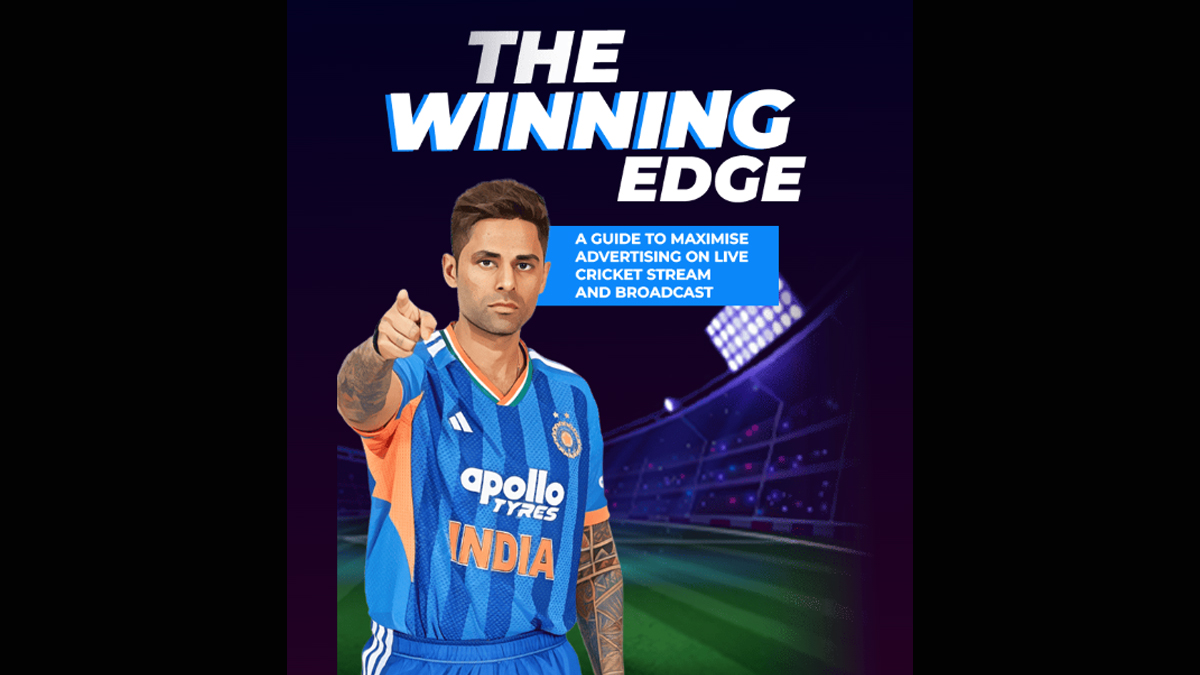
MUMBAI: JioStar has launched ‘The Winning Edge’, a data-backed advertising playbook aimed at helping brands maximise impact on live cricket, positioning the sport as one of the most powerful marketing platforms in India.
Built using billions of impression-level data points across marquee cricket properties and validated through studies by Kantar, the playbook offers practical insights into how brands can drive measurable outcomes such as awareness, recall and purchase intent.
The findings make a strong case for live cricket as a growth engine for both new and established brands. According to the report, new advertisers on live cricket campaigns saw up to 6.9 times higher brand awareness and up to 10.8 times higher purchase intent compared to industry benchmarks. Established brands also recorded gains, with up to four times higher awareness and nearly five times higher purchase intent.
Speaking about the initiative, JioStar head of sales sports Anup Govindan said, “The Winning Edge, developed in partnership with Kantar, is built on rigorous, data-backed analysis of how real brands have performed on our platform across categories, objectives, budgets, formats and tournament phases. The study reaffirms that when it comes to driving real outcomes such as awareness, consideration and purchase intent, nothing matches the intensity, scale and impact of live cricket. The depth of attention and emotional engagement during live moments creates a multiplier effect that non-live environments simply cannot replicate.”
One of the standout insights is the advantage of multi-screen strategies. Campaigns that ran simultaneously across linear TV, connected TV and mobile delivered up to seven times higher purchase intent than single-platform campaigns, with minimal audience overlap ensuring incremental reach.
The playbook also highlights the impact of combining formats. Brands using both video and display formats saw up to 7.4 times higher brand awareness compared to those relying on video alone.
Sponsorships emerged as another key lever. Brands with formal sponsorship deals recorded up to nine times higher purchase intent and up to eight times higher ad awareness than those opting only for standard inventory buys. Adding pre and post live studio programming further boosted aided awareness by up to 2.1 times.
Crucially, the report identifies high-impact in-match moments such as Super 4s, Super 6s, DRS and fall of wickets as prime opportunities for brands. Campaigns aligned with these moments delivered uplifts of up to 10 times in awareness and up to seven times in recall, reinforcing the value of contextual advertising.
Echoing these findings, Kantar managing director and chief client & solutions officer Soumya Mohanty said, “Numerous Kantar Brand Lift Studies have demonstrated the incremental impact of live cricket advertising, with results consistently ranking at the top end of Kantar’s Brand Lift database. This playbook distils those insights into actionable media planning and creative recommendations to help advertisers drive stronger outcomes in live cricket environments.”
With live cricket continuing to draw massive, highly engaged audiences, JioStar is positioning ‘The Winning Edge’ as a blueprint for brands looking to move beyond visibility and towards measurable impact.
As the competition for consumer attention intensifies, the message is clear. In the world of sports marketing, playing smart may matter just as much as showing up.









