Brands
Unilever’s New Chief Sets Ambitious Growth Agenda

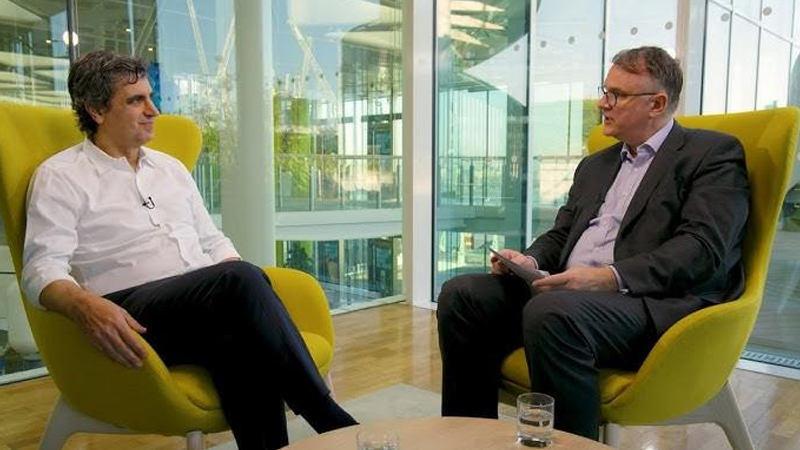
MUMBAI: “Desirability at scale and marketing activity systems of ‘others say’ at scale will be the fundamental principles of our marketing strategy. I’m 100 per cent behind that. I need to ensure this happens in the company.”
Those were the emphatic words of Unilever’s new CEO. Fernando Fernandez, who has barely warmed his seat before diving headfirst into a fiery fireside chat with Barclays’ Warren Ackerman. In his first week at the helm of the consumer goods giant, Fernandez wasted no time laying out his ambitious roadmap: turbocharging innovation, premiumising Unilever’s portfolio, and tackling underperforming geographies—all while ensuring his leadership is more action-packed than a telenovela.
Unilever is no stranger to corporate shake-ups, and Fernandez’s ascension to the top job has sparked curiosity, speculation, and a fair share of raised eyebrows. Investors were blindsided by the sudden departure of Hein Schumacher, whose tenure was seemingly on track. Addressing the elephant in the room, Fernandez made it clear, “This is a forward-looking decision. It’s not a retrospective one.”

The board, he said, believed he was the right fit for the next phase of Unilever’s evolution. Translation? He’s the man to push things harder and faster.
That means no time wasted. With the ice cream business out, emerging markets are becoming even more critical. But Fernandez is keeping his eye on the prize: “Investors put pounds, euros, dollars—they don’t want Argentinian pesos.”
His holy grail?
Hard-currency EPS growth, powered by volume and margin expansion.
No excuses.
With the ice cream division about to be spun off, Unilever still expects four to six per cent growth in 2025. Fernandez exuded confidence: 2024 saw a 3.5 per cent revenue boost, 13 per cent profit growth, and the company topping shareholder return charts. “No skeletons in the closet,” he assured.
Fernandez reaffirmed the plan to demerge the division, listing it in Amsterdam with secondary listings in London and New York.
“We separated ice cream because we always saw it as a clear outlier in our portfolio,” he explained, with the kind of decisiveness that suggests he’s already moved on. “I’m absolutely convinced that this separated and independent ice cream company, with a different ownership structure, will make that business thrive.”
If there’s one thing investors have been demanding, it’s speed. The message from Unilever’s chairman Ian Meakins and activist investor Nelson Peltz is clear: stop dawdling and unlock value. Fernandez, who has been with Unilever for 37 years, insists he’s ready to go full throttle.
“I have never crossed paths with an employee who told me, Fernando, we are going too fast,” he quipped. “The contrary, some people say, why are we going so slow?”
Under his watch, Unilever will ramp up investments in premiumisation. The company’s North American business is already leading the charge, with its prestige beauty and wellness brands like Liquid I.V. (now an €850 million brand) and Nutrafol (€650 million) expanding at a breakneck pace. But Europe? “We have neglected Europe for many years,” Fernandez admitted. “That has changed in the last couple of years. We have innovated substantially in Europe, and you have seen our volume growth in Europe close to 4 per cent last year.”
India is central to Fernandez’s strategy. “There are 60 million affluent Indian households now,” he noted. Quick commerce, a channel currently contributing two per cent of Unilever’s Indian sales, is projected to rise to 10-15 per cent within the next three to four years. “India is a very special place because richer Indians and poorer Indians live in close proximity, which provides demand and supply of labour. That made quick commerce a logical channel to grow.”
“If you were running Unilever, you wouldn’t trade our Indian business for anything,” quipped Fernandez.
India is Unilever’s second-largest market, making up 12 per cent of global sales, but lately, the numbers have been looking more ‘meh’ than marvellous. The past year has seen growth slow down as Indian consumers clutch their wallets tighter, thanks to inflation making essentials feel a little too premium. Regardless, Fernandez remains optimistic about its long-term potential.
“The economic environment in India will get better in the second half of the year,” he assured. The Indian government has introduced measures to stimulate growth, including a significant reduction in interest rates and €500 billion in household loans. Additionally, cuts in personal income tax and a shift from food inflation to food deflation are expected to boost disposable income and consumer spending.
“The only category in which we have some headwinds due to channel and segment development is in beauty. We have positive momentum in home care, personal care, and foods,” Fernandez pointed out.
The acquisition of Minimalist, a fast-growing prestige beauty brand, is part of Unilever’s plan to capitalise on India’s changing consumer landscape.
Fernandez is adamant about making Unilever a market leader in premium beauty in India. “If you ask me, do you prefer quick commerce to marketplace in terms of channel development? Yes, of course. Quick commerce is a limited assortment channel. For companies like us that have such a presence in India, that’s a favourable development of channels.”
Beyond premiumisation, Fernandez has some heavy lifting ahead. The disposal of non-core food brands, particularly in Europe, is on the table. Meanwhile, ice cream’s demerger is progressing rapidly, with “11 workstreams absolutely on track” for a separation by the end of 2025.
Then there’s the hunt for a new CFO. With Fernandez shifting from finance head honcho to executive boss, Unilever needs a strong financial steward.
“I would like to have somebody who is complementary to me,” he explained. “Somebody with a good reputation with the markets, a good communicator, and a real focus on performance management.”
If Fernandez’s strategy can be summed up in one word, it’s “desire.” Whether it’s driving desirability at scale or using AI and influencers to make Unilever brands more aspirational, he’s determined to inject a bit of sex appeal into the FMCG giant.
Unilever is flipping the script on marketing. Ad spend jumped from 13 per cent to 15.9 per cent of sales in 2024, and Fernandez wants more.
“Marketing activity systems in which others can speak for your brand at scale is very important,” he explained. “There are 19,000 postcodes in India, there are 5,764 municipalities in Brazil. I want one influencer in each of them.”
And where does that leave Unilever’s numbers? Investors will be watching closely as Fernandez attempts to hit the mid-single-digit growth target for 2026. “Our guidance is based on a hypothesis of three per cent GDP growth. If inflation is higher, we need to revise. If GDP growth is getting lower, we need to revise.”
Before wrapping up, Ackerman quizzed Fernandez on two essential matters—his favourite football team and his favourite book. Turns out, he’s a die-hard San Lorenzo de Almagro fan and an admirer of Mario Vargas Llosa’s The War at the End of the World.
“I like competitive wars and I’m coming from the end of the world,” he joked.
With his ambitious plans, rapid-fire decision-making, and no-nonsense approach, Fernandez may just be the shake-up Unilever needs. The question now: will he turn the consumer giant into a marketing powerhouse, or will the pace of change outstrip execution?

Brands
Microsoft faces worst quarter since 2008 financial crisis
Cloud giant battles soaring AI costs and fierce competition from nimble startups.

MUMBAI: When the tech titan starts looking a little wobbly, even the Magnificent Seven can feel the tremors because Microsoft is currently starring in its own sequel, “Clouds and Doubts.” Microsoft is on track for its worst quarterly performance since the 2008 global financial crisis, according to Bloomberg, as investors grow increasingly uneasy about rising capital expenditure and intensifying competition from nimble AI firms. The company has been pouring money into AI infrastructure, yet markets are questioning when these hefty investments will finally deliver stronger revenue growth.
At the same time, investors are shifting away from traditional software stocks amid fears that AI startups such as Anthropic and OpenAI are developing autonomous agents capable of replacing established products, including those from Microsoft. Jonathan Cofsky, portfolio manager at Janus Henderson Investors, noted growing concern that customers may bypass Microsoft and deal directly with AI vendors, potentially disrupting its core business and putting pressure on pricing and margins.
Microsoft’s stock has tumbled 25 per cent in the first quarter, putting it on course for its largest drop since a 27 per cent fall in the fourth quarter of 2008. It has also emerged as the weakest performer among the so-called Magnificent Seven technology stocks, while a broader index tracking the group has fallen 14 per cent over the same period. The shares slipped a further 1.7 per cent after markets opened on Friday, marking a potential fourth consecutive session of declines.
Cofsky pointed out that Microsoft has become more capital intensive and that improved investor confidence will hinge on assurances that software growth will not slow materially. Despite the sell-off, the stock is now trading at less than 20 times projected earnings over the next 12 months, its lowest valuation level since June 2016. Its valuation remains slightly above that of the S&P 500 Index, although it has recently traded at a discount to the broader benchmark for the first time since 2015.
Bloomberg data shows Microsoft’s capital expenditure, including leases, is expected to surge to $146 billion in fiscal 2026, up around 66 per cent from $88 billion in fiscal 2025. Spending is projected to climb further to $170 billion in fiscal 2027 and $191 billion in fiscal 2028, based on average estimates. Investors are growing cautious about such levels of spending without clearer signs of stronger growth.
Microsoft’s Azure cloud division has reported a slight slowdown in growth compared with the previous quarter, while its Copilot AI product has seen limited user traction, prompting internal changes aimed at improving performance. Ben Reitzes, an analyst at Melius Research, warned in a March note that Microsoft’s upside in Azure could be constrained as the company works to address challenges related to its AI models and Copilot offering, adding that these issues are unlikely to be resolved in the short term.
Of the 67 analysts covering Microsoft, 63 maintain buy ratings, three hold ratings and one a sell rating. The average 12-month price target of $592 implies a potential upside of more than 64 per cent, the highest on record based on data going back to 2009. The stock is also trading below its 200-day moving average by the widest margin since 2009.
Reitzes suggested the dominance of buy ratings may indicate complacency among analysts, while highlighting risks in Microsoft’s productivity and business processes segment as well as its More Personal Computing division. In contrast, Tal Liani of Bank of America reinstated coverage with a buy rating, citing durable multi-year growth prospects across cloud and AI. Jake Seltz, portfolio manager at Allspring Global Investments, maintained that Microsoft retains strong long-term value and that its AI strategy is likely to be validated over time, viewing near-term concerns as a potential opportunity for longer-term investors.
The report highlights a growing divergence in market sentiment, with optimism around long-term AI potential weighed against immediate execution risks and investor uncertainty. In the world of big tech, even the mightiest clouds can have silver linings but right now, Microsoft’s investors are scanning the horizon for clearer skies.








