MAM
Tobacco & advertising – ‘made for each’ other no more


It’s the festival of lights. And for many the festival of noise courtesy exploding fireworks. In the hope of reducing the number of those belonging to the latter tribe, we, at indiantelevision.com, decided to put a display of firecracker articles for visitors this Diwali. We have had many top journalists reporting, analysing, over the many years of indiantelevision.com’s existence. The articles we are presenting are representative of some of the best writing on the business of cable and satellite television and media for which we have gained renown. Read on to get a flavour and taste of indiantelevision.com over the years from some of its finest writers. And have a happy and safe Diwali!
Written By BIJOY AK and HETAL ADESARA
(AK Bijoy today works for a news agency; while Hetal mentors the young budding talent at indiantelevision.com these days)

Posted on 29 April 2004
 May 1 is Labour Day. 1 May will also go down in history as the day when cigarette advertising (of the type we have been used to) went up in smoke in India.That’s the day when the government’s diktat stubbing out cigarette and tobacco advertising, and smoking in public places will come into force. No more will the stick sellers be huffing and puffing, exhorting you to buy an individual brand from your newspaper, and radio set, the roadside billboard, or the cinema screen. Promoting themselves through ads could be injurious to tobacco companies’ health.
More than aware of this, the Indian tobacco majors and their marketing strategists have been scurrying around with their thinking caps on in order to come up with strategic and tactical ploys to continue to hammer their communication and product messages to cigarette smokers.
The tobacco industry, which contributes Rs 70 billion to the government by way of excise, will be forced to cut down Rs 2,500 million of their advertising

budget with the ban. According to industry sources, the ban is going to take a heavy toll on tobacco companies, outdoor ad agencies, hoarding suppliers, charity organizations who rely very much on the tobacco companies’ sponsorships, etc.
“Apart from outdoor agencies, tobacco companies who rely heavily on outdoor promotions are going to bear the brunt,” feels Maxus India managing director CVL Srinivas.
No wonder, outdoor agencies, like Ogilvy Landscape which handles the account of ITC cigarettes, sound very upset about the ban. Ogilvy Landscape managing consultant (West & North) Nabendu Bhattacharyya reveals, “It is going to affect us to a large extent and obviously we are very upset about it.”
He adds: “Tobacco-spends on outdoor, excluding retail signage, as per my estimate would be about 10 per cent of the outdoor spends in the country. The Indian outdoor industry would be about Rs 6000 million and tobacco advertising on outdoors will account for Rs 600 million approximately.”
According to an outdoor advertising agency executive, the ban has made a negative impact on the outdoor advertising industry’s revenue. “The big hoardings that were occupied by tobacco companies are now being taken up by telecom companies,” the executive said on condition of anonymity.
 “Advertising is one of the several factors influencing consumption in this category. More people smoke because of the habit, than advertising. Agencies that handle tobacco products will obviously lose money,” explains Ravi Kiran, managing director, Starcom Worldwide India – west/south.
Ad agencies, which handle accounts of major tobacco players, are facing the heat. These include ITC’s agencies Lowe, O&M, JWT and Initiative Media, and Rediffusion, which handles the account of Godfrey Philip India. Pan masala brands have been handled by many large and small agencies.
The media that would fall under the new law that bans all tobacco advertising include print, television, outdoor, Internet, etc. Kiran gives a low down on the revenue each medium will stand to lose with the ban.
According to Kiran, print would lose Rs 1,000 million while TV will see Rs 350 million evaporating. A Rs 100 million loss is estimated for cinema while for outdoor hoardings it could be Rs 600 million. Internet, radio and sports, however, would suffer only negligible loses with the ban, he says.
Though the ban would force them to mellow down on their advertising activities, tobacco companies have already started taking the changes in their stride.

Since the last one year, the industry was anticipating such a ban as India signed and ratified the International Framework Convention on Tobacco Control.
Proffers Godfrey Philips India (GPI) senior vice-president (corporate affairs) Sundeep Kumar: “…this is not an abrupt decision. Since Parliament has approved the bill, we are bound to accept it. What’s worse, now even sampling is not permitted.”
GPI, which spends above Rs 200 million on outdoor and point of sale advertising, spends only a negligible amount on print advertising, as the company doesn’t have many premium brands.
 “So there is no point in us advertising heavily in print that would rarely reach our targeted customers. We had been relying on outdoor ads. Now we would focus on in-shop advertising. We are allowed to display two boards in every shop,” informs Kumar.
“This is not the first time we are facing such a law,”he points out. “This has happened earlier also when tobacco ads were banned on TV. So we have the experience. And more than that, tobacco companies have never relied much on advertising and so, such a law can never impact the business. In Singapore where ads are banned, the market is growing. At the same time in the US where the ads are allowed, the market is shrinking,” offers Kumar.
“We were expecting this ban for quite some time now, so we were kind of prepared for the change,” says Ogilvy Landscape’s Bhattacharyya.
“Since the past year, tobacco companies have deliberately kept a low profile anticipating this ban. They had been making strategies looking at a long-term goal,” informs Mindshar
e managing director Ashutosh Srivastava.
According to Starcom India executive director (north) Anita Nayyar, companies like ITC and GPI, which have been very far-sighted and saw the ban coming, have very successfully ventured into trade mark diversification or brand extensions. “Companies who adopted the long term strategy of diversifying into a brand extension will surely gain now,” feels Nayyar.
An interesting observation that could be made in the wake of this ban is that, it could ultimately prove to be a blessing in disguise for big and established

players like ITC and GPI. The reason? Their brands have got higher brand-recall value and they won’t need much of advertising to push their products further. At the same time, smaller tobacco companies and new entrants would find it extremely difficult to establish themselves in this changed scenario.
 “Yes, established companies will have an easier time,” feels Triton Communications executive director Vivek Srivastava.
So, how effective is this ban going to be? Who is going to monitor them? Srivastava has the answer:
“The monitoring system is already there and it is very easy for the government to check. None of these big companies like ITC or GPI will play with the law of the land.”
So once the ban is imposed, where would all this ad money be diverted? Industry sources indicate that there won’t be a huge surplus, as changing strategies would cost them some money.
“Even, the changing of outdoor boards and investing in new promotional plans would cost us almost the same amount as we had been spending on advertising,” says Kumar.
Srivastava feels that the surplus will be utilised in below-the-line (BTL) activities. According to Kiran, the money would get diverted to retail signage, promotions inside movies and music (read: product placement), for localised private events and direct-to-consumer initiatives etc.
“Tobacco manufacturers will also learn to use principles of permission marketing rather than current intrusive advertising. If all the money saved still cannot be reinvested, may be it can used to plant trees,” elucidates Kiran in a lighter vein.
“BTL activities are something that the industry is thriving on. Hence, apart from enhancing the visibility and fighting for shelf space or having some striking POS (point of sale) material, there is not too much that is not already done. Brand extensions are really the name of the game or event-related activities can

also do the trick for tobacco-related advertiser. The idea is all about veiled-visibility,” feels Nayyar.
Srivastava believes that the emphasis on BTL activities will definitely climb in the wake of the ban. “The focus would be on smoker contacts, bar & restaurant promotions and lifestyle-related event associations at the upper end. At the lower end it will mean ground level participation in weekly markets, road shows, interactive shows etc.”
“The key word in this case would be innovation in all spheres. Media spends would be there to support brand visibility by way of iconic presence. But one would see a migration of resources towards events, person-to-person contact, and brand experience activities definitely,” opines Srivastava.
Tobacco companies sponsoring events are also going to be a thing of the past after 1 May. The only mainstream mode of name-projection that would prevail after the ban would be brand-extension programmes. “Companies will have to think of innovative ways of promoting,” feels Srinivas. According to him, now the business would heavily depend on local micro marketing, PoS marketing and subtle promotional activities.
Surrogate advertising has always provided that relief factor for advertisers whenever such a ban was imposed. Though the present ban seems to have taken even such tactics under consideration, Srivastava believes that, the new ban may spawn a whole category of surrogates and evolve into style-statement objects.
 “The fear is that it should not deteriorate into a sham like the alcohol industry. Personally I don’t see an altogether blackout for the category happening. It will surface in more brand value and brand experience based reincarnations instead of a clear product focus,” points out Srivastava.
According to reports, leading brands ITC and Godfrey Philip India have resorted to aggressive marketing campaigns plus new product launches to draw maximum eyeballs before the dawn of 1 May. While GPI has launched its premium brand Maxus in Chandigarh and Hyderabad, ITC is also unfolding some new packs. Wills Insignia and Wills Silk Cut are some of those which have hit shop shelves recently.
Kumar believes that, hastily conducted marketing campaigns would never help in the long run. “You are not going to capture a market in 10 days,” he says.

Now this final question – are you in favour of this ban? Industry sources like to play it safe.
“It depends on the cultural context, social costs of tobacco usage, secondary fall-outs etc. To single out advertising as an influencer of consumption is overemphasizing its role. We learn more about tobacco usage from people we know – our friends, parents, and others around us, than advertising,” quips Kiran.




MAM
India’s financial sector spent less on TV ads in 2025 but flooded the internet
Banks, insurers and lenders cut tv ads as digital jumps, LIC and Muthoot lead tv and Axis Bank tops online
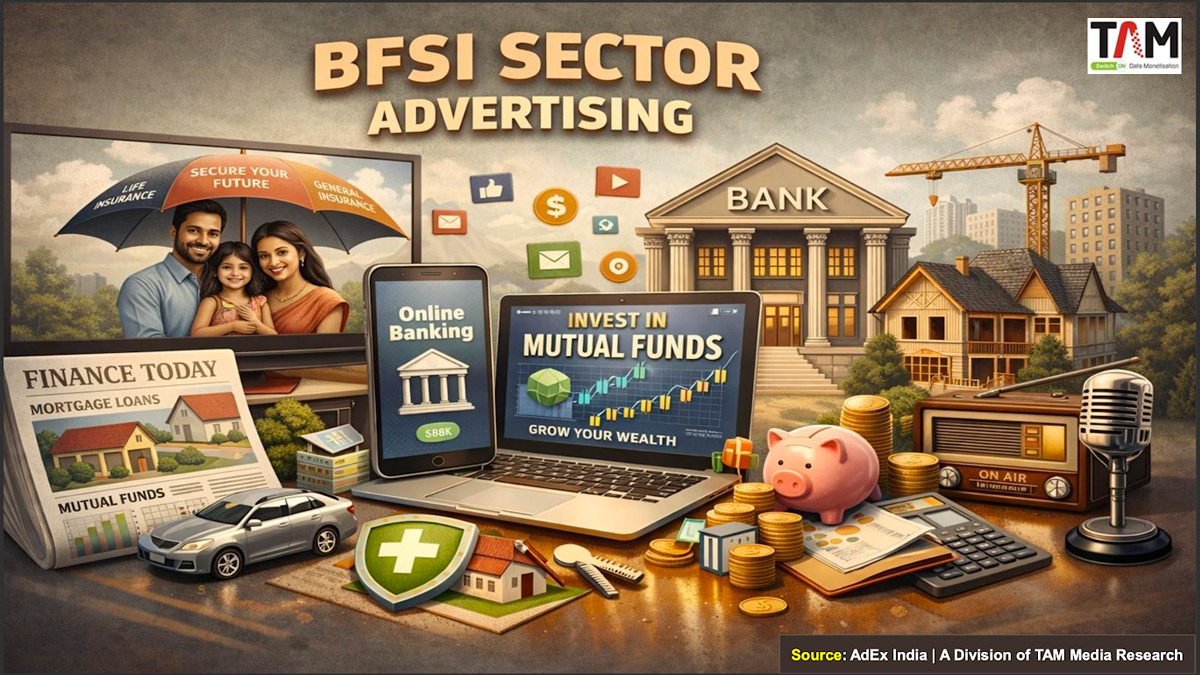
MUMBAI: India’s banking, financial services and insurance sector, one of the most prolific advertisers in the country, delivered a split verdict on media in 2025. It spent less on television, held its nerve in print, turned up the volume on radio and deluged the internet with a ferocity that left every other medium looking pedestrian. The picture that emerges from TAM AdEx’s cross-media report for the BFSI sector is of an industry in transition, still wedded to the news bulletin but increasingly seduced by the algorithm.
Television: a retreat with caveats
TV ad volumes for the BFSI sector fell 16 per cent in 2025 compared with 2024, a sharp reversal after two years of consistent growth that had pushed volumes 16 per cent above 2021 levels by 2023 and a further 7 per cent higher by 2024. Within 2025 itself, the drop was concentrated in the middle of the year: the second and third quarters saw ad volumes slide 35 per cent each against the first quarter, with a partial recovery of 13 per cent in the fourth.
The retreat did not reshuffle the deck. Life insurance retained first place among TV categories with 19 per cent of ad volumes, mortgage loans held second with 16 per cent, and the top ten categories together accounted for 82 per cent of all BFSI television advertising. The dominance of news channels was equally pronounced: news claimed 68 per cent of ad volumes, general entertainment channels a distant 14 per cent and movies 12 per cent. Together, news and GEC captured 82 per cent of the sector’s television spend. News bulletins alone took 48 per cent of programme-genre volumes, with feature films second at 12 per cent. Prime time, between 6pm and 11pm, drew 34 per cent of ad volumes, followed by afternoon at 22 per cent and morning at 20 per cent. A full 82 per cent of all ads ran between 20 and 40 seconds.
Life Insurance Corporation of India was the sector’s biggest TV spender with 11 per cent of ad volumes. Muthoot Financial Enterprises came second with 9 per cent, followed by National Payments Corporation of India at 6 per cent, Tata AIG General Insurance at 5 per cent and State Bank of India at 5 per cent. The top ten advertisers together accounted for 51 per cent of total TV volumes. Three names were new to the top ten in 2025: Tata AIG General Insurance, IIFL Finance and Tata Capital. At brand level, Muthoot Finance Loan Against Gold led with 9 per cent share, Tata AIG Health Insurance entered the top ten for the first time, and the top ten brands together contributed 35 per cent of ad volumes.
Print: the long climb continues
Print told a different story. Ad space for the BFSI sector has grown every year since 2021, rising 16 per cent in 2022, 30 per cent in 2023, 51 per cent in 2024 and 64 per cent in 2025, all measured against a 2021 baseline. Within 2025, ad space was flat in the second quarter but surged 46 per cent in the third and 33 per cent in the fourth compared with the first. Life insurance led print categories with 21 per cent of ad space, followed by mutual funds and banking services and products at 13 per cent each, and corporate financial institutes at 11 per cent. The top ten categories together took 82 per cent of print ad space. LIC led print advertisers with 6 per cent share, and the top ten together covered just 19 per cent of ad space, a reflection of how fragmented print spending remains. Three new entrants joined the top ten in 2025, with Billion Brains Garage Ventures the only exclusive presence not seen in 2024’s list. In the top ten brands, LIC dominated with a 2 per cent share, while Nippon India Mutual Fund rose to third position from fourth in 2024. English accounted for 62 per cent of print ad space, Hindi for 20 per cent. Business and finance publications took 59 per cent of the genre split. The south zone led regional spending with 33 per cent of print ad space, Bangalore topping that zone, while New Delhi and Mumbai were the leading cities nationally.
Radio: louder than ever
Radio ad volumes for the BFSI sector have climbed steadily, rising 12 per cent above 2021 levels in 2023, 36 per cent in 2024 and 45 per cent in 2025. The quarterly pattern within 2025 was volatile: a sharp drop of 43 per cent in the second quarter and 42 per cent in the third, followed by a near-full recovery in the fourth. Life insurance led radio categories with 22 per cent of volumes, banking services and products second at 14 per cent and corporate NBFCs third at 11 per cent. LIC of India held its position as the leading radio advertiser with 20 per cent of ad volumes; the top ten radio advertisers together covered 69 per cent. Muthoot Financial Enterprises led radio brands with 10 per cent share, five of the top ten brands belonged to LIC alone, and SBI Mutual Fund made a remarkable leap to fifth position from 272nd in 2024. Evening and morning time-bands together captured 84 per cent of radio ad volumes, with evenings at 44 per cent and mornings at 40 per cent. Maharashtra was the leading state for radio BFSI advertising with 18 per cent share; Maharashtra, Gujarat and Uttar Pradesh together accounted for 43 per cent.
Digital: the five-times surge
If one number defines the 2025 BFSI advertising story, it is five. Digital ad impressions for the sector multiplied fivefold between 2021 and 2025, having already doubled in 2023 and doubled again in 2024 before the 2025 leap. Within the year, impressions dipped 19 per cent in the second quarter and 12 per cent in the third before recovering 8 per cent above the first quarter by the fourth. Banking services and products led digital categories with 27 per cent of impressions, life insurance and credit cards tied at 19 per cent each, and securities and sharebroking organisations fell from first place in 2024 to fourth in 2025. Axis Bank was the runaway leader among digital advertisers with 12 per cent of impressions, followed by ICICI Bank at 9 per cent, IDFC First Bank at 7 per cent and Kotak Mahindra Bank at 6 per cent. The top ten digital advertisers covered 59 per cent of impressions, and seven of them were new entrants compared with 2024, signalling rapid churn in the digital spending hierarchy. At brand level, Axis Bank led with 9 per cent, ICICI HPCL Super Saver Credit Card vaulted to third place from 921st in 2024, and six of the top ten digital brands were new to the list. Programmatic buying accounted for 91 per cent of all digital BFSI transactions; combined with ad networks, it captured 96 per cent.
The data from TAM AdEx paints the portrait of a sector that still believes in the power of the television news bulletin to sell insurance to the masses, but increasingly knows that the next generation of borrowers, investors and cardholders is scrolling, not watching. The race is now on to reach them before the algorithm serves up someone else’s loan offer first.






