AD Agencies
Thought Blurb Communications launches brand Playseum

Mumbai: Thought Blurb Communications, a Mumbai headquartered, full-function advertising and design agency has successfully completed the branding and designing activities for the launch of Playseum. Playseum is a new age kids play area, launched in Mumbai.
In the world of children’s imaginative and interactive play, there are very few players in India, and Playseum has dramatically changed it. Since its inception in June 2023, the venture is billed as an interactive playhouse for children where they can learn as they play.
Thought Blurb Communications has been involved in the entire branding and designing activities. The key challenge was to come up with a brand name. The naming strategy was devised by the agency keeping in mind to combine a place of play and a place to learn. There was conscious efforts to eliminate various words like ‘school’, ‘library’ and ‘academy’, for being too trite or cumbersome, and thus the word ‘museum’ was chosen.

The core idea formed from there – that the place was to be a museum where the exhibits were playable. That had some legs. It also had the advantage of sounding like an immersive experience. For parents, it would manifest as a place of education and worthwhile of a child spending their time there. For the child, it was a place of play, entertainment, and happiness. Thus, the name was formed: Playseum.
The idea of interactivity and imagination comes alive in the space graphics by the design team. The logo, identity and overall design theme had to be warm, friendly, and comforting. The logo typography was designed as a series of curves, symbolizing smiles, carefully placed throughout the letters. The letters were intentionally shaped into soft curves to denote safety and comfort. The colour palette chosen also followed a similar thinking. The soft pastels of the logo were punctuated by complementary colours like yellow. Large fields and backgrounds were kept neutral with white, grey, light blue, and purple.
Every element of the interior has been treated with the same brush as it was with the collaterals, employee uniforms, printed materials and every other customer facing communication.
Playseum founder Meera Sheth noted, “Branding and designing in today’s times plays an highly important role in any business and specially in anything where kids are involved. Kids love colours and visuals which helps calm them and bring our joy and fun. With Thought Blurb onboard we were able to find a way to build the right strategy. Children can learn from a very early age. But structured education fails to provide this. I have always involved myself with my children’s playtime. You learn a lot by being with them and observing them pick up basic knowledge and skills, as long as they are all part of playtime.”
Thought Blurb founder & CCO Vinod Kunj added, “This is a unique brand in a unique space. There were really no precedents or examples leading us where we wanted to go. At Thought Blurb, we have made it a point to use our experience in launching new brands into the market to extensive use on this one. We had to establish guide-rails for the entire team to follow as we went about the task. We are proud to have been part of this brand and happy for another successful launch by our agency.”
The 6,000 sq. ft. facility has over 14 exhibits, and more than 50 activities that help children learn, observe, experience and feel as they absorb the meaning of what their actions are producing.





AD Agencies
Kevin Vaz opens FICCI-EY report with a declaration: India’s M&E industry set to breach Rs 3 trillion mark by 2027
In a keynote address at the FICCI-EY report launch, Kevin Vaz says sport, AI and the connected TV boom are driving a multi-screen revolution with no signs of slowing
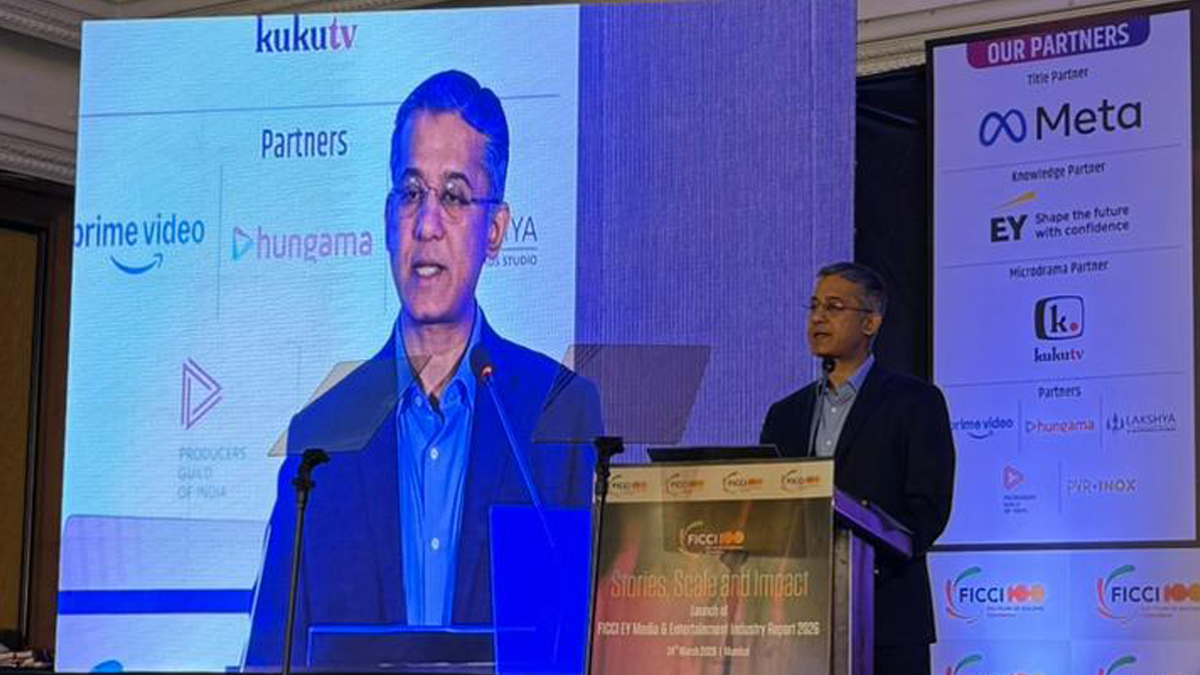
MUMBAI: India’s media and entertainment industry is growing faster than the economy, reshaping global benchmarks and is on course to blow past Rs 3 trillion by 2027. That was the headline message from Kevin Vaz, chairman of the FICCI Media and Entertainment Committee and chief executive of entertainment at JioStar, who delivered the opening keynote at the launch of the FICCI-EY Media and Entertainment Report 2026 in Mumbai on Monday. He did not waste much time on caveats.
The industry hit Rs 2.78 trillion in 2025, outpacing GDP per capita growth and surpassing even last year’s bullish forecasts. Vaz described the year in three words: scale, convergence, transformation. The numbers, he suggested, were only half the story. The other half was how that growth was happening.
Digital has become the industry’s largest segment, driven by advertising, subscriptions and commerce. But Vaz was quick to puncture the familiar narrative of digital killing everything else. India, he argued, is not an either-or market. It is an AND market. Connected TV is surging. Linear television, mobile, films and print are all still expanding. AVGC, the animation, visual effects, gaming and comics sector, is emerging as a serious growth engine, opening new storytelling formats and new global revenue streams. Nothing, he said, is replacing anything. Everything is reinforcing everything else.
Nowhere is that more vivid than in sport. In an on-demand world where audiences can watch anything, anytime, Indians still show up live. “Sports don’t fragment audiences,” Vaz said. “They unite them, just on different screens.” The ICC Men’s T20 World Cup 2026 made the point emphatically. During the final, JioHotstar delivered 72.5 million concurrent streams, a global record. Group chats exploded. Families renegotiated control of the television. Advertisers, Vaz noted with undisguised relish, stopped asking where audiences were and started asking how fast they could get in.
Cinema had its own landmark year. More than 1,900 films were released, with several crossing the Rs 1 billion mark. Dhurandhar was singled out as proof that Indian audiences will still turn up in large numbers for content that grips them. Live experiences, too, are getting bigger and more immersive, though Vaz suggested the surface has barely been scratched.
Then there is artificial intelligence, which he described as quietly, and sometimes not so quietly, reshaping everything. AI is enabling personalisation, efficiency and scale, but Vaz argued its deeper significance lies in what it is doing to creativity itself. He pointed to Mahabharat: Ek Dharmayudh, billed as the world’s first AI-produced show, as evidence that the technology can amplify creative ambition rather than hollow it out. He also used the platform to call on Indian policymakers to engage seriously with the creative industry on AI and copyright, ensuring that creators are fairly compensated as the technology spreads.
The picture that emerges from the report, and from Vaz’s keynote, is of an industry that has stopped thinking of itself as a fast-growing emerging market and started thinking of itself as a global template. Scale, diversity and innovation, he said, are no longer in tension in India. They are coexisting, and the rest of the world is taking notes.
The Rs 3 trillion milestone is two years away. As the man who chairs the committee that shapes the industry’s policy agenda and runs the country’s most powerful entertainment platform, Vaz set the tone for the day with characteristic directness: India’s media business is not just chasing growth. It is deciding what the country talks about at dinner. That is a different kind of power altogether.








