Digital
The influencer-government coalition: A new era of political engagement


Mumbai: Throughout history, governments have used various means to communicate their message to the public, including through the media. With the rise of social media, foreign governments have found new ways to spread their propaganda and influence public opinion in other countries, including through the use of social media influencers.
One recent example of this trend involves the Indian government’s collaboration with influencers like Ranveer Allahbadia to promote its policies and initiatives. This strategy has the potential to reach younger audiences directly and increase awareness and engagement with government programs.
While it is important to consider the potential impact on democratic processes and ensure transparency in the use of social media for political messaging, the use of influencers can also be viewed as a positive way for governments to connect with their citizens and promote their policies in a more accessible and engaging manner.

The topic has garnered responses from notable industry figures. Sharing their insightful thoughts on how influencers are becoming the government’s new favorite medium, and the reason behind this shift, they have also voiced their opinions on relatability to Gen Z and the common man, and what role do niche mediums like podcasts play in this trend.
Whoppl founder & CEO Ramya Ramachandran

The influencers and the influence of social media of influencers have become really significant, and it has become a topic of discussion. Hence, there is a growing need for all these regulations, transparencies, ethical practices, etc, which has to be followed while doing influencer marketing, this is also a sign that governments are recognising that influencers, content creators have that immense reach and engagement potential. Governing bodies have also realised the potential of their reach and have been collaborating with them to promote government schemes, initiatives, etc. Also, it is important to know why they like their audiences because
A) they have a large following
B) they have persuasive abilities.
Influencers can actually help in shaping public opinion, consumer behavior, and social or political movements as well. So because of this power, it, of course, has positive as well as negative purposes. So, one needs to understand why or how and how responsible you are while creating content without having any vested interest and regulation. For influencer marketing today, there are ASCI guidelines in place that talk about how transparent and authentic your content has to be. Not only in India, but also in the world there are a lot of guidelines in place to ensure that these regulations are met whenever there’s an endorsement or testimonial or if there is any sponsored content that has to be completely put very clearly so that the consumers are not misled.
If proper guidelines are followed, influencer reach can be a great source to disseminate information as influencers also tend to have a younger audience of following so you can reach more people at the same time and they leverage the influencers credibility to create a circle of influence.
Pulp Strategy founder and MD Ambika Sharma

It’s very cool to see India transitioning from a boring non youth synergetic government media policy to one where they are making such an interesting effort to talk to the youth of today. One of the biggest pros of using influencers is that they have a large following on social media. This means that they can reach a wider audience than traditional news sources. For example, #BeerBiceps has over ten million followers on Instagram. This gives him a platform to reach a large number of people with the government’s message. It also means the government recognizes the key information drivers of their people, and are smart enough to incorporate that change.
Another pro of using influencers is that they can use their platform to engage with the public in a more personal way. This is because influencers are seen as more relatable than traditional news sources. For example, #BeerBiceps is known for his down-to-earth personality and his willingness to interact with his followers. This makes him a more credible source of information for many people. However, there are also a number of cons to using influencers. One of the biggest cons is that influencers are not always credible sources of information. This is because they are often paid to promote products or services. This can lead to conflicts of interest, where the future behavior of the influencer may reflect on the government in the internet’s scheme of things.
SoCheers group head – outreach Kunal Khandelwal

The government’s decision to engage with influencers like Beer Biceps reflects the growing trend of leveraging influencers as a preferred medium. They have a large reach and influence over the younger generation, majorly Gen Z, who rely largely on digital platforms for everything from information to entertainment.
Influencer collaboration enables the government to effectively promote its policies and programmes to this tech-savvy audience. As a result, influencers act as coordinators between the government and the general audience, amplifying messages and interacting. As we know, podcasts have seen a rise in popularity, serving as a convenient medium for long-form conversations and discussions. Despite their perceived niche, podcasts attract a loyal following looking for specialised topics and substance. The government can reach this niche audience by engaging in podcasts thereby, delivering the message as engaging and impactful.

Digital
Ethical AI must benefit society, not dominate it, says WFEB chief Sanjay Pradhan at IAA event
At Mumbai event, ethics expert urges businesses and governments to shape AI responsibly
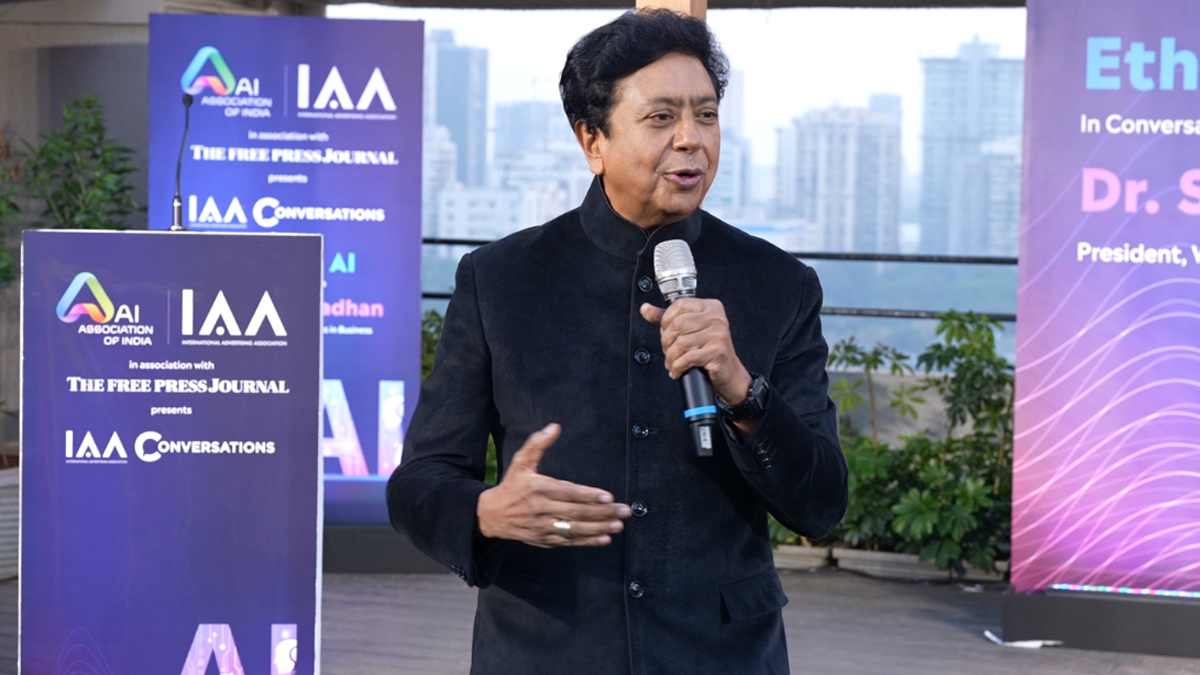
MUMBAI: Artificial intelligence may be racing ahead at lightning speed, but its direction must still be guided by human conscience. That was the central message delivered by Sanjay Pradhan, president of the World Forum for Ethics in Business (WFEB), during the latest edition of IAA Conversations held in Mumbai.
The session was organised by the International Advertising Association (IAA) and the Artificial Intelligence Association of India (AIAI) in association with The Free Press Journal at the Free Press House on 7 March. Addressing a packed audience, Pradhan called for stronger ethical leadership to ensure AI remains a tool that benefits humanity rather than one that governs it.
“Artificial intelligence has rapidly become one of the most powerful technologies humanity has created,” Pradhan said. “It is unlocking breakthroughs in medicine, science and creativity at a pace unimaginable just a few years ago.”
But he warned that the same technology carries serious risks. AI, he noted, can amplify disinformation faster than facts can travel, compromise privacy, deepen discrimination and disrupt millions of livelihoods. Referencing concerns raised by AI pioneers such as Geoffrey Hinton, often called the godfather of AI, Pradhan stressed that the real challenge is not whether AI will shape the world, but whether humans will shape it with ethics and wisdom.
Structuring his talk around four guiding questions, why, what, how and who, Pradhan introduced the audience to WFEB’s emerging AI Ethics Partnership, a global platform aimed at advancing responsible artificial intelligence. He outlined four priority concerns that demand urgent attention: disinformation, bias and discrimination, data privacy and job security.
To make the idea of ethical AI easier to grasp, Pradhan offered a simple metaphor. Ethical AI, he said, is like a three layered cake. The outer layer represents the visible value ethical AI creates for businesses and society. The middle layer is organisational culture that moves ethics from written codes to everyday practice. The innermost layer, however, is the most crucial, the conscience of individual leaders.
Drawing from Indian philosophical thought through WFEB co-founder Ravi Shankar, Pradhan noted that while artificial intelligence can reproduce stored knowledge, true intelligence is boundless and rooted in conscience, creativity and compassion. Practices such as breathwork and meditation, he suggested, can help leaders develop the calm clarity needed for ethical decision making.
The event also featured a discussion with Maninder Adityaraj Singh, chief of staff and head of innovation at Rediffusion Brand Solutions Pvt Ltd, and Yash Johri, lawyer, Supreme Court of India.
Opening the session, IAA India chapter president Abhishek Karnani, highlighted the need for industries to understand and engage with AI responsibly.
“AI has to be befriended and understood,” added Rediffusion managing director and AIAI national convenor Sandeep Goyal. “Its ethical use will determine whether it becomes a friend or a foe.”
As AI continues to reshape industries and societies, Pradhan ended with a simple but powerful call to action. Businesses, governments and individuals must work together to ensure that the algorithms shaping the future reflect human values rather than just cold logic.







