Brands
The future of publishing lies in user generated content: Seminar


MUMBAI: While there is a debate going on regarding the extent to which the online medium is affecting the print medium, one point that came up during a seminar on ‘The Future of Publishing’ is that its future will rest on user generated content.
The British Council organised a panel discussion last evening. The speakers were Rediff.com CEO Ajit Balakrishnan, DNA head sales and marketing Suresh Balakrishnan, Google India country head Ashish Kashyap and a British online journalist Kevin Braddock.
Balakrishnan made the point about the importance of user generated content. He started by talking about the problem of the long tail saying, “A recent study by Chris Anderson in the US shows that the top three online searches are for sex, MP3 and Britney Spears. Interestingly though these searches only account for three per cent of all searches. As many as 10 million search items were unique. This is what he called the long tail problem. The top 10 books on Amazon.com account for only five per cent of sales. On our site Rediff.com the top 10 ring tone downloads account for only 35 per cent of sales. Clearly for publishers this has deeper implications in that best sellers may be a thing of the past.”

“The rise of user generated content has been one of the fascinating aspects of the internet. Wikipedia is one of the top sites on the net. This is a user contributed dictionary. Brittanica does not even appear in the top 2000 sites. Myspace.com, which is another top site allows musicians to upload their music. These two sites cater to the tail. Journalists at the moment focus on the head whether it is cricket, Bollywood or the Sensex. I predict that in three years time, more and more content even in the print sector will be user generated,” said Balakrishnan.
Balakrishnan dwelt on the fact that just because the net consumption is rising, that does not mean that print is being adversely affected.
He points to the fact that one billion people globally read a newspaper everyday saying,”Four billion dollars were spent last year by newspaper firms on better technology like printing equipment. While for India, the advertising industry growth is expected to be 17 per cent for print. It is expected to be 20 per cent growth for online. Increasingly there is integration of print and online. The challenge for any organisation is to eliminate the divide while maintaining the uniqueness. One cannot simply reproduce newspaper items online and hope it will work. The style of journalism is different.”
He further stressed, “Online journalists should also have multimedia skills to make stories more attractive. Newspapers can have online supplements with user forums. While it is true that newspaper consumption in Mumbai has stayed static for four years that is because there was a monopoly. In this situation, it is to the newspapers advantage to keep circulation down and increase ad revenue. Each copy sold would mean a loss. The actual cost of printing a newspaper is much more that two rupees. I predict that with DNA, HT, Mumbai Mirror coming in when figures for this year are published you will see a 30 per cent growth in newspaper readership.”
“Another thing that newspapers will do well is to focus on local stories. That is because news agencies like AP are competing online with newspapers in terms of global stories. They may not have the manpower to cover local events, which is where local newspapers have an advantage,” added Balakrishnan.
Braddock stated that print publications like fashion magazines forge an emotional bond with their readers that online cannot do. He drew the analogy of Vinyl.
“When CDs came in everyone thought that Vinyl was dead and buried. Now that MP3 has come in people feel that CDs are in danger. Today, though in London, Vinyl sales have gone through the roof. That is because there is a novelty value. The physical connection is important.”
He also noted that the fundamentals of journalism are still the same even if one is in the online space. It is important for journalists to go out and find out stories and not just rely on Google to find out if something is true or not. Magazines, he said, have an advantage in that nobody wants to read a 4000 word story online. At the same time, a couple of magazines he worked for in the UK, have since folded. He attributed this to the fact those publications did not aim high enough rather than the rise of the online medium.
Kashyap pointed out that Google works with publishers to organise content online and monetise it. Google gives its technology to publishers to organise their information so that it is easily searchable. Saying, “Google also allows people to search across the web while staying in the publishers arena,” he mentioned Google’s Adsense product.
“The aim is to make online ads more relevant for the reader. There is a revenue sharing arrangement with the publisher each time an ad is clicked. An article on Fringe Benefit Tax will give an ad from a tax advisor. There is a clear and measurable delivery for the advertiser at a time when clients want more accountability. What Google’s Adsense also does is allow an independent publisher to access the thousands of Google advertisers – in other words the tail. This is something that he might not have earlier dreamt of.” said Kashyap.







Brands
KKR sixes to power EV charger rollout under VIDA campaign
Cricket meets clean mobility as big hits spark India’s charging growth
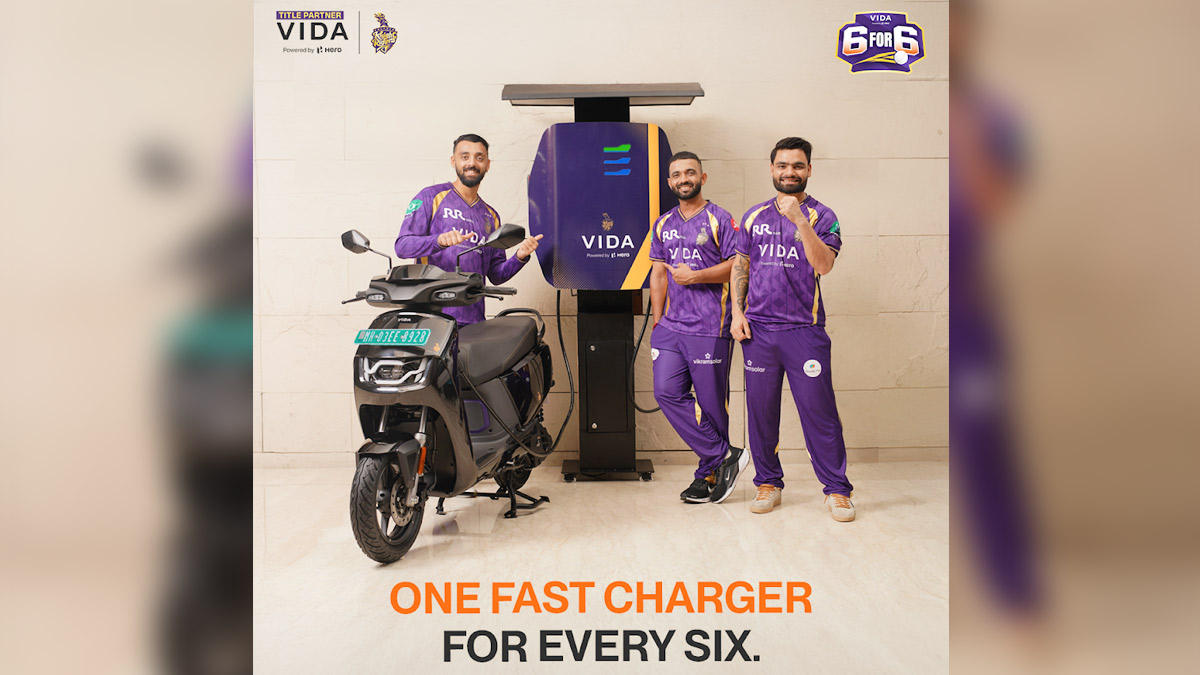
NEW DELHI: VIDA, the electric mobility arm of Hero MotoCorp, has teamed up with Kolkata Knight Riders to launch a campaign that turns cricketing flair into real-world impact.
Titled ‘6 for 6’, the initiative promises to install a 6kW fast EV charger for every six hit by KKR during the ongoing Indian Premier League season. The idea is simple but powerful, as each big hit on the field contributes directly to expanding India’s fast-charging infrastructure.
The campaign builds on VIDA’s growing network, which already spans over 5,300 fast-charging points across more than 430 cities. With EV adoption gaining pace, the brand is using cricket’s mass appeal to accelerate both awareness and infrastructure growth.
Explaining the thinking behind the move, Hero MotoCorp emerging mobility business unit chief business officer Kausalya Nandakumar said, “Cricket has an incredible ability to unite and inspire millions across the country. With the ‘6 for 6’ campaign, we are turning every big hit on the field into a step towards a cleaner and a more accessible mobility future.”
She added that VIDA’s expanding fast-charging network and removable battery technology are designed to make EV ownership more convenient and practical for everyday users.
From the franchise’s side, the campaign is also about giving on-field moments a larger purpose. Kolkata Knight Riders chief executive officer Venky Mysore said, “The ‘6 for 6’ campaign exemplifies the potential of sport as a platform for meaningful, real-world impact. By linking every six to the expansion of EV charging infrastructure, this partnership transforms fan excitement into tangible progress.”
As part of the rollout, VIDA has introduced co-branded charging stations in KKR’s signature colours, with a flagship installation unveiled alongside team players. The chargers are designed for quick top-ups, powering VIDA scooters from zero to 80 percent in about an hour, while also being positioned along key highways to support longer journeys.
The initiative also taps into VIDA’s removable battery system, which allows users to charge using standard household plug points, adding flexibility to the charging ecosystem.
By blending the thrill of cricket with the urgency of clean mobility, VIDA and KKR have found a neat way to make every six count twice, once on the scoreboard and again on India’s road to an electric future.








