MAM
South Indian Bank welcomes P R Seshadri as new MD & CEO


Mumbai: South Indian Bank (SIB), one of India’s leading private sector banks with over a nine-decade legacy has appointed P R Seshadri as its MD & CEO effective 1 October 2023. He will succeed Murali Ramakrishnan who served a successful tenure from 1 October 2020 till 30 September 2023.
With nearly 25 years of banking experience spanning domestic and international markets, P R Seshadri has held senior leadership positions at prestigious institutions, including Karur Vysya Bank Ltd and Citigroup. His leadership, marked by scaling, optimizing, growing, and transforming businesses, has earned him respect and acclaim within the industry. His career trajectory underscores his ability to drive sustained growth, emphasizing the adoption of digital operational frameworks and innovative solutions to meet the unique demands of the Indian market. Prior to joining SIB, Seshadri was associated with the Karur Vysya Bank (KVB) in a similar role.
Welcoming the incoming MD & CEO, executive vice president and chief business officer Thomas Joseph K, said, “Embracing a new era of leadership, we proudly welcome Mr. Seshadri to lead our institution. With a proven track record and a visionary approach, he embodies the future of banking excellence. His expertise will guide us towards greater heights, paving the way for success and prosperity for our valued clients and stakeholders. Together, we anticipate exploring new frontiers in finance and redefining growth through a customer-centric ethos.”

Commenting on his appointment,South Indian Bank MD and CEO P R Seshadri said, “Leading South Indian Bank is a privilege as we embark on a growth journey, leveraging technology while upholding our business values and rich heritage. I am enthusiastic about collaborating with the Bank’s talented professionals to build upon the legacy. Together, we will navigate the evolving financial landscape, delivering innovative solutions and unparalleled service to our clients.”
P R Seshadri is an electrical engineer and holds a Post Graduate Diploma in management from IIM Bangalore. In his new role as MD & CEO, he is poised to lead South Indian Bank into an era of growth and innovation, while upholding its rich legacy and core values, promising an exciting journey ahead for the Bank and its stakeholders.


Brands
HP launches Smart Champs learning game show with JioStar for students
Sanya Malhotra hosts quiz series blending fun, learning and prizes
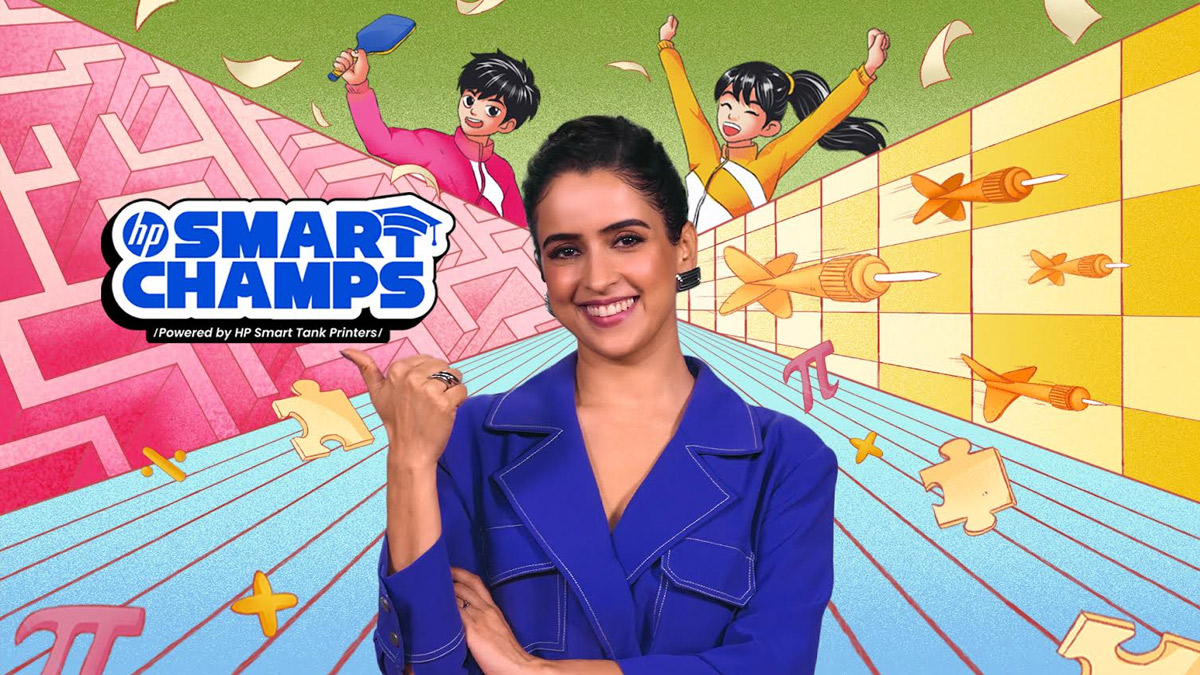
NEW DELHI: HP India has teamed up with JioStar to launch HP Smart Champs, a new learning-based game show designed to make education engaging for school students across the country.
Hosted by Sanya Malhotra, the 10-episode series brings together students from Grades 5 to 9, who compete in teams through quiz and puzzle-based challenges that test knowledge, logic and teamwork. The show will begin streaming on JioHotstar from April 11 and will premiere on Nick on April 18, with weekend episodes airing at 7 PM.
Powered by HP Smart Tank printers, the format integrates print-based learning into the gameplay, using worksheets, clues and visual problem-solving tools to encourage hands-on participation. The idea is to move students beyond rote memorisation and towards more applied, curiosity-led learning.
The competition promises high stakes, with winners set to receive a cash prize of Rs 10 lakh, while runners-up will take home Rs 5 lakh. Additional rewards include HP AI laptops, Smart Tank printers and accessories, while the winning school will be awarded an HP Smart Tech Lab.
Speaking about the initiative, HP India managing director Ipsita Dasgupta said, “At HP, we believe nurturing India’s youth is key to the country’s progress, and technology plays a foundational role in enabling this. With HP Smart Champs, we wanted to create something beyond traditional learning, a fun-filled platform where curiosity, creativity and critical thinking take centre stage.”
On the show’s reach, JioStar head entertainment sales Mahesh Shetty said, “HP Smart Champs reflects how children today learn through exploration and experience. With Nick and JioHotstar, we are creating a multi-screen approach that is both engaging and meaningful.”
Highlighting the role of print, HP India senior director print Satish Kumar said, “The show brings print-based learning to life in an engaging format, helping students develop deeper understanding through hands-on experiences.”
The journey to the finale began with participation from over 1,000 schools across 26 cities, narrowing down to 34 finalists who will compete in a studio showdown in Mumbai.
With its blend of entertainment, education and technology, HP Smart Champs is positioning itself as more than just a quiz show. It is a nationwide push to make learning interactive, accessible and, above all, a lot more fun.







