Brands
Redington unveils new global brand identity


MUMBAI: Redington, the $6 billion distribution and supply chain giant for international brands in the IT and mobility sectors, has unveiled its new global brand identity with a new logo and tagline – Seamless Partnerships.
The new brand identity reflects the core values of Redington as a contemporary and innovative company, which has developed its messaging strategy to reflect its evolution as a brand and its global role as one of the largest providers in the supply chain solution industry. The new logo and tagline epitomises the new direction that the company would like to take in the years to come.
Unveiling the impressive new logo and tagline, Redington managing director Raj Shankar says, “I am proud to launch today our rejuvenated brand and visual identity that fully reflects what we stand for as an organisation. This is not a mere change of brand identity but a coming of age for Redington, a transformation that the company is engineering to take it to the next level. The new identity carries forward our core values on which our company is built – adaptability, collaboration, know-how, objectivity, simplicity, transparency and trust. We look to expand our horizons from being a ‘brand behind brands’ to a platform that enables seamless partnerships. Redington is committed to do everything to achieve its ultimate goal of being the preferred company for connecting buyers and sellers. Re-emphasising the word ‘preferred’ as in a competitive world, Redington wants to build and grow lasting partnerships.”

The new logo of Redington symbolises synergy – while the existing colour green has been retained, different shades have been introduced as well, keeping in mind the ever-expanding portfolio and services of the company. It represents the synergy and oneness that Redington possesses as an organisation – be it with vendors, customers, team, the environment, technology and the ecosystem within its circle of influence. The latticed geometric design depicts technological innovation as well as simplicity in complexity. The symmetrical form shows harmony between Redington and the other organisations that it collaborates. The energy is depicted in the reverse white lines, also representing the common thread of Redington’s philosophy and spirit running through the organisation towards a common good.
As a heritage brand, Redington is stepping into its 25th year and the new branding builds on its well-established reputation in the industry.
Established in Chennai in the year 1993, Redington is a well-known global brand having its operations across India, South Asia, Middle East, Turkey and Africa. With a strong network of 37,500 partners, Redington distributes more than 200 brands across 24 markets and has leadership position in most markets and brands.
Redington, which has a strong distribution base, prides on the trust that it enjoys among not only its customers but also the vendors whose brands it distributes. Some of Redington’s brand and vendor relationships have been existent for decades.






Brands
KKR sixes to power EV charger rollout under VIDA campaign
Cricket meets clean mobility as big hits spark India’s charging growth
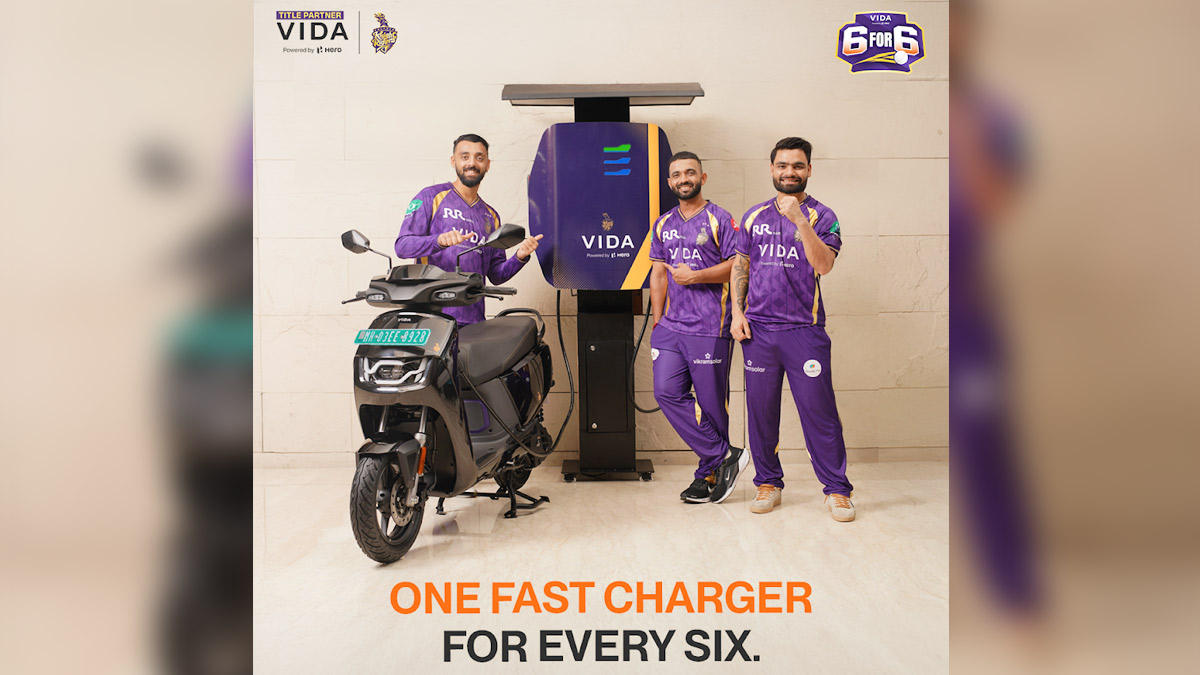
NEW DELHI: VIDA, the electric mobility arm of Hero MotoCorp, has teamed up with Kolkata Knight Riders to launch a campaign that turns cricketing flair into real-world impact.
Titled ‘6 for 6’, the initiative promises to install a 6kW fast EV charger for every six hit by KKR during the ongoing Indian Premier League season. The idea is simple but powerful, as each big hit on the field contributes directly to expanding India’s fast-charging infrastructure.
The campaign builds on VIDA’s growing network, which already spans over 5,300 fast-charging points across more than 430 cities. With EV adoption gaining pace, the brand is using cricket’s mass appeal to accelerate both awareness and infrastructure growth.
Explaining the thinking behind the move, Hero MotoCorp emerging mobility business unit chief business officer Kausalya Nandakumar said, “Cricket has an incredible ability to unite and inspire millions across the country. With the ‘6 for 6’ campaign, we are turning every big hit on the field into a step towards a cleaner and a more accessible mobility future.”
She added that VIDA’s expanding fast-charging network and removable battery technology are designed to make EV ownership more convenient and practical for everyday users.
From the franchise’s side, the campaign is also about giving on-field moments a larger purpose. Kolkata Knight Riders chief executive officer Venky Mysore said, “The ‘6 for 6’ campaign exemplifies the potential of sport as a platform for meaningful, real-world impact. By linking every six to the expansion of EV charging infrastructure, this partnership transforms fan excitement into tangible progress.”
As part of the rollout, VIDA has introduced co-branded charging stations in KKR’s signature colours, with a flagship installation unveiled alongside team players. The chargers are designed for quick top-ups, powering VIDA scooters from zero to 80 percent in about an hour, while also being positioned along key highways to support longer journeys.
The initiative also taps into VIDA’s removable battery system, which allows users to charge using standard household plug points, adding flexibility to the charging ecosystem.
By blending the thrill of cricket with the urgency of clean mobility, VIDA and KKR have found a neat way to make every six count twice, once on the scoreboard and again on India’s road to an electric future.








