MAM
Post-Covid outlook for India’s creative economy


Mumbai: The pandemic has shaken the spine of economies across the world, and the Indian economy was no different. The impact is well analysed and measured by several studies, but ‘Taking the Temperature’ research is a first-of-its-kind, landmark longitudinal report on the impact of the Covid-19 pandemic on India’s creative economy.
The British Council, FICCI, and Art X Company have jointly launched the third edition of the report at the Jaipur Literature Festival (JLF).
Released against the backdrop of Asia’s largest literature festival, JLF, the report transcends the literature sector, and for the first time, offers a quantitative mapping of India’s creative economy and culture sector – in the organised and unorganised sectors – across literature, crafts, festivals, performing arts and other art forms. The final edition is a series of three reports, and a culmination of 18 months of mapping the sector.

The research tracks the longitudinal impact of the pandemic on India’s creative and culture industry and identifies a way ahead in a systematic and sustainable roadmap for recovery. The pioneering research is a first-of-its-kind, the extensive report outlines the monetary size and scale of the creative economy and contribution of the culture industries to the national GDP and wealth creation in India.
On this, FICCI creative and cultural industries co-chair Sanjoy Roy said, “The TTT report on the creative sector underlies the vital nature and impact of this sector and its potential in creating jobs, contributing to local economies and creating a platform to realise one’s full potential.”
The British Council works with the Indian stakeholders to strengthen India’s creative economy and create sustained livelihoods for Indian creative professionals. The report, in collaboration with FICCI and The Art X Company, underlines the British Council’s aim to gather credible information and insights that can enable businesses and governments to make effective and well-informed decisions about public and private investment in the creative sector.
Key findings of the report:
India’s creative economy reduced to Rs 30,440 crore GDP in 2021 from Rs 50,000 crore GDP in 2020, pre-Covid.
There was a 39 per cent recession in creative industries to Rs 30,440 crore in 2021.
50 per cent of creative sectors reported 51 per cent or more loss in annual revenue in the financial year 2020-2021.
89 per cent of creative sectors in TTT2 and 82 per cent in TTT 3 have confirmed the pandemic impacted their income.
49 per cent of creative sectors have not been able to keep creative businesses and artistic programmes running in the financial year 2020-2021.
94 per cent of arts sectors are now operating in ‘digital only’ or ‘hybrid’ models.
27 per cent of the sector is generating income through digital platforms with only eight per cent running physical programmes.
In view of the findings and the feedback from the creative industry workforce and stakeholders, the report makes the following recommendations:
Establish a cross-government creative economy Task Force from the 14 ministries that have a mandate for arts and culture in India.
Government emergency grant-in-aid for MSMEs.
A comprehensive national skills campaign across urban and rural geographies for creative MSMEs in digital and technological skills, business development, marketing, and communication capacity.
Establish sector-specific management, self-help groups and management organisations, and city-wide enterprise zones and clusters.
Establish arms-length bodies (ALBs) to strengthen and invest in arts and culture through a partnership of public and private investors.
Embed tax coding of the creative industries in the formal economy through the Goods and Services Tax (GST) council.
British Council India director – arts Jonathan Kennedy said, “Since the onset of Covid-19, we’ve dedicated our research to understanding the impact of the pandemic on India’s creative and culture economy with FICCI, Art X Company, and Smart Cube.”
The final report makes practical recommendations for the short and long-term recovery of creative sectors and livelihoods. While our first two reports measured the impact of the pandemic on the incomes of the professionals and culture organisations, the third edition offers a definitive mapping of the scale and significance of the creative economy in India, added Kennedy.
“There could not have been a better platform than the Jaipur Literature Festival to announce the report and we hope the insights from the report trigger much-needed conversations amongst stakeholders. We hope recommendations for recovery of the creative economy will be implemented through governance, infrastructure development and India’s enduring self-reliance,” he said.
The Art X Company founder-director Rashmi Dhanwani said, “This final leg of the Taking the Temperature survey underscores the hard journey that the cultural sector in India has been on. Not only has the sector lost more than 50 per cent of its income, its performance has also affected India’s GDP growth. Besides the economic impact, the loss of lives and livelihoods that the pandemic has caused begs an urgent intervention – India’s culture sector needs a voice and demands urgent regulatory frameworks to safeguard this vital part of India’s identity.”





Brands
KKR sixes to power EV charger rollout under VIDA campaign
Cricket meets clean mobility as big hits spark India’s charging growth
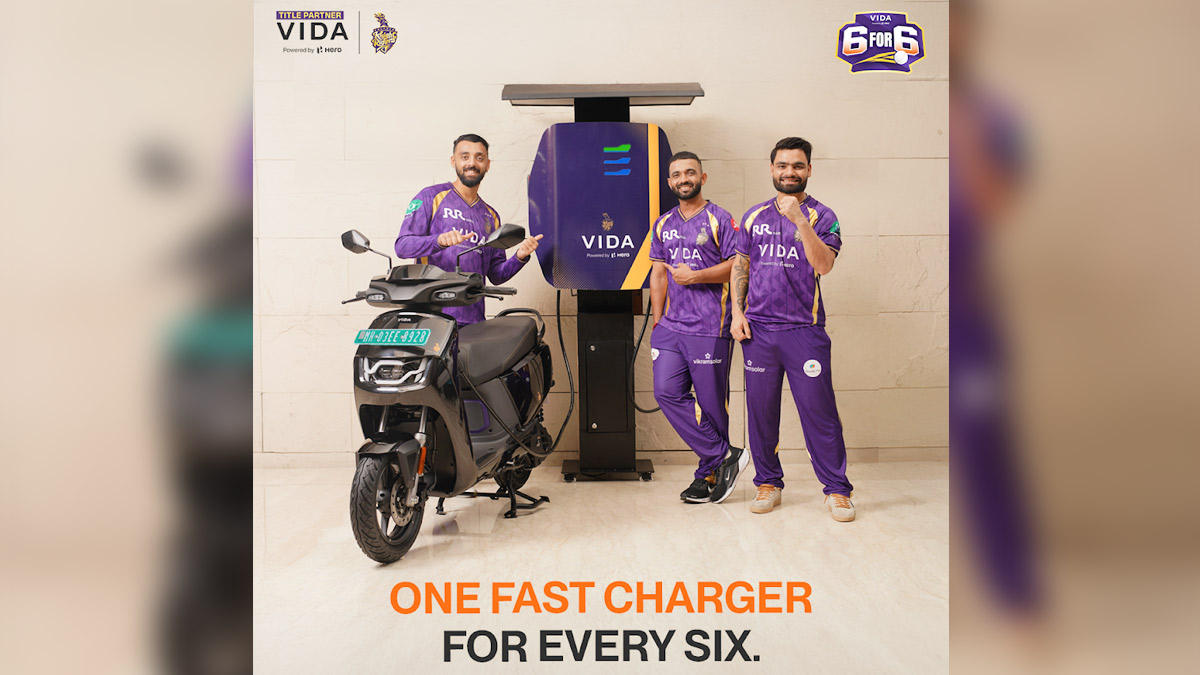
NEW DELHI: VIDA, the electric mobility arm of Hero MotoCorp, has teamed up with Kolkata Knight Riders to launch a campaign that turns cricketing flair into real-world impact.
Titled ‘6 for 6’, the initiative promises to install a 6kW fast EV charger for every six hit by KKR during the ongoing Indian Premier League season. The idea is simple but powerful, as each big hit on the field contributes directly to expanding India’s fast-charging infrastructure.
The campaign builds on VIDA’s growing network, which already spans over 5,300 fast-charging points across more than 430 cities. With EV adoption gaining pace, the brand is using cricket’s mass appeal to accelerate both awareness and infrastructure growth.
Explaining the thinking behind the move, Hero MotoCorp emerging mobility business unit chief business officer Kausalya Nandakumar said, “Cricket has an incredible ability to unite and inspire millions across the country. With the ‘6 for 6’ campaign, we are turning every big hit on the field into a step towards a cleaner and a more accessible mobility future.”
She added that VIDA’s expanding fast-charging network and removable battery technology are designed to make EV ownership more convenient and practical for everyday users.
From the franchise’s side, the campaign is also about giving on-field moments a larger purpose. Kolkata Knight Riders chief executive officer Venky Mysore said, “The ‘6 for 6’ campaign exemplifies the potential of sport as a platform for meaningful, real-world impact. By linking every six to the expansion of EV charging infrastructure, this partnership transforms fan excitement into tangible progress.”
As part of the rollout, VIDA has introduced co-branded charging stations in KKR’s signature colours, with a flagship installation unveiled alongside team players. The chargers are designed for quick top-ups, powering VIDA scooters from zero to 80 percent in about an hour, while also being positioned along key highways to support longer journeys.
The initiative also taps into VIDA’s removable battery system, which allows users to charge using standard household plug points, adding flexibility to the charging ecosystem.
By blending the thrill of cricket with the urgency of clean mobility, VIDA and KKR have found a neat way to make every six count twice, once on the scoreboard and again on India’s road to an electric future.








