MAM
POP Asia bullish on advertising market

MUMBAI: The first Indian Point Of Purchase (POP) exhibition-cum-conference – POP Asia 2005, kick started in Mumbai today. The first day of the two day conference saw speakers like Point of Purchase Advertsing International (POPAI) director genreal Martin Kingdon, the organising committee chairman Harish Bijoor, AC Nielsen director – client service Nehal Medh, Foodworld Supermarkets vice president merchandising and marketing K Radhakrishnan and IIT Mumbai’s Ravi Poovaiah presenting their views on the Rs 18 billion POP ad market.
Bijoor, in his inaugral speech, said that the growth of top of the line advertising has become stagnant and hence mass media advertising was working less and less. This has resulted in the increase in demand for below the line (BTL) activities which is seen as an alternate medium, he said.
Elaborating further on the advertising pie as far as the media mix for a brand is concerned, Bijoor said that 46 per cent was being spent of press advertising, 41 per cent on television, 3 per cent on cinema (the share of which is shrinking at a rate of 23 per cent per annum), 2 per cent on radio, 0.5 per cent on Internet (as opposed to 0.01 per cent a couple of years back) and 7 per cent on out-of-home (OOH).
“The seven per cent that is spent on OOH is the most interesting as that is where direct contact with the consumer takes place and POP forms an intergral part of OOH,” Bijoor said.
Bijoor concluded that POP was more action oriented, immediacy led, more measureable than mass media advertising and was a dynamic concept. “The conference aims to focus on the niche that POP is looking at handling the last mile issue that hasseled marketers are facing,” he said.
Kingdon, on the other hand spoke about the different brand and retail approaches that were taken in the UK as far as POP was concerned. Citing the example of “black goods” (read ciggrattes, alcohol, tobacco products), he said that since traditional advertising of these goods was banned the companies spent millions of pounds every year on POP advertising in the retail space.
“The role of POP is to stop the shopper, either mentally or physically, and not to make him buy the product. The attention that a POP attracts can then be instrumental in the purchasing decisions of the consumer,” said Kingdon.

In 2003, the total POP market size in UK, according to Kingdon, was 1.1 billion pound sterling. Speaking to indiantelevision.com he said that the market would grow 5 per cent this year but that he still termed as a conservative growth expectation.
Ending on the note – “The sky is the limit as far as POP is concerned,” Kingdon said that there were certain brand visibility requirements in the space, which if taken care of can spur sales of products that go in for POP advertising.
AC Nielsen’s Medh touched upon the research done on consumers and POP. “India is dominated by the traditional format retailing and hence POP is virtually invisible here. POP is only prominent in the dark category brands and for other brands, mass media advertising dominates the mind and pride space and also the budgets of companies. POP is seen as a complimentary tool,” he said.
He also stressed on the fact that in India the use of POP was very unimaginative and that brands needed to work on that front.
“Almost 15 per cent of buying decisions are made on the shop floor and hence companies should not spend in an ad hoc manner in the POP space, because there is a huge potential for the brand in POP advertising. Marketers should ignore POP at their own risk,” Medh emphasised.
Radhkrishnan, on the other hand, stressed on organised retailing and said that there was a steady growth in the organised retail sector in India. “Anything that communicates a message is POP. Product display, banners, posters, shelf tickets, bay headers etc are examples of POP. One should look at the category and not just the brand while deciding on the POP for the brand,” he said.
He also said that POP formed an important part of the media mix and that while planning for the brand, one should plan down to the POP.




Brands
Jubilant FoodWorks faces Rs 47.5 crore GST demand, plans appeal
Tax authorities flag alleged misclassification of restaurant services
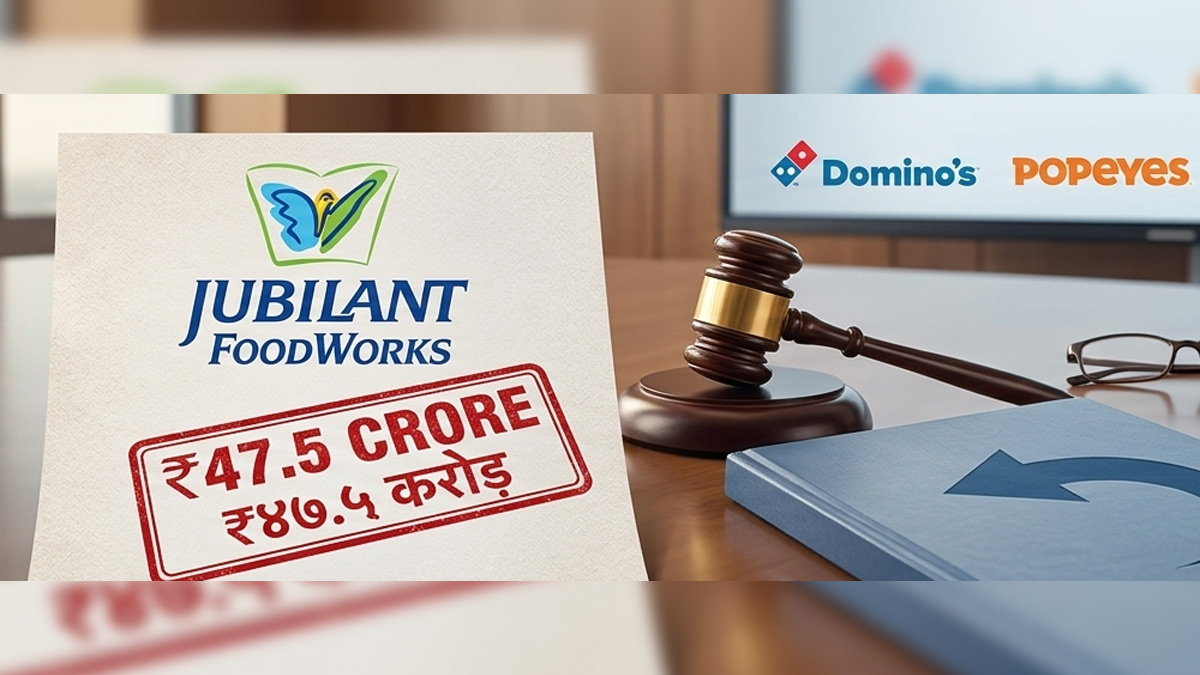
MUMBAI: Jubilant FoodWorks Limited has landed in a tax tussle after receiving a GST demand of Rs 47.5 crore from the office of the additional commissioner of CGST and central excise in Thane, Maharashtra.
The order, issued under the provisions of the Central Goods and Services Tax Act, 2017, relates to an alleged incorrect classification of certain services under the category of restaurant services. According to the tax authorities, this classification resulted in a short payment of goods and services tax for the period between the financial years 2019-20 and 2021-22.
The demand includes Rs 47.5 crore in GST along with an equal amount as penalty, in addition to applicable interest. The order was received by the company on March 13, 2026.
In a regulatory filing to the BSE Limited and the National Stock Exchange of India Limited, the company said it disagrees with the order and believes its arguments were not adequately considered.
The company is preparing to challenge the decision and plans to file an appeal. It added that once the redressal process is complete, the demand is likely to be dropped.
Despite the sizeable figure attached to the notice, the company said it does not expect any material impact on its financials, operations or other activities.
The disclosure was signed by Suman Hegde, EVP and chief financial officer, who confirmed that the company received the order at 19:06 IST on March 13 and has already initiated steps to contest it.
The development places the quick service restaurant major in the middle of a tax debate that could hinge on how certain restaurant-linked services are classified under GST rules. For now, the company appears ready to take the matter from the tax office to the appeals desk.