MAM
Piyush Pandey’s top 5 popular campaigns

MUMBAI: Piyush Pandey reveals his favourite David Ogilvy quote: “The psychiatrists say that everybody should have a hobby. The hobby I recommend is advertising.”
For the big dad of Indian advertising, the workplace is where he pursues his hobby. No wonder. Pandey has been with Ogilvy since 1 August 1982. Since then, his rise has been meteoric. In 1989, he moved to the creative department in O&M and became the agency‘s creative director in 1992. He rose to become the national creative director in 1994 and was inducted to Ogilvy‘s worldwide board in 2006.
For the man who led Glamorgan University‘s cricket team to its win in the Rohinton Baria Trophy in 1979, the long innings at O&M is remarkable. Under Pandey‘s leadership, O&M has become the third largest advertising agency in India.

Pandey has been named the most influential man in Indian Advertising for eight straight years by The Economic Times. In 2000, the Ad Club of Mumbai voted his commercial for the adhesive brand Fevikwik the ‘Commercial of the Century‘ and his work on Cadbury‘s as the ‘Campaign of the Century‘. He was voted Asia‘s Creative person of the year at the Media Asia Awards 2002.
He is the only Indian to have won a double Gold at Cannes and a triple Grand Prize at London International Awards. O&M India has won 25 lions at Cannes under his leadership. In 2002, he won India‘s first ever Silver Pencil at The One Show Awards. In 2010 he was given Lifetime Achievement Award by The Advertising Agencies Association of India.
Pandey was invited as a Jury in the Clio Awards (2000), Cannes Film Festival(2002), and as the President of the Jury for Outdoor & Press and Film at the Cannes Lion International Advertising Festival (2004) which was a first for an Asian. He was also invited to be a judge at the Asia Pacific Advertising Festival Awards, 2007.
Asked to list his five favourite campaigns, the South Asia executive chairperson and creative director at O&M instead provided a listing of five of people’s favourite campaigns saying it would do injustice to his clients and also choosing five best works over 30 years is difficult.
Here is Pandey‘s list of most popular campaigns:
Cadbury‘s ‘kuch Khaas Hai‘
It is one of my favourite campaigns because it changed the market completely. We had to find out some way to get adults to eating chocolates openly. The entire campaign is about the fact that there is a child in all of us and we let it go only once in a while. So why be scared of getting your head down, being yourself and enjoying life? It was voted as the campaign of the century.
Fevicol
The work on Fevicol has also been loved by people a lot over the years. The Fevicol ad became a hit because it is “son of the soil” kind of campaign; it is rooted in India but with ideas that touched people even abroad. And it’s simple! We hardly have words in it and people find it very funny and yet meaningful. And today Fevicol is in the top most trusted brands. For a low-interest category, to be amongst the big brands is not easy. After all, it is a product that one never sees once the furniture is made.
Polio
I am also very proud of the work that I have done on Polio along with Amitabh Bachchan. This year India has reported zero cases of polio. The campaign is highly credited to Bachchan; the way he spoke to the people of the country like an elder brother, a father who is upset with his near and dear ones and about what are they are doing for their children, is remarkable. The ad used very harsh language. For ads like Polio to use such a language was completely unprecedented. For the whole campaign, what I can say is that a lot of ground work is done by the government and medical associations; we were able to support their efforts meaningfully. At the end of the day they were the ones who were on streets, they were the ones who made it happen, but we were able to give them some kind of support.
The thing is that when Amitabh speaks people listen. For instance, when there was this controversy about Cadbury, we re-launched
the campaign with Bachchan. He is a very sincere man. He won‘t do anything just like that. He came to the factory to see for himself how the chocolates were manufacturedand packed. We are grateful to him for the campaign.
Fevikwik
The Fevikwik campaign (the fish one) also won us many accolades.
Asian Paints
The next ad close to me would be that of Asian Paints, ‘Har Ghar Kuch Kehta Hai‘. If you look at Asian Paints, the way they have built the brand and the way we have been able to partner them by finding regional nuances built again around India and its traditions. It’s the no.1 brand since so many years. From Umbrella campaign, ‘har ghar kuch kehta hai‘ to the Sunil babu (tu kya dekh raha hai yeh, deewar ki picture chal rahi hai) to the two brothers doing home decor ads — that‘s a good series.
These are the campaigns that have been awarded over the years but it is very difficult to say that which are my best five. These are
among my most successful work. They are closest to me because they are close to the people. No campaign is worth its salt unless the people on the street do not love it. Fevicol (dam laga k haisha), Fevicol (egg) and Fevikwick (fish) and current Fevicol marine, there is a huge body of work. Let me put it this way — these five campaigns are longest running campaigns. We have ads which ran for a year and were fantastic. These were the campaigns that ran over the years.
It all starts with the product, the opportunity that the product has, the connect that it has with the people, the vision that the clients have for their brands, or what is the problem that the product is having. If you look at the polio scenario, it was the problem that the country was facing, that people were not going to the booths, you start with that and then see how you can address it.
Like in the case of Cadbury, adults were not eating it openly, so the question was how to tackle it. It has to come from a market need and then how well you are able to go under the skin of the consumer and identify that what will make this person change his work or behavior and what is the stimuli that they would want to watch, want to act upon. The process is very simple.
I never thought that I am a painter or an artist. I am a commercial artist who has to do messaging to make people to react.
I think we can never do a very bad campaign; we can do a bad ad because you do one ad and then you realise that you need to correct yourself. It is not that you will succeed every time. There are times when you experiment.
Here is Pandey‘s list of the bad campaigns:
Cadbury
There was a campaign that we attempted for Cadbury. It was based on a very good insight that we got from the research that people feel like eating chocolate when they are sad. We took that very seriously and made ads on ‘moments when you are sad‘ and people were not willing to see it on television. They wanted to see moments that made them smile, feel happy. Yes, it was a mistake but you won’t remember them because we pulled them out within a week.
Fevicol
Nothing is totally wrong but something that does not create that magical impact…I loved the suicide Fevicol ad. It was supposed to be funny but some people didn’t find it funny.
Kinetic
After doing a great campaign on ‘Chal meri luna’ (Kinetic), we tried to do an ad on petrol price hike featuring Azharuddin and Sachin Tendulkar. But it couldn‘t compare to the ‘chal meri luna’ campaign.
(As told to PRACHI SRIVASTAVA)





Brands
KKR sixes to power EV charger rollout under VIDA campaign
Cricket meets clean mobility as big hits spark India’s charging growth
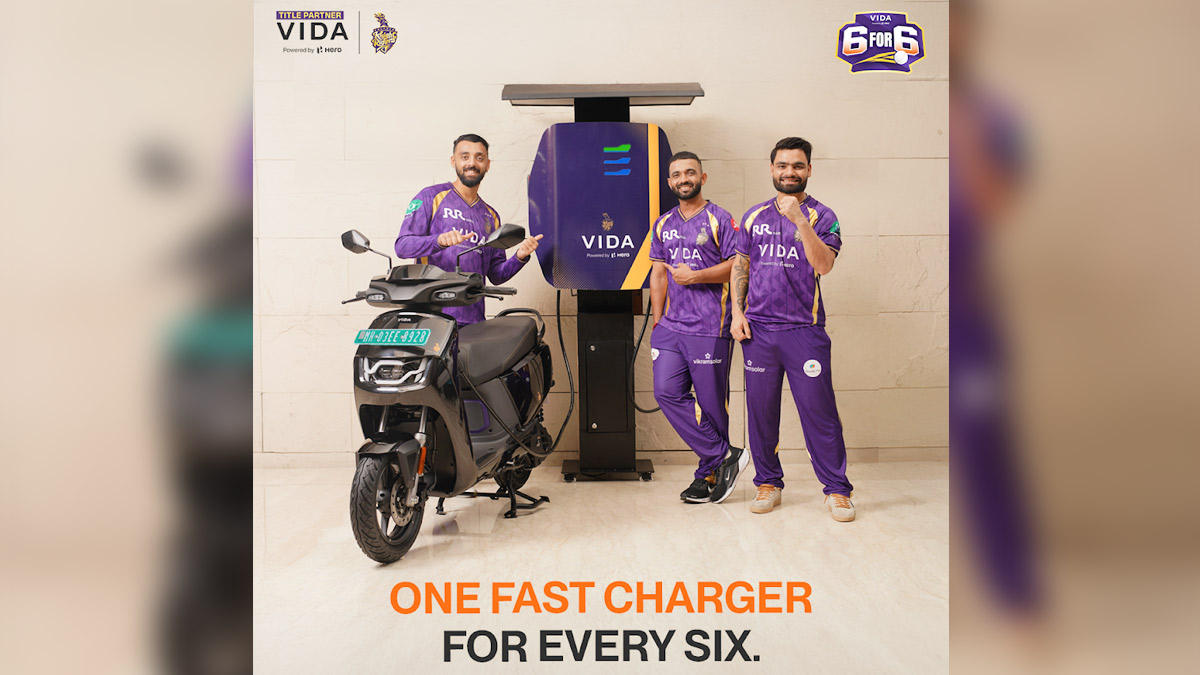
NEW DELHI: VIDA, the electric mobility arm of Hero MotoCorp, has teamed up with Kolkata Knight Riders to launch a campaign that turns cricketing flair into real-world impact.
Titled ‘6 for 6’, the initiative promises to install a 6kW fast EV charger for every six hit by KKR during the ongoing Indian Premier League season. The idea is simple but powerful, as each big hit on the field contributes directly to expanding India’s fast-charging infrastructure.
The campaign builds on VIDA’s growing network, which already spans over 5,300 fast-charging points across more than 430 cities. With EV adoption gaining pace, the brand is using cricket’s mass appeal to accelerate both awareness and infrastructure growth.
Explaining the thinking behind the move, Hero MotoCorp emerging mobility business unit chief business officer Kausalya Nandakumar said, “Cricket has an incredible ability to unite and inspire millions across the country. With the ‘6 for 6’ campaign, we are turning every big hit on the field into a step towards a cleaner and a more accessible mobility future.”
She added that VIDA’s expanding fast-charging network and removable battery technology are designed to make EV ownership more convenient and practical for everyday users.
From the franchise’s side, the campaign is also about giving on-field moments a larger purpose. Kolkata Knight Riders chief executive officer Venky Mysore said, “The ‘6 for 6’ campaign exemplifies the potential of sport as a platform for meaningful, real-world impact. By linking every six to the expansion of EV charging infrastructure, this partnership transforms fan excitement into tangible progress.”
As part of the rollout, VIDA has introduced co-branded charging stations in KKR’s signature colours, with a flagship installation unveiled alongside team players. The chargers are designed for quick top-ups, powering VIDA scooters from zero to 80 percent in about an hour, while also being positioned along key highways to support longer journeys.
The initiative also taps into VIDA’s removable battery system, which allows users to charge using standard household plug points, adding flexibility to the charging ecosystem.
By blending the thrill of cricket with the urgency of clean mobility, VIDA and KKR have found a neat way to make every six count twice, once on the scoreboard and again on India’s road to an electric future.








