Digital
OpenAI drops Sora AI video tool, ends planned $1 billion Disney deal
Pivot to coding and AGI leaves media giant rethinking AI tie-up plans

CALIFORNIA: In a move that has sent ripples through both Hollywood and Silicon Valley, OpenAI has pulled the plug on its much-hyped AI video tool Sora, abruptly ending what was shaping up to be a landmark partnership with The Walt Disney Company.
According to media reports, the decision came with little warning. Teams from both sides had been working on a Sora-linked project when the shutdown was communicated, catching even those close to the collaboration off guard.
The fallout is significant. The move effectively scraps a proposed $1 billion, three-year agreement that would have seen Disney invest in OpenAI while opening up access to its vast library of characters for AI-generated short-form video content. The deal, however, had not been finalised and no funds had changed hands.

Sora, unveiled in early 2024, had dazzled the industry with its ability to generate cinematic-quality video from simple text prompts, triggering a wave of competing launches from AI players across the United States and China. Its sudden exit marks a sharp turn in OpenAI’s strategy.
The company is now redirecting its focus towards more commercially scalable areas such as coding tools, enterprise solutions and the long-term pursuit of artificial general intelligence. Internally, resources required to run the video model are understood to have weighed on other priorities, accelerating the decision.
Leadership roles are also evolving to match the shift. Sam Altman continues to steer the broader vision, while Fidji Simo’s remit has been realigned towards deploying AGI capabilities as part of a wider push to consolidate offerings into a unified platform.
For Disney, the setback is more strategic than financial. The company is said to be evaluating alternative ways to collaborate with OpenAI, even as it recalibrates its approach to generative AI in storytelling.
For the wider industry, the episode is a reminder that in the fast-moving world of artificial intelligence, even the most dazzling innovations can have a surprisingly short shelf life.







Digital
AI set to transform media and entertainment industry
From creation to monetisation, AI is rewriting how stories are made and found
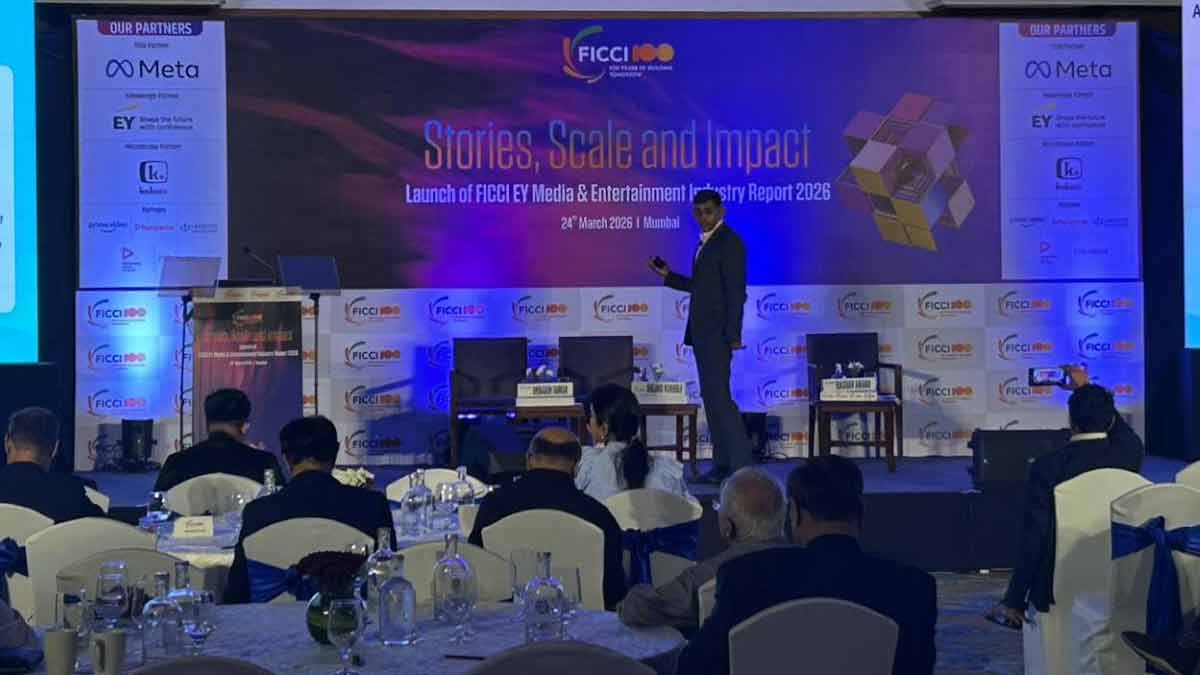
MUMBAI: Artificial intelligence is no longer a backstage tool in media and entertainment. It is fast becoming the main act. Delivering the keynote at the FICCI-EY M&E Industry Report launch, Meta managing director and country head Arun Srinivas, laid out how AI is transforming the entire value chain, from content creation to discovery and monetisation.
At the heart of this shift is access. AI is breaking long-standing barriers of language and reach, allowing content to travel further than ever before. Films, short-form videos and creator-led stories are now being dubbed, subtitled and even lip-synced across multiple languages with ease. The result is a more fluid, borderless entertainment ecosystem where stories find audiences far beyond their original markets.
Discovery, Srinivas noted, is undergoing an equally dramatic shift. On platforms such as Instagram and Facebook, a significant share of content consumption now comes from recommendations rather than followers. AI-driven systems are increasingly acting as matchmakers, connecting viewers with content tailored to their interests. In simple terms, content no longer waits to be found, it finds you.
For advertisers and platforms, this intelligence is translating into sharper targeting and improved efficiency. AI tools can identify the right audiences, optimise campaigns and even assist in crafting narratives for advertisements. What was once manual and intuitive is now data-driven and predictive.
India, Srinivas argued, sits at the centre of this transformation. With millions of creators producing content in dozens of languages, the country is both a testing ground and a growth engine for AI-led innovation. A large and rapidly digitising population, widespread smartphone adoption and expanding 5G access are further accelerating this shift towards a digital-first media economy.
Creators are already tapping into AI tools for editing, translation, dubbing and audience insights, enabling them to refine content in real time. Studios, meanwhile, are using predictive models to gauge consumer sentiment and optimise release strategies. Advertisers are deploying AI across campaigns, while developers continue to build new layers of tools and services on top of these platforms.
Srinivas also pointed to emerging interfaces that could redefine how content is consumed. From AI-powered assistants embedded in everyday apps to wearable devices offering immersive, on-the-go entertainment and real-time translation, the next wave of innovation is set to be more interactive and deeply personalised.
The broader message was clear. AI is not just enhancing the media business, it is restructuring it. As creators evolve into full-fledged studios and content becomes inherently multilingual, the lines between production, distribution and consumption are blurring.
With its scale, diversity and digital momentum, India is uniquely positioned to lead this shift. If storytelling has always been the country’s strength, Srinivas suggested, AI could well be the force that amplifies it to a global stage.








