MAM
NTO ambiguity resulting in ad rev drop for small broadcasters, niche channels


MUMBAI: Just when it felt like the dust on the NTO had settled, Telecom Regulatory Authority of India (TRAI) came out with yet another consultation paper reviewing the order, seeking more fundamental changes in channel pricing and bouquet formation. As clarified by TRAI chairman RS Sharma, while the regulatory body does not plan to revise the pricing framework, it is surely looking at fine-tuning the existing parameters as consumers are facing certain issues because of the current set of rules.
This has once again left a big question mark on the fate of broadcasters and might have a bigger impact on advertising revenues as well.
Y&A Collective co-founder S Yesudas told Indiantelevision.com that this uncertainty over the tariff order and channel pricing will impact nice channels the most, resulting into a dip in their revenue.

He said, “The biggest sufferers will be niche channels, particularly those which are mid and bottom-rung. Even as the power to choose rests with consumers and the general mindset of sensitivity for the paid-for options resulting in those always taking precedence, the snacking-in viewership will reduce. Between the two time periods, pre-new tariff order to July 19, there’s apparently already a drop of approximately 7 per cent of the total TV impressions. This will consequently mean revenue reduction.”
HyperCollective founder and CCO KV Sridhar (Pops) also agreed that the past few months have seen a dip in the revenues for broadcasters, barring a few big ones, because of many reasons like the economic slowdown and growth of digital bouquets, along with the NTO.
“The NTO is putting a lot of pressure on the broadcasters and some easing out is required, maybe not so suddenly but definitely. The bigger groups like Star and Sony can survive in the turmoil, but it is difficult for smaller groups, especially independent channels and some regional channels,” he said.
TheSmallBigIdea CEO & co-founder Harikrishnan Pillai shared that this ambiguity over the tariff might result in advertisers taking their money to digital platforms than spending on television.
He said, “One needs to reckon that any industry with fluttering policy fuels questions on its stability. While TV broadcasting is the most robust of all mediums, the effect of such policy-based tremors cannot be ignored. Especially by smaller TV channels, which already are fighting for eyeballs. It is likely that they might be ignored by the advertiser for other lucrative digital options. Investment into fresh content might take a back seat, which might further make it difficult for certain channels to attract advertisers on the back of new shows."
Sridhar also noted that the loyalty of the consumer is with the content and not the channel. If they can access the same content on OTT platforms or other media, they will not want to spend on purchasing the channels.
He further elaborated, “Advertisers are interested in viewership only. Also, they would play their ads during the content that is relevant to them. They are not going to place an ad on your channel even if you offer cheaper slots, or guarantee greater reach. Every advertiser is looking for relevant content now. If the content is not good, your channel will drop. OTT, therefore, is a big hindrance for the broadcasters in getting revenue.”
While the tariff order seems to be generating problems for the broadcasters, Yesudas feels that it will be beneficial for the marketers and advertisers. He said, “Marketing and adverting industry will only stand to gain from this as there will be further consolidation of the viewership pie. While the top-rung channels will find a place in almost all media plans (with reduced cost per contact) the mid-and bottom-rung channels which no longer can only stay focused on transactional and passive advertising time selling will also embrace true innovation in helping clients solve certain marketing challenges within a segment of consumers, they can influence.”




Brands
Samsung certifies 1,000 Maharashtra students in AI and coding
The South Korean electronics giant marks its first large-scale skilling push in the state, with women making up nearly half the national programme’s enrolment
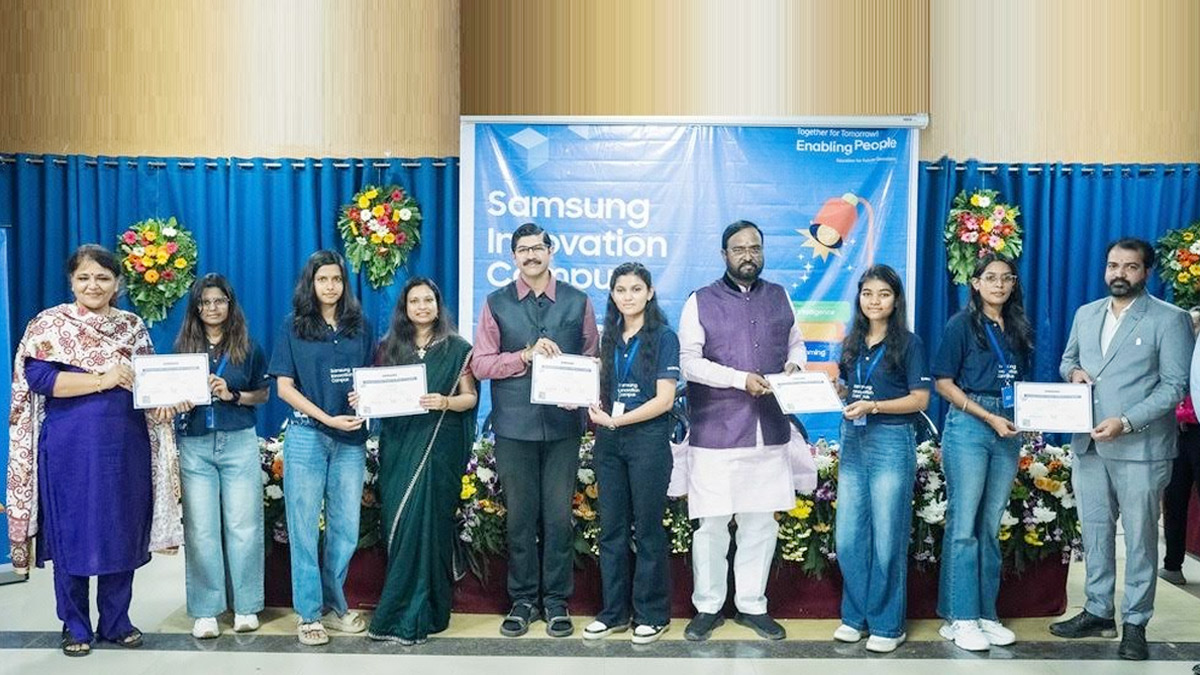
PUNE: Samsung has put 1,000 students in Maharashtra through a certified training programme in artificial intelligence and coding, the largest such drive the South Korean electronics company has run in the state and a signal that corporate India’s skilling ambitions are moving well beyond the boardroom brochure.
The certifications were awarded under Samsung Innovation Campus (SIC), the company’s flagship corporate social responsibility programme, which launched in India in 2022 with the stated aim of democratising access to future-technology education. The 1,000 graduates were drawn from four institutions: 127 from Savitribai Phule Pune University, 373 from Pimpri Chinchwad University, 250 from D.Y. Patil University’s Ramrao Adik Institute of Technology and 250 from Anjuman-I-Islam’s Kalsekar Technical Campus. All completed training in either AI or coding and programming, the two disciplines Samsung has identified as the critical pillars of the digital economy.
The programme does not stop at technical training. Soft-skills development and career-readiness modules are baked into the curriculum, a deliberate attempt to close the gap between what universities teach and what employers actually want.
“India’s digital growth story will ultimately be shaped by the quality of its talent pipeline,” said Shubham Mukherjee, head of CSR and corporate communications at Samsung Southwest Asia. “As technologies like AI move from the periphery to the core of industries, skilling must evolve from basic training to building real-world capability. This milestone in Maharashtra reflects how industry and academia can come together to create a future-ready workforce that is both globally competitive and locally relevant.”
The Maharashtra drive sits within a rapidly scaling national effort. Samsung Innovation Campus trained 20,000 young people across India in 2025, hitting its stated target for the year. Women account for 48 per cent of national enrolments, a figure the company cites as evidence of its push for an inclusive technology ecosystem. The programme is implemented in partnership with the Electronics Sector Skills Council of India and the Telecom Sector Skill Council.
Samsung, which is marking 30 years in India this year, runs SIC alongside two other initiatives, Samsung Solve for Tomorrow and Samsung DOST, as part of a broader effort to build what it calls a generation of innovators with both the technical depth and the problem-solving mindset to thrive in a fast-moving digital world.
A thousand certified students is a tidy headline. Whether they find jobs that match their new skills is the harder question, and the one that will ultimately determine whether corporate skilling programmes like this one are genuine pipelines or well-photographed gestures.






