MAM
New consumer mantra: Have money, will indulge in lifestyle spends

NEW DELHI: Indian consumer is rapidly changing and evolving as far as his or her shopping habits are concerned. At the end of the day, a consumer is looking at the satisfaction of what is bought and from where, marketing experts opined here today.
As people are attaining higher spending power with the rapid growth in the Indian economy, the retail space is constantly evolving to keep pace, the experts added.
Speaking on the final day of the 7th KSA Retail Summit ICICI Bank retail business senior GM and country head V Vaidyanathan said banks can learn from the spending patterns of consumers.
“The Indian retail market is still at a nascent stage but is growing at a very fast pace. There is a lot of potential for people to cater to niche segments like car accessories, jewelry, books etc,” he said.
Focusing on the role of banks in retail, Vaidyanathan said, “Banks can tie up with retailers and developers, launch co-branded cards with retailers, innovative B2B products, credit cards securitization for retailers, put up POS (point of sales) terminals, give working capital loan, joint marketing with retailers, provide research and consulting services to them.”

The spending patterns of Indian consumers are stabilizing
after double-digit growths in discretionary spending over the last two years. While overall spending across 13 categories grew by 44 per cent, the total spending basket, comprising 20 categories [including groceries, consumer durables and entertainment], has seen a 9 per cent growth this year,as against 20 per cent last year.
The main concern of retailers, Vaidyanathan pointed out, is that retail today is still a real estate business activity, which needs to change.
KSA Techopak India principal Harminder Sahni threw light on a couple of studies that the company has undertaken in the area of understanding consumer behaviour.
The first study, titled KSA Consumer Outlook: Changed Paradigms, is an annual tracking survey of Indian consumers with focus on spending habits and the share of their wallet.
The survey covers 10,000 people in the SEC A, B and C segments of 20 major cities across India and analyses what people buy and where and when. When the survey was started in 1999, it covered 13 categories of goods people buy, which has now increased to 20 categories.
On the other hand, the second study- KSA Youth Trendmill 2005- is a first of its kind study in India, which tracks trends and tastes in the youth market. The study spans the SEC A segment of 11 – 21 year olds in “specific” (read elite) areas of Delhi, Mumbai and Bangalore. The study looks at the tweens and teens in their homes, favourite shopping and hangout places and evaluates their behavioural trends.
Sahni said, “The overall spending across the 13 categories has grown 44 per cent in the last six years. The grocery, savings and investments, consumer durables and apparel segments have seen a dip in spend among consumers.”
He added: “On the other hand, eating out and books and music have seen a burgeoning growth in the spending. Personal care, vacation, movies, entertainment, theater, footwear, home textiles and accessories, too have seen a growth. At the same time, after double digit growth in the consumer discretionary spending over the last two years, the overall spending is stabilizing.”
2002-03 2003-04 2004-05
Lifestyle share 70.9% 68% 64.9%
Regular share 29.1% 32% 35.1%
Consumer spends can be divided into regular and lifestyle spends (as shown in the graphic). It was found that the regular spends’ pie was losing the share to the lifestyle spending pie. The regular spends’ pie was growing at a rate of four per cent, whereas the lifestyle spends’ pie was growing at a rate of 20 per cent year on year.
Lifestyle spends pie
Lifestyle Categories 2002-2003 2003-2004 2004-2005 Rise/Dip
Payment for household help 17.1 21 24.2 Rise
Gifts 7.8 6.2 5.5 Dip
Furniture 1.3 1 1.5 Rise
Computer/peripherals 1.6 1.5 1.4 Stable
Mobile phones
1
1.7 2 Rise
Internet connections
0.2
0.6 0.4 Stable
Throwing light on the four emerging consumer segments in India, Sahni pointed out, they were as follows:
1. “Technological Babies” – aged 8-19, 32 million Indians in SEC A B C
2. “Impatient Aspirers” – aged 20-25, 16 million Indians in SEC A B C
3. “Balance Seekers” – aged 26-30, 41 million Indians in SEC A B C
4. “Arrived Veterans” – aged 51-60, 9 million Indians in SEC A B C
Dwelling on the shopping preferences of people, Sahni said that 55 per cent would like to shop for apparels and home appliances s from well-known outlets, 52 per cent preferred shopping for personal care and toiletries from local colony markets, while 82 per cent shopped from local colony markets for groceries.
“Consumer shopping trends are changing and change is good for innovation and growth in the retail market,” he concluded.
Indiatimes.com CEO Mahendra Swarup pondered over the growing trend of online shopping in India with easy and cheap Internet access among people. Dubbing Internet shopping as `E Tailing’, Swarup said, “More and more consumers have taken to E Tailing. However, this is not expected to take over the traditional retail channels. It will only compliment it.”
Citing the advantages of E Tailing, Swarup said that it dismantles the intermediary stage, making it more convinient 24×7 with electronic catalogues channel of shopping. “E Tailing in the context of India is a disruptive innovation as it is not just a complicated channel, but also a new value innovation. It has the ability to simplify people’s lives and enables them to acquire things which they were previously not planning upon,” he said.
Indiatimes.com disrupted the retail space when they introduced online booking of air tickets at lower rates than what were being offered. More than half a million Indians have purchased air tickets online on Indiatimes.com at almost 60 per cent lower rates, he said.
Apart from that, as far as sales of air conditioners were concerned, Indiatimes.com drove sales of almost 15,000 ACs in less than six months. “We launched this under a unique pricing application, wherein the consumer was asked to choose what the best price for an AC was for him.”
In an interesting display of facts, indicative of shopping trens now being seen in India, Swarup said that at present the Indian E Tailing market was Rs 4000 million and was expected to be a market worth Rs 8000 million by the end of this year.
In 2006, the size was expected to increase to Rs 12,000 million, in 2007 to Rs 20,000 million. By 2008, the market is estimated to grow to Rs 50,000 million, while by 2010, the size would increase to as much as Rs 10,0000+ million with “zilch infrastructure investment and a huge captive market,” Swarup concluded.

Brands
KKR sixes to power EV charger rollout under VIDA campaign
Cricket meets clean mobility as big hits spark India’s charging growth
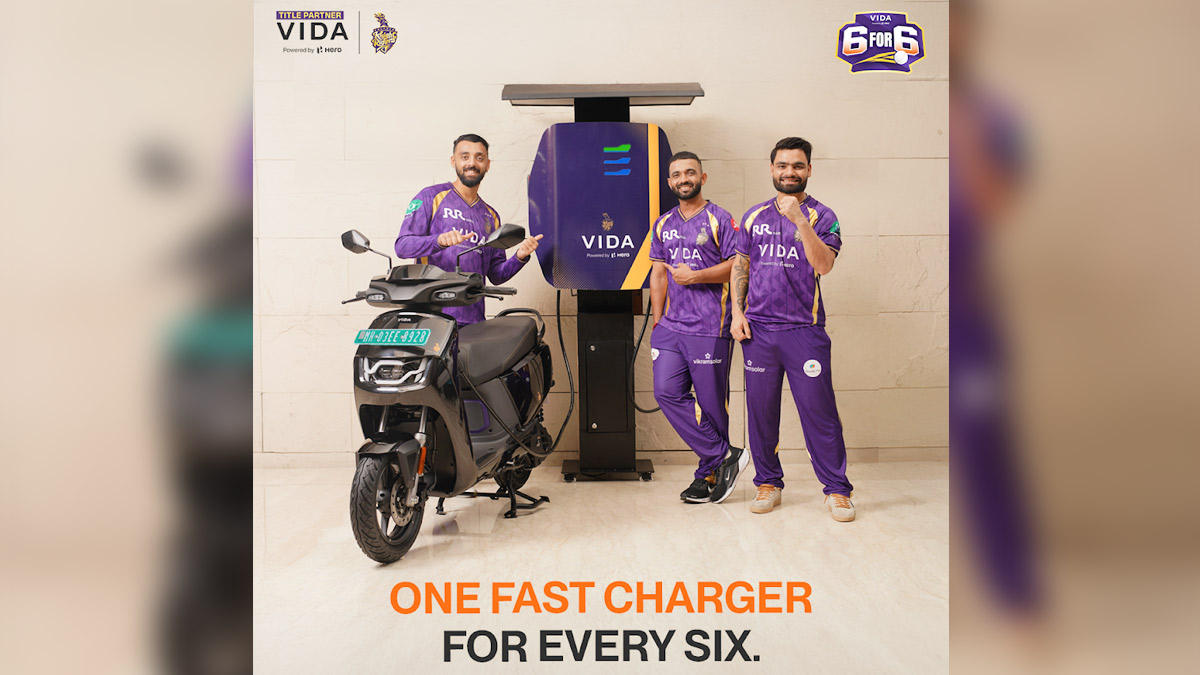
NEW DELHI: VIDA, the electric mobility arm of Hero MotoCorp, has teamed up with Kolkata Knight Riders to launch a campaign that turns cricketing flair into real-world impact.
Titled ‘6 for 6’, the initiative promises to install a 6kW fast EV charger for every six hit by KKR during the ongoing Indian Premier League season. The idea is simple but powerful, as each big hit on the field contributes directly to expanding India’s fast-charging infrastructure.
The campaign builds on VIDA’s growing network, which already spans over 5,300 fast-charging points across more than 430 cities. With EV adoption gaining pace, the brand is using cricket’s mass appeal to accelerate both awareness and infrastructure growth.
Explaining the thinking behind the move, Hero MotoCorp emerging mobility business unit chief business officer Kausalya Nandakumar said, “Cricket has an incredible ability to unite and inspire millions across the country. With the ‘6 for 6’ campaign, we are turning every big hit on the field into a step towards a cleaner and a more accessible mobility future.”
She added that VIDA’s expanding fast-charging network and removable battery technology are designed to make EV ownership more convenient and practical for everyday users.
From the franchise’s side, the campaign is also about giving on-field moments a larger purpose. Kolkata Knight Riders chief executive officer Venky Mysore said, “The ‘6 for 6’ campaign exemplifies the potential of sport as a platform for meaningful, real-world impact. By linking every six to the expansion of EV charging infrastructure, this partnership transforms fan excitement into tangible progress.”
As part of the rollout, VIDA has introduced co-branded charging stations in KKR’s signature colours, with a flagship installation unveiled alongside team players. The chargers are designed for quick top-ups, powering VIDA scooters from zero to 80 percent in about an hour, while also being positioned along key highways to support longer journeys.
The initiative also taps into VIDA’s removable battery system, which allows users to charge using standard household plug points, adding flexibility to the charging ecosystem.
By blending the thrill of cricket with the urgency of clean mobility, VIDA and KKR have found a neat way to make every six count twice, once on the scoreboard and again on India’s road to an electric future.








