MAM
Move Over B2B, B2C — It’s M2E Time

Like a series of conveyer belts zipping along the latitude and the longitude lines, our society is strung together via an international supply chain, linking globally scattered manufacturers of objects delivering directly to globally scattered herds of end-users — one end user at a time.
Today it’s the direct form that rules, the manufacturer’s product going straight to the lap of the end user. No matter if the end user is a teenager, a roofer or a big business, a single-item purchase is sufficient.
No more demands to buy large inventories. No middle layers, no costly structures, no bureaucracies and no extra hoards of people or any unnecessary tapes. The supply chain is fast, quick and cheap — it just takes one call and one quick delivery.

It’s like getting a pizza delivered to your home any time or all the time. All you need is online access to the factory, and voila! The goods are at your doorstep.
Anything and Everything
Welcome to the manufacturer to end user business model! From ultra-complicated, highly polished and highly engineered modular devices to soft baby carriages, custom-labeled wines, engraved books, custom-designed furniture and tailored apparel. Is there anything left? Even steamy fertilizers and bulky chicken feed find their way into the chain!
Like a series of conveyer belts zipping along the latitude and the longitude lines, our society is strung together via an international supply chain, linking globally scattered manufacturers of objects delivering directly to globally scattered herds of end-users — one end user at a time.
Airlines and hotels went direct and proved to be very successful with this approach, while snatching millions of expensive desks from the travel agents. Now there are thousands of other products and services covering a full spectrum within every industry sector doing the same thing.
These online conveyer belts of goods are also being serviced by call centers conveniently located in tropically warm regions with the cheapest labor costs. This system of moving products direct from the manufacturer to the end user is also very successful in the business sector, as they are eliminating distributors, agents and wholesalers. Everyone wants direct access, and it’s available to anyone and everyone, ’round the clock.
The wealth is also being shifted to the fabricators and the manufacturers; they now have the power of e-commerce to divert the transactional flow directly to them and block it from the old-fashioned infrastructures of wholesalers and retailers. The basic contract manufacturer has spread its wings over marketing and branding and now wants to play the cyber-branding games, building global name brands and corporate name identities. For this reason, naming and global branding now demand very stringent protocols and no longer a game for novice creative shops rather a tactical exercise in corporate name management. The middle layer in all types of industries is being crushed while countries with cheap labor manufacturing are seeing the boom.
The U.S. and the Western economies, meanwhile, are all heavily dependent on intermediate services, and thus are trying to cope with the new pressures. Primarily service-based economies that thrived by offering sophisticated sales marketing and channel distribution are getting left behind as a very large number of high tech and rich content-producing countries have emerged. A small e-commerce-driven economy can easily shake up a sluggish giant country tangled in old economy models.
It’s this magic of e-commerce that now allows a direct to end user delivery that has become a boom for the logistical and door-to-door courier corporations around the globe. All those middle layers created over the past century, along with the emerging needs of the then-naive consumer, have disappeared.
Across the Divide
Once upon a time, consumers were scared of or oblivious to the shiny things behind the old muddy and slushy factories, and this ugly side of manufacturing kept them away. It didn’t hurt that they were offered white glove service skating on marble floors, and everything on a silver plate. Now manufacturers are projecting ultra-friendly and ultra-customer-service-driven images, all supported by modern plants, while the Web has helped them to cross the bridge of the fears of smoke and dust, like an open kitchen concept in expensive restaurants, where black-tie consumers are extremely comfortable with the rattle, shouting, sizzle and all the smoke. Party time.
Anything can be shipped from one corner of the world to the other without any logistical problems, thanks to the major overnight services and great courier and delivery companies in the world. End users now have many successful experiences. They have become open to further expanding their overall purchases and aiming for more and more M-to-E models.
Economies that ignored the manufacturing base and adopted an overly-aggressive service model will feel this pinch in a big way, while others with a manufacturing base will have to maintain their price and quality or lose their edge.
This is now the age of manufacturers and their personal and direct link to individual customers. This is now the age of elimination and the unnecessary middle layers. This is now the age of the consumer.


MAM
India’s financial sector spent less on TV ads in 2025 but flooded the internet
Banks, insurers and lenders cut tv ads as digital jumps, LIC and Muthoot lead tv and Axis Bank tops online
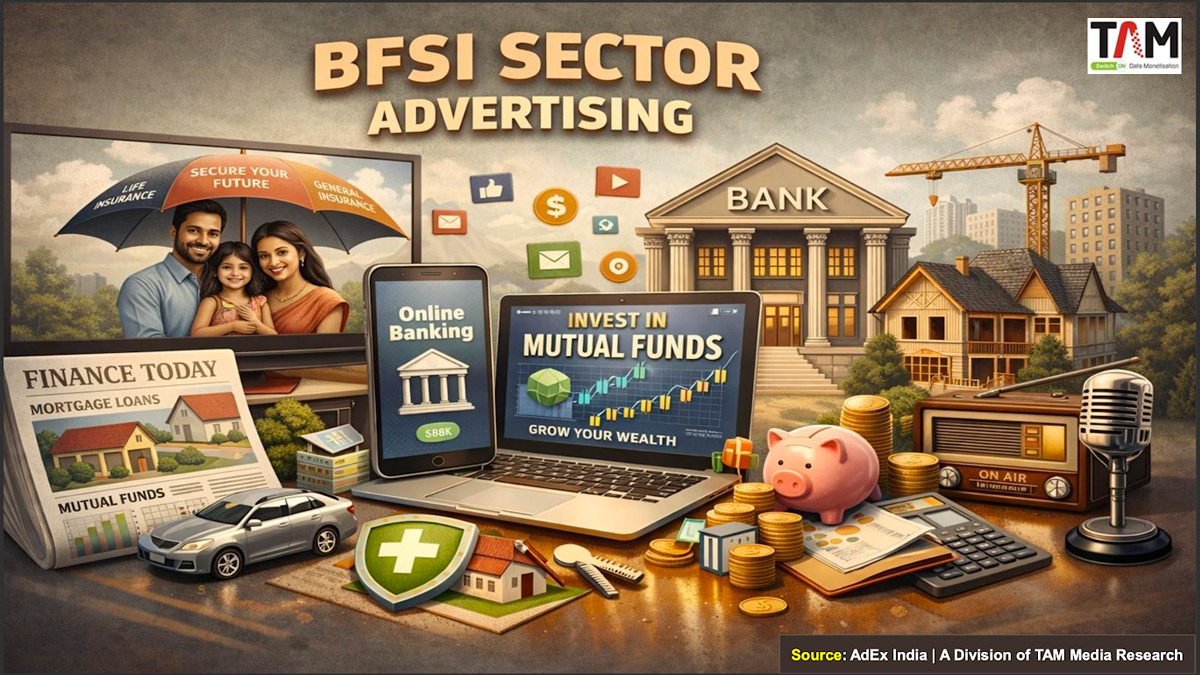
MUMBAI: India’s banking, financial services and insurance sector, one of the most prolific advertisers in the country, delivered a split verdict on media in 2025. It spent less on television, held its nerve in print, turned up the volume on radio and deluged the internet with a ferocity that left every other medium looking pedestrian. The picture that emerges from TAM AdEx’s cross-media report for the BFSI sector is of an industry in transition, still wedded to the news bulletin but increasingly seduced by the algorithm.
Television: a retreat with caveats
TV ad volumes for the BFSI sector fell 16 per cent in 2025 compared with 2024, a sharp reversal after two years of consistent growth that had pushed volumes 16 per cent above 2021 levels by 2023 and a further 7 per cent higher by 2024. Within 2025 itself, the drop was concentrated in the middle of the year: the second and third quarters saw ad volumes slide 35 per cent each against the first quarter, with a partial recovery of 13 per cent in the fourth.
The retreat did not reshuffle the deck. Life insurance retained first place among TV categories with 19 per cent of ad volumes, mortgage loans held second with 16 per cent, and the top ten categories together accounted for 82 per cent of all BFSI television advertising. The dominance of news channels was equally pronounced: news claimed 68 per cent of ad volumes, general entertainment channels a distant 14 per cent and movies 12 per cent. Together, news and GEC captured 82 per cent of the sector’s television spend. News bulletins alone took 48 per cent of programme-genre volumes, with feature films second at 12 per cent. Prime time, between 6pm and 11pm, drew 34 per cent of ad volumes, followed by afternoon at 22 per cent and morning at 20 per cent. A full 82 per cent of all ads ran between 20 and 40 seconds.
Life Insurance Corporation of India was the sector’s biggest TV spender with 11 per cent of ad volumes. Muthoot Financial Enterprises came second with 9 per cent, followed by National Payments Corporation of India at 6 per cent, Tata AIG General Insurance at 5 per cent and State Bank of India at 5 per cent. The top ten advertisers together accounted for 51 per cent of total TV volumes. Three names were new to the top ten in 2025: Tata AIG General Insurance, IIFL Finance and Tata Capital. At brand level, Muthoot Finance Loan Against Gold led with 9 per cent share, Tata AIG Health Insurance entered the top ten for the first time, and the top ten brands together contributed 35 per cent of ad volumes.
Print: the long climb continues
Print told a different story. Ad space for the BFSI sector has grown every year since 2021, rising 16 per cent in 2022, 30 per cent in 2023, 51 per cent in 2024 and 64 per cent in 2025, all measured against a 2021 baseline. Within 2025, ad space was flat in the second quarter but surged 46 per cent in the third and 33 per cent in the fourth compared with the first. Life insurance led print categories with 21 per cent of ad space, followed by mutual funds and banking services and products at 13 per cent each, and corporate financial institutes at 11 per cent. The top ten categories together took 82 per cent of print ad space. LIC led print advertisers with 6 per cent share, and the top ten together covered just 19 per cent of ad space, a reflection of how fragmented print spending remains. Three new entrants joined the top ten in 2025, with Billion Brains Garage Ventures the only exclusive presence not seen in 2024’s list. In the top ten brands, LIC dominated with a 2 per cent share, while Nippon India Mutual Fund rose to third position from fourth in 2024. English accounted for 62 per cent of print ad space, Hindi for 20 per cent. Business and finance publications took 59 per cent of the genre split. The south zone led regional spending with 33 per cent of print ad space, Bangalore topping that zone, while New Delhi and Mumbai were the leading cities nationally.
Radio: louder than ever
Radio ad volumes for the BFSI sector have climbed steadily, rising 12 per cent above 2021 levels in 2023, 36 per cent in 2024 and 45 per cent in 2025. The quarterly pattern within 2025 was volatile: a sharp drop of 43 per cent in the second quarter and 42 per cent in the third, followed by a near-full recovery in the fourth. Life insurance led radio categories with 22 per cent of volumes, banking services and products second at 14 per cent and corporate NBFCs third at 11 per cent. LIC of India held its position as the leading radio advertiser with 20 per cent of ad volumes; the top ten radio advertisers together covered 69 per cent. Muthoot Financial Enterprises led radio brands with 10 per cent share, five of the top ten brands belonged to LIC alone, and SBI Mutual Fund made a remarkable leap to fifth position from 272nd in 2024. Evening and morning time-bands together captured 84 per cent of radio ad volumes, with evenings at 44 per cent and mornings at 40 per cent. Maharashtra was the leading state for radio BFSI advertising with 18 per cent share; Maharashtra, Gujarat and Uttar Pradesh together accounted for 43 per cent.
Digital: the five-times surge
If one number defines the 2025 BFSI advertising story, it is five. Digital ad impressions for the sector multiplied fivefold between 2021 and 2025, having already doubled in 2023 and doubled again in 2024 before the 2025 leap. Within the year, impressions dipped 19 per cent in the second quarter and 12 per cent in the third before recovering 8 per cent above the first quarter by the fourth. Banking services and products led digital categories with 27 per cent of impressions, life insurance and credit cards tied at 19 per cent each, and securities and sharebroking organisations fell from first place in 2024 to fourth in 2025. Axis Bank was the runaway leader among digital advertisers with 12 per cent of impressions, followed by ICICI Bank at 9 per cent, IDFC First Bank at 7 per cent and Kotak Mahindra Bank at 6 per cent. The top ten digital advertisers covered 59 per cent of impressions, and seven of them were new entrants compared with 2024, signalling rapid churn in the digital spending hierarchy. At brand level, Axis Bank led with 9 per cent, ICICI HPCL Super Saver Credit Card vaulted to third place from 921st in 2024, and six of the top ten digital brands were new to the list. Programmatic buying accounted for 91 per cent of all digital BFSI transactions; combined with ad networks, it captured 96 per cent.
The data from TAM AdEx paints the portrait of a sector that still believes in the power of the television news bulletin to sell insurance to the masses, but increasingly knows that the next generation of borrowers, investors and cardholders is scrolling, not watching. The race is now on to reach them before the algorithm serves up someone else’s loan offer first.






